For small businesses, acquiring a customer is only half the battle; a more complex task is winning the trust of the first buyer so they complete the payment. A customer might be interested in a product, but a young or lesser-known brand must overcome the barrier of distrust before interest turns into a transaction. For new digital enterprises, the payment process becomes an integral part of the overall customer experience.
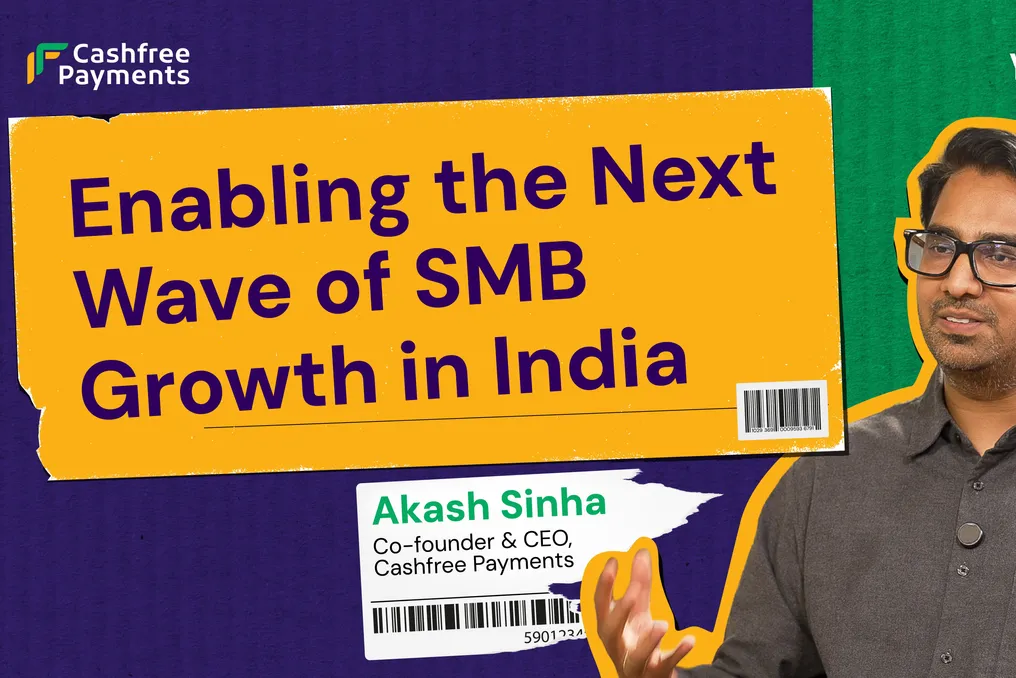
In a recent interview with YourStory, Akash Sinha, co-founder and CEO of Cashfree Payments, discussed the evolution of the digital payments ecosystem in India over the last decade, why Small and Medium Businesses (SMBs) represent a growing opportunity, and how payment infrastructure can facilitate a business's transition from its first deal to large-scale growth.
When Cashfree Payments was founded in 2015, online payments were still in their early stages, and Sinha recalls that companies approached them with great caution, creating an initial need for simplification and increased accessibility of digital payments.
Since then, thanks to the proliferation of smartphones and the internet, as well as broader adoption of digital payments, the digital commerce market has grown significantly. Features such as instant refunds and settlements make transactions convenient for both consumers and businesses.
Sinha believes that the next significant potential lies in the increasing number of enterprises joining this ecosystem. He noted that 'SMBs will grow, and online will become the primary channel for customer engagement.'
For these businesses, payments serve a function beyond just collecting funds: they influence whether a customer completes a purchase, whether a new brand earns trust, and how quickly it starts gaining momentum. While customers may recognize large corporations, for a new business, every transaction is a process of building trust. Even a strong product and a clear market opportunity cannot always overcome the hesitation of the first buyer during an online payment.
Sinha emphasized the importance of choosing the right payment partner, as this partner shapes the trust between customers and businesses. Cashfree Payments has developed features aimed at enhancing transaction comfort, including seller trust indicators. This is especially crucial for young companies whose limited capital might hinder the maintenance of a business that has not yet shown results.
As SMBs begin to accept digital payments, the next challenge is converting interest into completed purchases. For example, a customer who arrived via an Instagram ad might abandon the purchase if the checkout process requires too much effort. Cashfree Payments' Checkout 360 solution aims to reduce this friction through features like saved addresses and payment methods.
Opportunities are also linked to accessibility. Installment payments (EMI), 'Buy Now, Pay Later' (BNPL), and targeted offers make goods more affordable for customers who do not want to pay the full amount immediately, helping SMBs turn intentions into real transactions and retain customers. The goal is now not just to process the payment, but to reduce barriers throughout the entire customer journey.
For an entrepreneur testing an idea, payment costs can be an additional factor while the business model and margins are being formed. Cashfree Payments' zero-MDR initiative addresses this by waiving payment gateway fees for all new companies registered with Cashfree until they achieve sales of 20 lakh rupees, thereby removing another hurdle to starting.
Support goes beyond cost: daily settlements and a dedicated account manager help new businesses handle issues related to refunds, settlements, and other aspects of digital payments as they grow, allowing them to focus on the product and customers.
Artificial intelligence can be valuable for SMBs because smaller teams have fewer resources to handle repetitive operational tasks. Sinha described a use case related to abandoned payments: instead of a large support team calling to find out the reason for a customer's refusal, an AI-based agent could interact with the customer, identify the problem, and suggest a suitable payment option, thus transforming AI from an efficiency tool into a lost revenue recovery tool.
Agentic commerce could bring another shift, as consumers delegate purchasing tasks to AI agents. Businesses will require payment infrastructure designed for these new scenarios, supporting both consumers using agents and business operations automation.
For the next generation of SMBs, growth may also mean reaching customers outside of India. Sinha sees significant potential in cross-border payments, especially for e-commerce and tourism, as well as for Indian companies looking to sell globally. Cashfree Payments supports both international companies selling into India and Indian sellers operating abroad, aiming to simplify globalization complexities—from setting up foreign legal entities to currency management.
Sinha concluded that 'we must think globally,' reflecting a broader shift occurring in the Indian SMB ecosystem. The opportunity is no longer just about helping more businesses adopt digital payments, but about providing them with the infrastructure to build trust, convert customers, automate processes, and reach markets far beyond their immediate geography. As more entrepreneurs create digital companies, the role of payments will be defined not by the transaction itself, but by what it enables the business to do next.