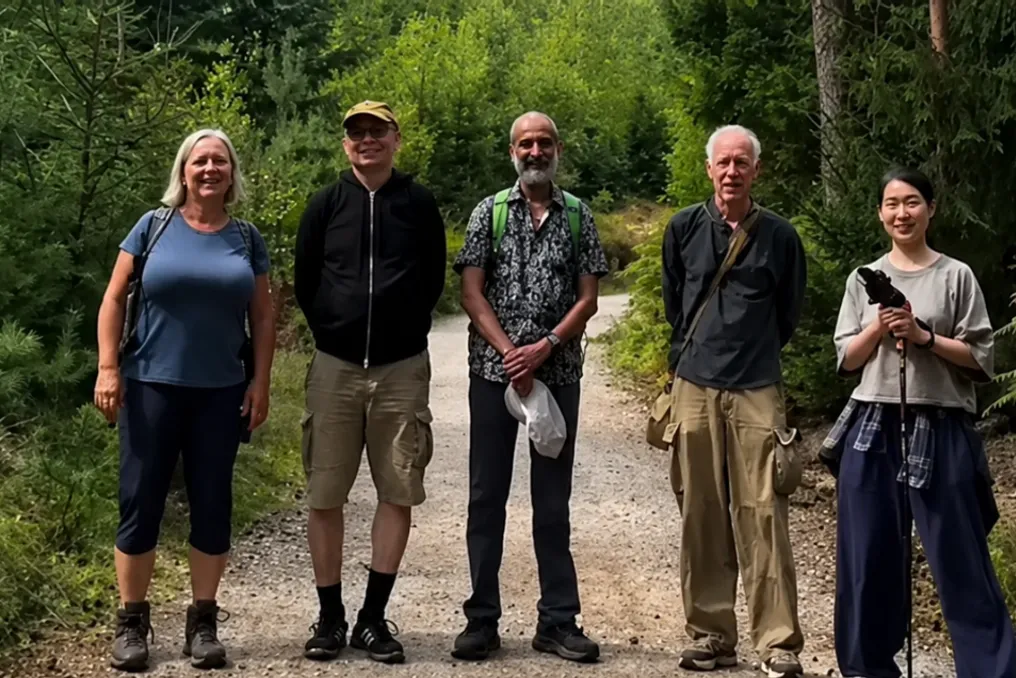
A group of international students studying Sanskrit undertook a hike in the Elbsandsteingebirge, or Elbe Sandstone Mountains, in Germany. During the walk, they navigated uneven trails, enjoyed the scenery, and looked out for one another.
During this hike, Sanskrit became part of their communication. They described what they saw around them in Sanskrit, discussed the terrain, checked on each other's condition, and later talked about food and tea during a picnic.
For these students, the hike turned into an opportunity to use Sanskrit as a living language—to talk about what they are seeing, doing, and experiencing at that moment.
Beyond Textbooks
Sanskrit is traditionally introduced to students through grammar, texts, and formal study. This ancient Indo-Aryan language of South Asia has its roots in Vedic Sanskrit, dating back to approximately 1500–1200 BCE, and is associated with texts such as the Rigveda. Sanskrit also holds an important place in Buddhist and Jain traditions, and its extensive literary history gives it significance.
However, studying ancient texts is not the only way to interact with a language; it can be spoken, practiced, and used to describe everyday experiences. The German hike provided the students with exactly this opportunity.
Instead of viewing vocabulary as something to memorize before use, the environment became a stimulus for conversation. A steep section of the trail prompted a discussion about difficulty, and the food provided words for sharing a meal. The landscape offered vocabulary that might otherwise remain just an exercise in class.
A Classroom Without Walls
This hike took place in an informal setting; it was not an official lesson or part of a summer school. The participants were simply trying to make Sanskrit work in a situation requiring real-time communication. This meant needing to find words, construct sentences, and react to each other as the walk progressed.
For the students, this trail became a kind of alternative space for language learning.
Reviving the Utility of Old Words
This experience raises a broader question: what does it mean to keep a classical language alive? Preservation can imply protecting manuscripts, teaching grammar, and studying historical texts. But using the language adds another dimension, giving students a chance to explore how it can describe experiences that were not part of the world in which many of its foundational texts were written.
A mountain hike in modern Germany is not an ancient Sanskrit setting, nor is a general tea break, picnic, or discussion about fatigue or informal exchange of opinions among international students. Nevertheless, the students used Sanskrit to discuss all these moments. This was the value of practicing the language outdoors: the words ceased to be merely something to memorize for a lesson; they gained immediate purpose.
From Hike to Daily Life
The group did more than just walk and talk. Some participants also practiced yoga while continuing to converse in Sanskrit. For international students, such events create opportunities for joint language practice within a shared activity.
The hike in the Elbsandsteingebirge does not replace formal Sanskrit instruction. Grammar, literature, history, and structured learning remain vital aspects of language acquisition. However, it showed the students something simple: language needs opportunities for use. For Sanskrit, these opportunities do not always have to be in classrooms, libraries, or lecture halls; they can be found on a hiking trail, at a picnic table, or anywhere the students can say something to each other.