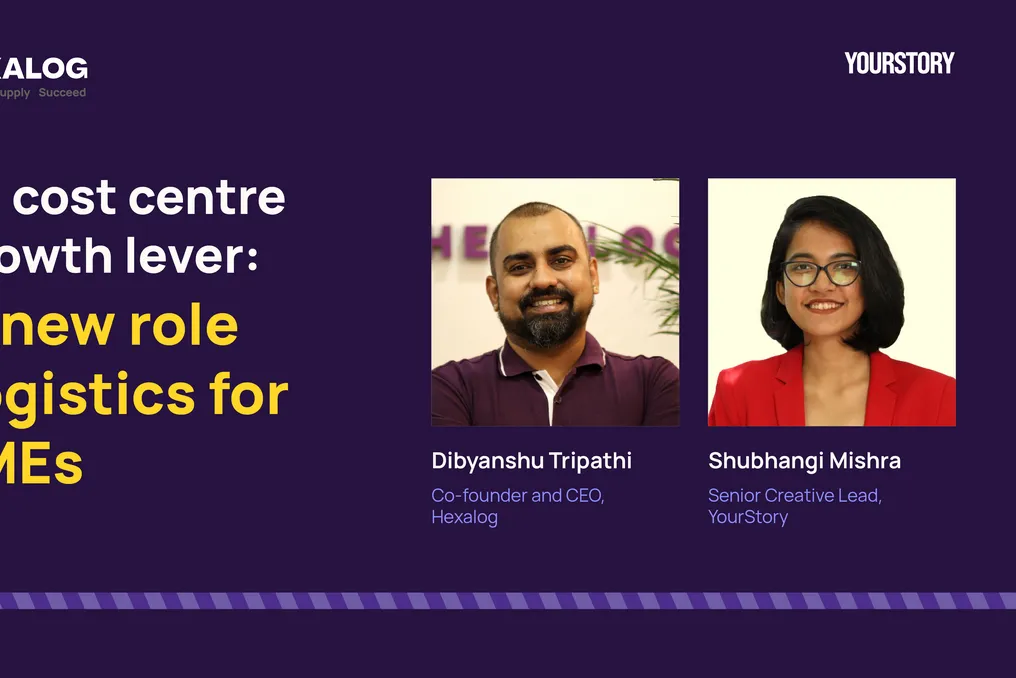
The growth of e-commerce in India has transformed logistics from a supporting function into a differentiating factor for businesses. As D2C brands and SMEs expand beyond domestic markets, supply chains now influence numerous aspects, including inventory management, customer experience, working capital, and international growth.
Dibyanshu Tripathi, co-founder and CEO of Hexalog, discussed this transformation that has occurred over the last decade. He also explained why, for global competition, it is not just the speed of goods movement that is important for small enterprises, but rather the more coordinated coordination of the entire supply chain.
Tripathi started working in the logistics industry in 2017 when the Indian e-commerce ecosystem processed about five million orders. Over the subsequent seven years, this number increased fourfold. As companies began serving customers in different geographical regions, logistics evolved from an operational task to a key component of brand scaling and customer service.
Today, through Hexalog, Tripathi helps D2C brands and SMEs conduct cross-border trade using enterprise-level logistics orchestration. This allows companies to focus on product development while the company manages the operational complexity associated with global trade.
The founders of Hexalog noticed an opportunity as e-commerce matured. Manufacturing centers appeared in locations not traditionally associated with production, and Indian sellers increasingly sourced goods from countries like China, Vietnam, and Thailand before selling them on online marketplaces. The founders believed the next step was to help Indian businesses bring their own products to global markets.
The founding team, which includes Dibyanshu Tripathi (Co-founder and CEO), Utkarsha Tripathi (Co-founder and COO), Vinita Malik (Co-founder and Customs Officer), and Shobhita Singh (Co-founder and Head of Product and Technology), combined expertise in customs compliance, international operations, product development, and sales.
Instead of first building technology, they decided to understand the operational needs of customers. Tripathi recalls: 'We sat in one room, brainstormed, and realized: do we build the product first or start working? Technically, our first product was a Google Sheet. We effectively orchestrated this entire end-to-end process in a Google Sheet.'
Currently, Hexalog helps D2C brands and SMEs build enterprise-level supply chains through cross-border logistics orchestration. This early, operation-focused approach continues to shape the company. Instead of isolated technology development, the company designed workflows around customer pain points before digitizing them.
Tripathi believes that logistics should not be viewed merely as an operating expense. Efficient supply chains improve working capital by reducing the amount of capital tied up in inventory and inefficient operations. In his view, once logistics enhances working capital efficiency, it becomes a driver of business growth, not just an expense.
For many SMEs, entering the international market often depends less on product quality than on the ability to handle operational complexity. While the founders know how to create and promote their products, selling across borders requires interaction with customs authorities, regulatory agencies, freight operators, warehousing partners, and last-mile suppliers.
According to Tripathi, the lack of operational transparency deters many businesses from going global. He notes: 'Suddenly, from knowing the SME's product, you have to move to knowing the operations.'
Hexalog's approach is to simplify this process. Instead of expecting founders to figure out customs rules, indirect taxation, certification, and documentation themselves, the company positions itself as a supply chain partner. Businesses can focus on product development, branding, and customer acquisition, while Hexalog manages the entire journey from the factory gate to international delivery. For the founders, this means fewer operational distractions and greater confidence when entering new markets.
Tripathi argues that one of the biggest misconceptions about cross-border logistics is that success depends on choosing the right carrier or customs agent. In reality, he says that logistics is as strong as the coordination among all participants in the supply chain.
Shipments can pass through first-mile operators, customs agents, forwarders, destination partners, and last-mile suppliers. Even if each works well individually, poor coordination between them can lead to delays, increased inventory cycles, and a degraded customer experience.
Hexalog focuses on orchestrating the entire journey, not managing individual parts. Its philosophy of delivering products 'from workshop to customer door' goes beyond transportation and includes managing the entire customer journey.
One of the company's key innovations is the Value-Added Center, where products undergo quality checks before leaving the country of origin. This helps identify defective goods before they reach India or foreign markets, reducing reverse logistics costs and avoiding delays. Tripathi notes that many logistics providers simply transport sealed cargo without inspection. By implementing quality checks at an earlier stage, Hexalog reduces operational risks and increases customer satisfaction.
The company also helps brands calculate the true landed cost, accounting for freight, insurance, compliance costs, and import duties, instead of basing procurement decisions solely on manufacturing costs. Unlike traditional logistics providers who manage individual stages of transport, Hexalog controls the entire workflow, striving to maintain a consistent level of service at every stage.
Its lean operating model is central to this approach. Instead of owning warehouses or transport assets, the company relies on existing infrastructure while retaining responsibility for customer experience and service delivery. Tripathi emphasizes: 'Today, given the state of global uncertainty we are in, it is much easier for me to enter the market because I am building it based on the capabilities of existing structures and with a partnership model.'
According to Tripathi, this model allows Hexalog to enter new markets faster while maintaining operational reliability and a predictable level of service. While the founders often track customer acquisition cost, marketing spend, and return on ad spend, Tripathi believes one of the most important metrics lies elsewhere: in working capital. He argues that efficient supply chains improve working capital by reducing the time inventory spends in transit or idle. This allows businesses to reinvest capital faster and scale sustainably.
Faster inventory turnover is not just a financial metric. It also reflects healthy demand and efficient operation. Instead of viewing logistics purely as an expense, founders should see it as a business function capable of increasing profitability, supporting growth, and strengthening the business in the long term. For Tripathi, helping SMEs compete with much larger companies is not about giving them large logistics budgets or large teams. It is about giving them access to the operational capabilities and transparency traditionally enjoyed by large enterprises. This also requires founders to broaden their understanding beyond the products they develop. He concludes: 'Founders need to understand taxation, compliance, supply chain design, and the macroeconomic forces shaping global trade,' adding that operational awareness is becoming as important as product expertise. By simplifying cross-border logistics and improving supply chain coordination, Hexalog aims to help SMEs and new brands expand internationally with greater confidence.