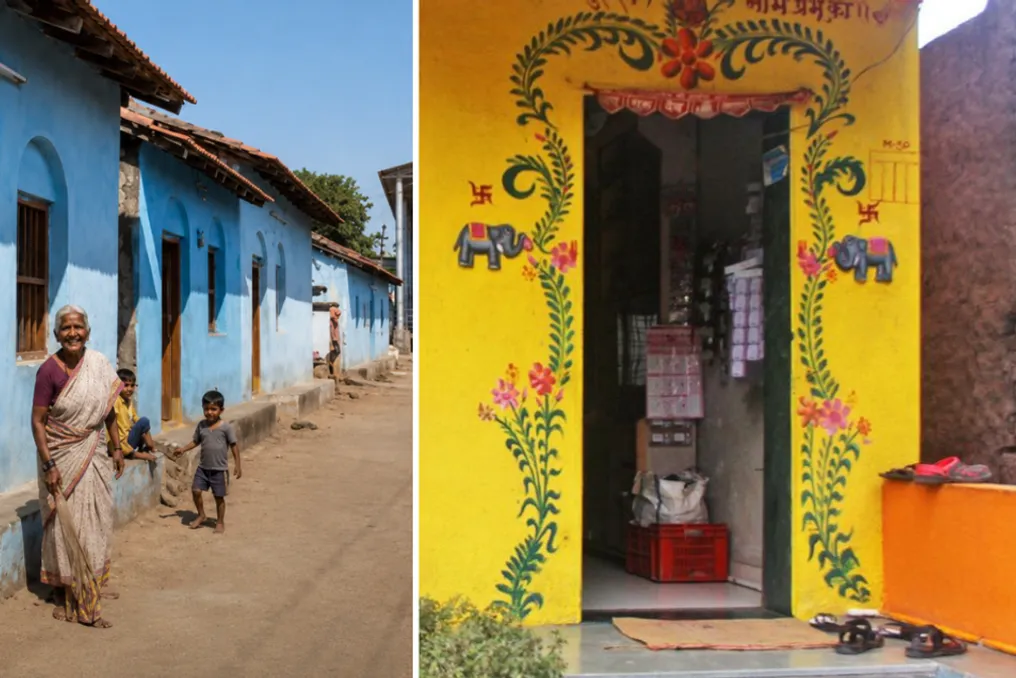
In the village of Shani Shingnapur, homes can remain empty for days without a locked entrance door. Many entrances are not protected by padlocks or metal gates; often, only a curtain remains between the family and the street.
This same belief extends to shops and public places. Even the local branch of the nationalized bank once opened with a glass entrance that had no lock.
In a country where even rural homes increasingly rely on security grills, CCTV cameras, and heavy locks, this village in Maharashtra followed the opposite idea for generations: leaving doors open and trusting that no one would steal.
Shani Shingnapur is located in the Ahilyanagar district of Maharashtra, formerly Ahmednagar, about 240 km east of Mumbai. Today, it is home to about 15,000 people, and the village is known throughout India for a surprisingly simple phenomenon—its homes traditionally have no doors.
For many generations, residents believed that theft attracted punishment from Shani, a deity associated with the planet Saturn, who is believed to protect the village. This belief became so deeply rooted that locking up a house was traditionally considered unnecessary.
However, this is not just a story about a village without locks; it is a story about what happens when religious conviction becomes the social rule of an entire community, and what happens when that rule clashes with a changing world.
300-Year Promise
This custom dates back to a legend passed down by residents for nearly three centuries. About 300 years ago, a shepherd living near the Panasnala River allegedly pushed a strange black boulder washed ashore after a flood, from which blood supposedly emerged.
That night, according to local beliefs, Shani appeared in the dream of one of the residents and announced that the stone was his own self-manifested form. He requested that the stone remain open, without a roof, and promised to protect the village. The story gradually evolved into something more than just a legend about a mysterious stone; it shaped the way of life of the people.
If Shani protected the settlement, the residents felt there was little reason to protect their homes from each other. Over time, the absence of doors became part of daily life.
How the Entire Village Adopted the Custom
For the residents, this practice is less about deliberately rejecting modern security and more about growing up with the assumption that it was simply unnecessary. Homes traditionally have open entrances, sometimes softened by curtains for privacy. Shops follow similar practices. Families can leave their homes unattended without worrying about locking them beforehand.
For example, homemaker Jayashri Ghade recounted keeping family savings in an unlocked tin bucket—a practice that would seem unthinkable in most homes. The belief is also reinforced socially. Children grow up hearing that stealing from another person will attract Shani's punishment. This idea becomes part of the village's moral code: the consequence of theft is not just arrest or social shame, but divine retribution. It is this shared conviction that perhaps allows the system to work.
A lock is a physical barrier. In Shani Shingnapur, faith traditionally served as that barrier.
Even the Bank Followed the Rule
Perhaps the clearest example of how deeply the custom penetrated village life was the incident of the state bank opening here in January 2011. Its glass entrance door was intentionally installed without a regular lock, and this decision was presented as a continuation of the village's long-held belief.
However, this agreement also revealed an interesting compromise between tradition and modern life. Although customers could pass through the unlocked entrance, the bank did not leave its money unprotected. Cash was kept in a secured vault. This distinction was telling: the village could maintain its symbolic tradition of open doors while still using conventional security where financial risk demanded it.
As the village grew and the number of visitors increased, this balance became increasingly important.
When Belief Met Reality
The tradition was not entirely untested. In October 2010, a visitor from northern India reported the theft of cash and valuables worth 35,000 rupees from a car. The following year, there was a case of jewelry theft. These incidents called into question the image of a settlement where thefts simply do not occur.
When the bank opened without an entrance lock in 2011, the local police also reportedly expressed private concerns about the unsecured cash register in a village that could see tens of thousands of pilgrims on busy weekends. The outside world was also changing. For decades, the nearest police station was several kilometers away, which locals cited as additional proof that serious crimes rarely happened. But as the population and number of visitors grew, the village eventually received its own police station. Even this building reflected the unusual relationship between tradition and modern governance: its door was installed without a lock out of respect for local sentiment.
When Tradition Becomes Personally Costly
Not everyone found the tradition of open doors easy to accept. For Sukhadev Bajri Shete, the belief became difficult to accept after his mother's necklace was stolen from their home during his adolescence. His father, the temple custodian, continued to oppose installing a door during his lifetime. For Shete's wife, this meant years of living without the privacy that most people take for granted. Only after Shete's father died did he install sliding metal gates with a padlock, becoming one of the few residents to openly violate the village's traditional practice. His decision highlights the tension that is easily missed if the custom is viewed only as an intriguing cultural curiosity. For some residents, the open door represents community trust and faith. For others, the door can represent something equally fundamental: privacy, autonomy, and the right to feel safe in one's own home.
Can the Village Truly Be Crime-Free?
The reputation of Shani Shingnapur has also attracted skepticism. Critics argue that the image of the village may be partially maintained because minor incidents are not always reported. Documented cases of theft also make it difficult to defend the idea of a completely crime-free settlement. There are also contradictions. While homes traditionally lack locks, the temple donation box has a lock—an irony often pointed out by skeptics, questioning the absoluteness of the custom. Nevertheless, for many residents, these contradictions were not enough to abandon the tradition. Trust here is not necessarily presented as a substitute for any form of security. Instead, it has become a deeply ingrained part of the community's identity.
A Village Stuck Between Faith and Change
Shani Shingnapur today is vastly different from the small settlement of three hundred years ago. The population has grown to about 15,000 people. Thousands of visitors arrive regularly, especially on busy weekends. What was once a relatively isolated village is now connected to a much larger world. This brings new challenges. More people mean more movement. More visitors mean more strangers. And modern life is increasingly associated with expectations of privacy and security that did not exist when the tradition of open doors began.
Nevertheless, the custom continues. Residents still leave homes and shops without conventional locks. The police station has an unlocked door. The bank maintains modern security behind its open entrance. And families continue to make their own choices about where tradition ends and personal security begins. Will the doors ever return?
For almost 300 years, the open door in Shani Shingnapur represented more than just the absence of a lock. It represented a collective agreement—that neighbors can be trusted, that theft is unthinkable, and that a divine presence watches over the community. But change rarely comes all at once. Families like the Shetes have quietly begun to bring doors and locks back into their lives. Younger generations are growing up in a village that is increasingly influenced by the realities of the outside world. Thus, the question facing Shani Shingnapur may not be whether its ancient faith can survive, but whether the next generation will believe that observation is enough.