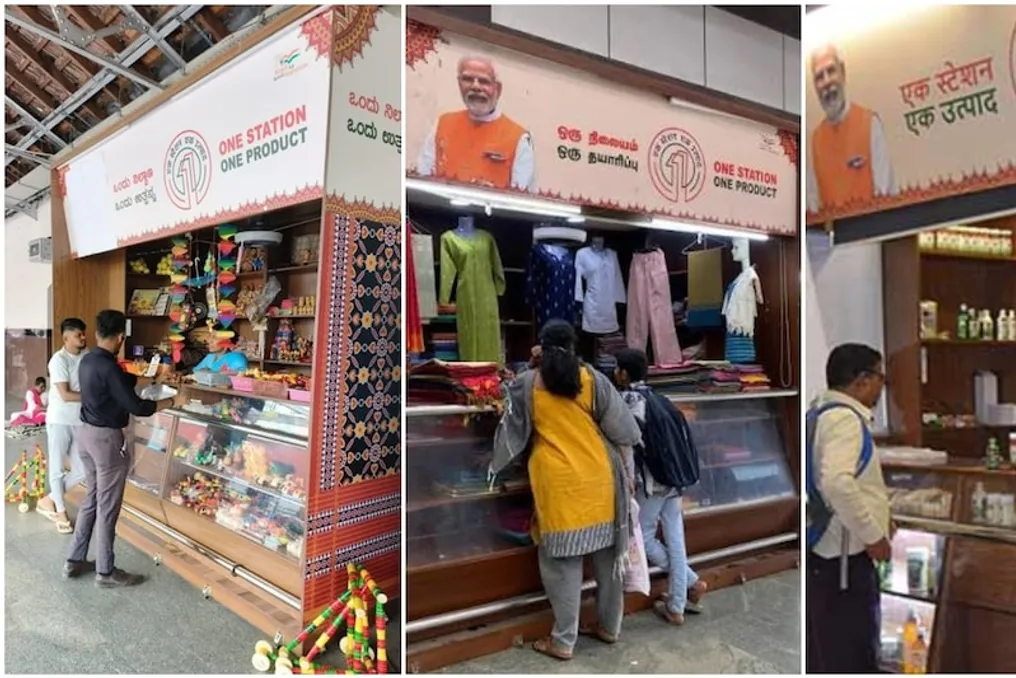
Railway stations are no longer just places for passengers to board and alight. The 'One Station - One Product' (OSOP) program is becoming a significant tool in promoting Prime Minister Narendra Modi's 'Vocal for Local' campaign at the grassroots level, providing markets for local artisans, weavers, and small producers across the country.
According to official railway data, more than 162.39 crore rupees worth of products have already been sold through the OSOP program. The goal of this initiative is to leverage the extensive railway network to deliver local and regional goods to various parts of the country. Thus, passengers waiting for a train have the opportunity to purchase unique local crafts, textiles, or regional products, while small entrepreneurs and artisans gain access to a large market.
The railway reports that the OSOP network includes over 2300 trading points, covering more than 2000 railway stations. This initiative has already benefited over 1.54 lakh people, including about 1.50 lakh direct beneficiaries who have been given the opportunity to sell their products at the stations.
This measure also aligns with Prime Minister Modi's vision to support local products and the 'Vocal for Local' campaign. The program's focus is not limited only to selling local goods; it aims to create a platform for local artisans, weavers, and small entrepreneurs, allowing them to connect directly with customers without the need for large retail chains or expensive markets.
'One Station - One Product' was launched on March 25, 2022. It initially started as a pilot project at 19 stations for 15 days. Following this, the program was gradually expanded. Under this system, local producers and artisans are provided the opportunity to set up stalls at the stations. Stalls are provided on a rotational basis and require a relatively small fee. The main objective is to provide access to the vast passenger network of the railway for the maximum number of local sellers.
Diverse goods related to the region's local identity are sold at OSOP trading points. These include handicrafts, leather goods, jewelry, traditional items, as well as textiles and toys. Local food products are also available at many stations.
Products included in this network are Madhubani paintings from Bihar, Pagalpuri silk, Gamosa and Mekla Chadar from Assam, Kota Doria and Sanganeri print from Rajasthan, Channapatna toys and Kanchipuram silk from Karnataka, as well as traditional Kolhapuri items from Maharashtra, Muradabad brassware from Uttar Pradesh, and Banaras items from Uttar Pradesh. Through this, local arts and cultures help reach new buyers via railway stations.
By state data, West Bengal leads with 378 OSOP units. Maharashtra follows with 205, Tamil Nadu with 199, and Uttar Pradesh with 196 units. These figures demonstrate that the extensive railway station network is now being utilized as a major marketplace for local products. This is particularly important for small artisans and local producers, as they gain the ability to reach customers outside their region.
One of the key features of OSOP is the low cost of market access. The registration fee for 15 days ranges from 500 to 1000 rupees, with the charge varying depending on the station category. Stalls are provided on a rotational basis to give a chance to as many local producers as possible. The railway is also actively promoting cashless payment methods at these points, such as UPI, BHIM, POS terminals, and digital wallets.
The main goal of 'Vocal for Local' is to take local products beyond the local market and provide them with a wide sales market. OSOP implements this idea through the railway network. An artisan from a small town or village, who might previously have been limited to the local market, can now reach passengers from different parts of the country through a railway station. Passengers, in turn, can easily purchase local goods, crafts, and regional products and take them home.
Over 162 crore rupees in sales, coverage across more than 2000 stations, and more than 1.50 lakh direct beneficiaries show that OSOP is gradually transforming into a major platform connecting traditional railway infrastructure with local business and culture. Within Prime Minister Modi's 'Vocal for Local' message, this railway model plays an important role in providing local artisans with customers, market, and recognition.