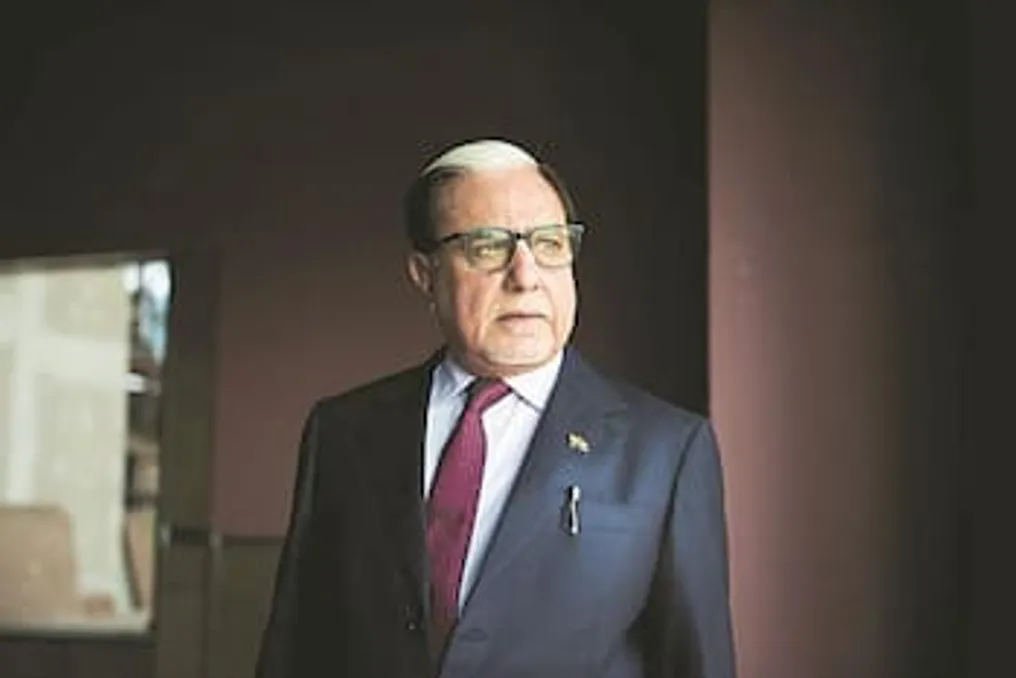
Subash Chandra of Essel Group opposed the formation of a five-member NCLT panel
Read more
Business Standard
business-standard.com

Subash Chandra of Essel Group opposed the formation of a five-member NCLT panel

Subash Chandra, Chairman of Essel Group, expressed disagreement on Wednesday with the NCLT's decision to form a five-member panel to consider his personal insolvency case. He argued that the tribunal lacks the authority to form such a panel.

Chandra's representative before the National Company Law Appellate Tribunal (NCLAT), senior advocate Sasmit Patra, called the NCLT order 'erroneous and incorrect,' stating that they are 'not authorized' to create a five-member panel.

Patra pointed out that it was this five-member panel that suspended the order of Nilesh Sharma, a member (judge), who was brought in as a third member after the NCLT collegium issued an ambiguous decision.

NCLT's Decision to Freeze Assets

On Tuesday, the NCLT prohibited Essel Group Chairman Chandra from disposing of his assets and suspended the order allowing him to settle claims arising from personal guarantees on group loans amounting to about 6.5 crore rupees, despite demands of approximately 22,006 crore rupees.

Patra questioned the legality of this decision, asking: 'On what authority' was the suspension made and 'when did this five-member panel convene? What proceedings led this five-member panel to pass only one order?'

Arguments of the Parties in NCLAT

Government Solicitor Tushar Mehta, representing dissenting creditors such as LIC Housing Finance, Canara Bank, and Union Bank, stated that the petition filed against the third member's order 'may be dismissed with the possibility of restoration,' as some respondents may challenge the reference itself.

He noted that the case has 'very peculiar circumstances' because it generated 'three diverging opinions,' making it suitable for consideration by a larger panel.

Clash of Positions

However, Patra objected to this view, arguing that the orders of Ashok Kumar Bhardwaj and Nilesh Sharma coincide regarding the repayment plan and admissibility issues. He emphasized that Ashok Kumar Bhardwaj's first order, along with Nilesh Sharma's, provides clarity on the repayment plan.

Patra stated: 'Both completely agree on Section 79 regarding admissibility. Therefore, saying that all these issues must be re-examined is completely wrong. The scope of 419(5) (Companies Act 2013) is very limited,' adding that 419(6) states that in case of a difference of opinion, this difference must be considered by another or other members.

He again questioned the authority: 'This does not give NCLT the power under IPC or the Companies Act to form a five-member panel. On what basis, what authority, exists this five-member panel?'

Proceedings in NCLAT

It is worth noting that the National Company Law Tribunal (NCLT) formed a five-member panel on Monday, which suspended Nilesh Sharma's order on Tuesday after notifying all parties and scheduled the next hearing for September 23, 2026. This dispute reached the appellate tribunal NCLAT, where dissatisfied creditors challenged the third member's order.

On Wednesday, Mehta informed the three-member bench of NCLAT about the need to dismiss the appeal, as the five-member panel of NCLT had suspended the order of the third member—arbitrator judge Nilesh Sharma. Nevertheless, Patra insisted that the five-member panel of NCLT should have suspended all three orders passed, including the dissenting decision of the collegium.

He also opposed the Government Solicitor's request to withdraw the appeal. Presiding Judge Yogesh Khanna, who headed the NCLAT bench, noted that 'forming a five-member panel is not a matter for us.'

Mehta responded by suggesting that Chandra's side be allowed to challenge this order separately while his own appeal remains pending, stating that he has 'no difficulty' with such a course. However, the NCLAT bench ruled that this could not be permitted.

Patra informed NCLAT that Chandra was facing ostracism across the country due to the proposed payment of 6.5 crore rupees versus the recognized creditor claims of 22,006 crore rupees, even though there is currently no final order confirming the repayment plan.

In response, Mehta stated: 'This forum cannot be used to say anything outside the court... this forum is used to say something that will be printed tomorrow in the media. It is not a forum.' Agreeing with them, the NCLAT bench stated: 'If you have any complaints, the matter is under consideration by NCLT; you raise the complaint there.' Mehta decided not to insist on the withdrawal statements and requested the appeals remain valid. NCLAT agreed and ordered the petitions to be listed for the next hearing on October 7.
Similar stories

NCLAT to consider creditors' challenge to Subhash Chandra's debt repayment plan
Read more
business-standard.com

NCLAT to consider creditors' challenge to Subhash Chandra's debt repayment plan

The National Company Law Appellate Tribunal (NCLAT) will on Tuesday consider objections from several financial institutions against the approval by the National Company Law Tribunal (NCLT) of the repayment plan presented by Essel Group founder Subhash Chandra in his personal insolvency case.

The appeal was urgently filed with the appellate tribunal on Monday by General Counsel Tushar Mehta, who represented the interests of creditors, including LIC Housing Finance, HDFC Bank, and Union Bank of India. NCLAT agreed to schedule the hearing for Tuesday at 10:30 AM.

The creditors seek to overturn the NCLT's decision, which effectively allows Chandra to settle the claims recognized in his personal insolvency case by paying creditors ₹6.25 crore, as well as ₹25 lakh towards the insolvency process. The recognized claims before the tribunal amounted to approximately ₹22,006.57 crore.

The proposed payout amount is about 0.03 percent of the recognized claims, implying a recovery deficit of nearly 99.97 percent. During the request for an urgent hearing, Mehta told the appellate tribunal: 'There are two or three important issues being decided, and if these conclusions are correct, we may face a complete loss of the intent and purpose of the Insolvency and Bankruptcy Code (IBC)'.

Several creditors had previously opposed Chandra's proposal in the NCLT. Among them were HDFC Bank, Axis Bank, Canara Bank, RBL Bank, and Union Bank of India, which voted against the plan. Nevertheless, the proposal received support from 80.81 percent in the creditors committee.

A key issue likely to be examined by the NCLAT is the voting rights of certain financial creditors whose support proved decisive. Opposing creditors questioned the participation of entities allegedly linked to Chandra or his family, including Veena Investments, Direct Media Distribution Ventures, World Crest Advisors, Lemonade Capital Advisors, and Corpcall Capital Advisors. Their votes helped exceed the required threshold for the plan.

LIC Housing Finance specifically questioned the lack of forensic audit of Chandra's financial position. This organization stated that it could only recover about ₹38 lakh against a recognized claim of approximately ₹1,322 crore under the plan.

Meanwhile, HDFC Bank reported that it expects to recover only about 3.2 percent of its claim and opposed the settlement. Proceedings against Chandra began in 2022 when Indiabulls Housing Finance approached the NCLT under Section 95 of the IBC regarding a personal guarantee provided by Chandra for a corporate loan.

The proceedings under review concern Chandra as a personal guarantor, not treating the entire sum of ₹22,006 crore as money personally borrowed by him. This distinction became central to the dispute surrounding the NCLT's decision.

Chandra disputes the total figure of ₹22,000 crore, asserting that the claims related to him as a personal guarantor were significantly lower. According to his version, the claims considered by opposing creditors amounted to about ₹3,992 crore. His office also stated that several underlying borrowers have already repaid significant amounts, and the remaining liabilities should be settled and recovered from the borrowing companies, not treated as Chandra's personal debt.

The repayment plan was submitted to the NCLT after disagreements in the initial bench, after which the matter was referred to a third judicial member. Nilesh Sharma, appointed as an additional judicial member in February 2026, ultimately approved the plan on August 25.

The NCLT's decision has since drawn opposition from both private and public creditors, including LIC Housing Finance, Canara Bank, and Union Bank of India, who are among those challenging it. Thus, the hearing at NCLAT on Tuesday will scrutinize both the quantum of recovery and the validity of the voting process, as creditors argue that the NCLT's decision could have broader implications for the functioning of the personal guarantee insolvency regime under the IBC.

Petition to Supreme Court demands removal of Manan Mishra from the post of Chairman of the Bar Council of India
Read more
timesofindia.indiatimes.com

Petition to Supreme Court demands removal of Manan Mishra from the post of Chairman of the Bar Council of India

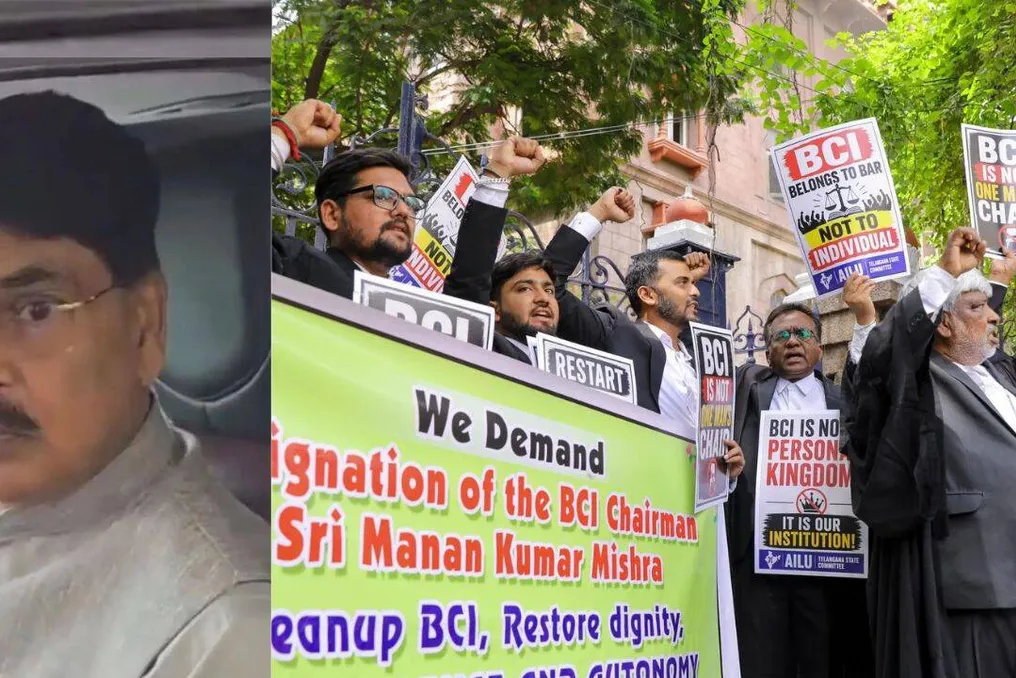
Following the statement by Manan Kumar Mishra, Chairman of the Bar Council of India (BCI), that he does not intend to step down, a petition has been filed in the Supreme Court. This lawsuit challenges his ten-year tenure and demands his removal, the holding of new elections, and amendments to the rules governing the Chairman's term.

The petition, filed by advocate Yogamae MG through advocate Dipak Prakash, questions the legality of Mishra's prolonged service. The suit asserts that Rule 12(2) of the BCI Rules stipulates a two-year term for the Chairman and Vice-Chairman, or until membership ceases, whichever comes first.

The petitioners also challenged a notification in the Gazette dated April 21, 2025, which allegedly extended Mishra's term until 2030. Proponents of the suit argue that an administrative notification cannot override the legislative framework regulating the BCI's operations.

The petition includes a demand for the highest court to annul this notification and require the BCI to withdraw or cancel it. The document points out that despite the two-year term established by Rule 12(2), there are no significant restrictions on re-election, resulting in the same person holding the position for nearly twelve years.

Furthermore, it was stated that such a prolonged concentration of power 'prima facie contradicts the representative mechanism enshrined in Section 4(1)(c),' according to which State Bar Councils contribute to the composition of the BCI. The petition emphasized that the national body representing the entire legal profession should not allow the highest office to remain indefinitely concentrated in the hands of one individual or a narrow regional group.

Among the demands put forward in the lawsuit are the removal of Mishra, holding new elections within a stipulated time under independent supervision, and introducing a general limit on the number of years a person can serve as BCI Chairman. Additionally, the petitioners requested a cooling-off period and a transparent rotation mechanism to allow representatives from different states and regions to lead the BCI.

The petition also asks the Supreme Court to establish an independent committee led by a former Supreme Court judge or former High Court chief. According to the suit, this committee could receive assistance from an auditor appointed by the Comptroller and Auditor General (CAG), as well as financial and technical experts.

The petitioners expressed concern regarding the functioning and finances of the BCI Trust 'PEARL-FIRST,' as well as the financial status of the All India Bar Examination. A request was made for an independent investigation and timely audit of target funds, examination receipts, institutional income, trust finances, supplier contracts, and related-party transactions.

The lawsuit traces Mishra's history as BCI Chairman dating back to 2012. It is noted that although he briefly left the post in 2014, he returned to the position in November of the same year and has remained there since. Mishra was re-elected without opponents in March 2025, which, according to the petitioner, marked his seventh consecutive term.

The petition also mentions that Mishra became a member of Rajya Sabha after nomination by the BJP in 2024. The petitioners clarify that they do not dispute that political affiliation itself renders Mishra ineligible, but they express concerns about the perception of institutional neutrality.

Mishra rejected calls for resignation amid the dispute with NALSAR. He stated: 'I served as Chairman of the Bar Council of India for 12–14 years because I was elected. Manan Mishra represents 2.5 million lawyers; he will not just leave.' He also defended the BCI's approach to the dispute with NALSAR University, calling the student boycott against the Head of State 'highly unacceptable.' Mishra reported that the BCI withdrew its order against the students within 15 minutes. He also noted that about 15 students gathered near the BCI office demanding his resignation.

Securities Tribunal rejects Danny Gaekwad's request for exemption from takeover rules regarding Religare acquisition
Read more
business-standard.com

Securities Tribunal rejects Danny Gaekwad's request for exemption from takeover rules regarding Religare acquisition

The Securities Appellate Tribunal (SAT) has rejected the appeal of businessman Didwijay Lakshmansingh Gaekwad, also known as Danny Gaekwad, who sought an exemption from regulatory requirements for making a competing open offer for Religare Enterprises (REL).

The Tribunal ruled that Gaekwad missed the stipulated 15-day deadline under SEBI regulations. The three-member bench, presided over by Justice P. S. Dinesh Kumar, noted that Gaekwad was required to submit his competing offer within 15 working days following the publication of the detailed public statement by Burman Group in October 2023.

Instead, Gaekwad approached SEBI only in January 2025, offering a price of ₹275 per share, compared to Burman Group's offer of ₹235. The Tribunal dismissed Gaekwad's argument that the 15-day period should be calculated from January 2025, when Burman Group sent the offer letter, or from subsequent advertising.

It observed that the wording of Regulation 20(1) of the SEBI (Substantial Acquisition of Shares and Takeovers) Regulations is unambiguous and directly links the timelines to the detailed public statement. SAT also stated that allowing a competing offer at this stage would lead to unequal treatment of the 'first offer,' which had already deposited funds into an escrow account and received regulatory approvals.

The August 19 order mentioned: 'If the appellant's interpretation is accepted and his competing offer is considered, it will be regarded as gross discrimination against the first offer (in this case, Burman Group) to the extent that the sidelined appellant bypasses the first offer by not making his public offer within 15 days of the first offer's public announcement.'

Furthermore, the tribunal took into account Gaekwad's failure to comply with the Supreme Court's requirement to deposit ₹600 crore, which was set in February 2025. Although the Supreme Court granted a one-day extension, the deposit was still not made.

SAT concluded that the exemption provision under Regulation 11 does not allow for timeline extensions for the current open offer. The Burman Group's offer closed on February 13, 2025, rendering subsequent proceedings moot. Nevertheless, the tribunal indicated that the possibility of acquiring REL for Gaekwad is not closed, and he can initiate a new open offer while complying with the SAST Regulations.

Popular