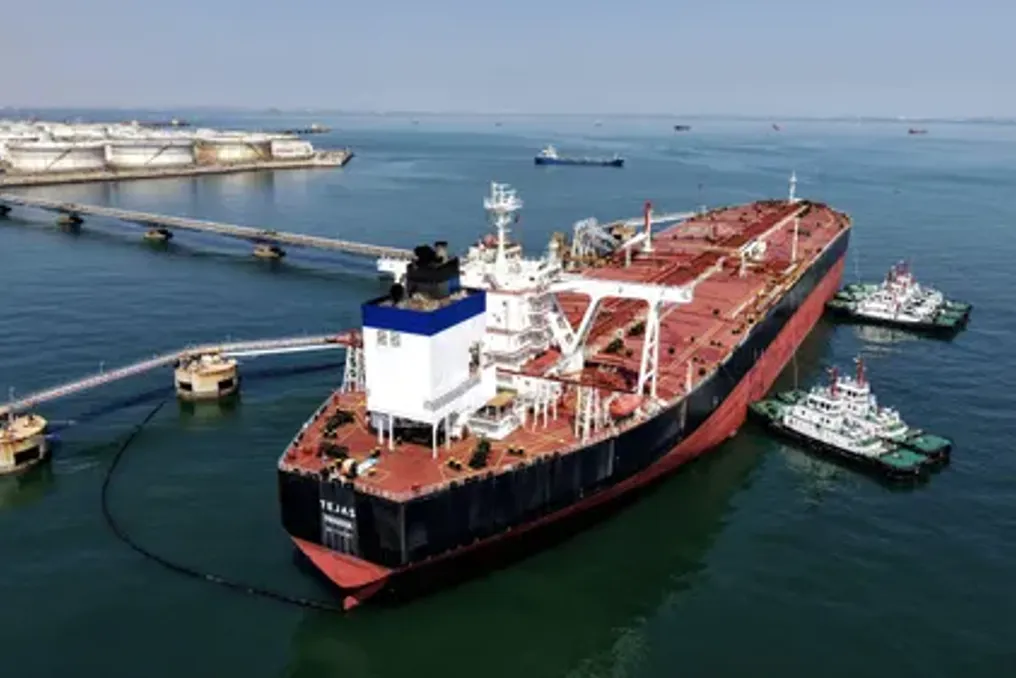
Oil prices rose while stock markets fell amid escalating tensions in the Middle East. Brent crude traded around the $95 mark on Wednesday.
Investors increased bets on interest rate hikes as the situation in the Middle East worsened again, triggering another spike in crude oil prices. Crude oil continued its weekly rise, increasing by approximately 10 percent after the United States attacked an Iranian island in the Strait of Hormuz over the weekend. This attack led to a series of retaliatory strikes, during which Tehran struck at American interests in several regional countries.
On Wednesday morning, Brent North Sea crude traded at $95.43 per barrel. The latest wave of military action occurred after several weeks of relative calm, during which peace talks failed to yield results, and Washington stated its intention to achieve an 'economic strangulation' of the Islamic Republic.
As the Strait of Hormuz, through which about one-fifth of the world's oil and gas passes, is effectively closed for an indefinite period, and energy costs are unlikely to decrease, inflation fears are growing. These fears, along with concerns about government spending and mass corporate debt selling, have led to a sharp rise in rate hike expectations, putting upward pressure on the cost of government borrowing.
The yield on 30-year UK government bonds reached its highest level since 1998, and the 10-year yield is at a level seen during the 2007–2008 global financial crisis. Similarly, Japan's 10-year bond yield reached a 30-year high, and US 30-year Treasury bonds approached 2007 levels, while the US 10-year yield is also at crisis levels.
Rajiv De Mello from Gama Asset Management noted: 'Bond yields were already rising, and the renewed attacks by the US and Iran and their impact on oil prices have caused investors more concern about bonds.' He added that 'at these levels, higher yields are clearly a hindrance to Asian stocks, especially long-term technology stocks.'
Asian markets showed declines, with technology companies, which rely on low borrowing rates to finance investments, being hit hard: Tokyo fell by 3.9 percent, and Seoul fell by 4 percent. Markets in Hong Kong, Shanghai, Sydney, Taipei, Mumbai, Bangkok, Jakarta, and Manila also declined significantly. London, Frankfurt, and Paris opened with slight declines. Selling followed the drop across all three major Wall Street indices.
Investors are preparing for key employment and inflation data releases next week, which may determine whether the Federal Reserve will raise rates at its next meeting in two weeks. According to Bloomberg data, traders estimate the probability of a rate hike at 70 percent. Fed Chair Michael Barr reinforced expectations, stating that policymakers must be prepared to raise rates if inflation stubbornly remains above the bank's target of two percent, which has been the case for over five years. He specified: 'If trends in the data give me confidence that inflation is slowing down toward two percent, then I think we can spend a little more time assessing our policy. However, if inflation does not appear to be slowing down sufficiently, I think we should act decisively to raise rates.'
Key figures around 9:15 AM (SA time)
West Texas Intermediate: ROSE by 0.5 percent to $90.67 per barrel
Brent North Sea Crude: ROSE by 0.8 percent to $95.43 per barrel
Tokyo - Nikkei 225: FELL by 2.9 percent to 64,325.64 (close)
Hong Kong - Hang Seng Index: FELL by 0.4 percent to 25,236.95
Shanghai - Composite: FELL by 1.0 percent to 3,941.39 (close)
London - FTSE 100: FELL by 0.1 percent to 10,780.62
Dollar/Yen: FELL to 159.60 yen from 160.24 yen on Tuesday
Euro/Dollar: FELL to $1.1588 from $1.1589
Pound/Dollar: FELL to $1.3495 from $1.3511
Euro/Pound: FELL to 85.73 pence from 85.77 pence
New York - Dow: FELL by 0.8 percent to 52,766.88 (close)