NASA is preparing for the launch of the Roman Space Telescope, which is capable of creating extremely detailed maps of the heavens. This telescope will help scientists uncover some of the most mysterious cosmic enigmas.
Similar stories
AI global infrastructure investments could exceed $4 trillion by 2028, according to summit in Uxi
Experts gathered in Uxi, China, at the 2026 Conference on Innovation and Integrated Circuit Development noted that artificial intelligence is accelerating the transformation of the global semiconductor industry faster than expected.
According to forecasts presented at the meeting on August 31, global investments in new data center infrastructure will exceed $4 trillion by 2028, with semiconductor spending accounting for $2.8 trillion of that total.
The sector growth, which participants believe will continue this year and over the next two to three years, has already allowed the global integrated circuit industry to surpass the one trillion dollar mark in 2026, beating the widely predicted timeline of 2030; total sales for this year are projected to be around $1.6 trillion.
Bai Peng, Chairman and CEO of Hua Hong Semiconductor, highlighted the sharp growth, noting that the industry reached the trillion-dollar milestone significantly earlier than planned. However, the industry faces a persistent bottleneck in memory: the global HBM market must grow by almost 60 percent this year, reaching $54.6 billion, which accounts for approximately 40 percent of the DRAM market, despite major memory manufacturers redirecting up to 70 percent of new capacity to HBM, while a stated capacity shortage of 50–60 percent persists.
China used the forum to showcase its role in advanced packaging. Jiangsu Province introduced several new innovative platforms, including a high-density optoelectronic microsystem integration lab led by packaging giant JCET and an intelligent power IC and module lab led by Chipown, both focused on AI power chips. Furthermore, the province established its integrated circuit industry alliance.
Officials emphasized strengths related to new equipment: in the 2025 global ranking of semiconductor equipment manufacturers, Naura and AMEC ranked fifth and eighth, respectively, while China's domestic equipment segment has shown a compound annual growth rate of 57 percent since 2017, roughly double the global rate.
On the technological front, speakers discussed the evolution of advanced packaging from the perspective of interconnects, power delivery, and thermal dissipation. Hybrid bonding can increase interconnect density from tens of contacts per square millimeter to over a million, solve the 'memory wall' problem, and shift AI power delivery towards two-level vertical architectures to reduce energy consumption. As chip power increases, thermal management becomes critically important; for example, Nvidia has already implemented two-phase immersion cooling.
Fudan Microelectronics announced the future development of its FPGA agent development platform in response to growing interest in programmable logic in the AI era, which the company deems advantageous due to a faster and more agent-controlled iteration cycle.
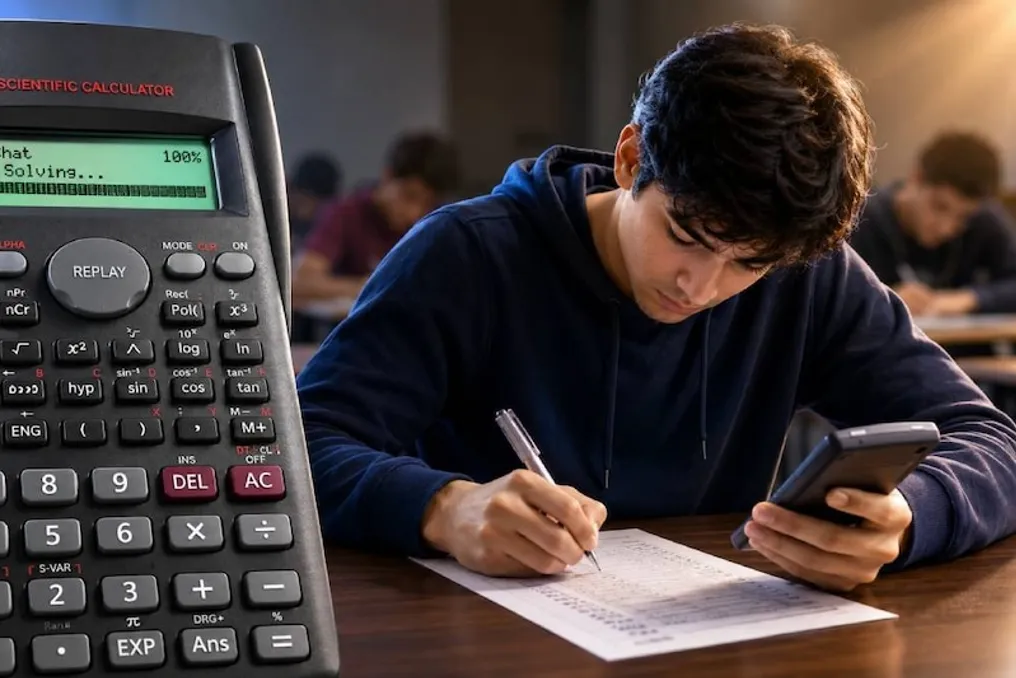
Artificial intelligence in calculators raises concerns about cheating on exams
The use of artificial intelligence (AI) is currently growing rapidly. AI is no longer limited to phones, laptops, or applications, but has also penetrated devices used for studying. Currently, there is discussion about an AI calculator that can not only perform addition and subtraction but also understand the question itself and assist in solving it.
This makes it easier for students to tackle complex problems, but this is precisely what is causing growing fear of cheating during exams. Next, we examine what makes this AI calculator special.
A standard calculator provides an answer after numbers are entered. However, an AI calculator functions differently, utilizing AI technology that allows it to understand the question and help find the solution. That is, instead of simply giving the answer to a problem like 10+20, it can help understand and solve a complex mathematical problem. This is why it is considered more advanced than a standard calculator.
If a student does not understand a question while studying, the AI calculator can assist them. It can not only provide the answer but also explain the method of solving the problem. This is especially useful in subjects such as mathematics and natural sciences. Students can use AI for better understanding of questions and simplifying the learning process. Nevertheless, if a student starts relying on AI for every small or large question, it may lead to a decrease in their ability to think and solve problems independently.
The greatest resonance around AI calculators comes from their potential use in exams. The reason for this is obvious: if a device can understand a question and find the answer during knowledge testing, it can be used for unintended purposes. Suppose a calculator is allowed in an exam. In that case, if someone secretly brings an AI calculator with them, the chances of cheating will significantly increase, as it can look like a regular calculator externally.
Now the question arises whether such AI calculators will be permitted in exams. Many tests already have restrictions on the use of smart devices and gadgets connected to the internet. In the future, rules regarding calculators in examination centers may become even stricter. Perhaps permission for use will only be granted for certain models of standard calculators.
On one hand, an AI calculator can become an excellent educational tool for students, helping them understand complex issues and learn their solutions. However, its misuse during an exam can facilitate cheating. Therefore, it is crucial that AI is applied for learning and gaining knowledge, not for gaining an unfair advantage during assessments.
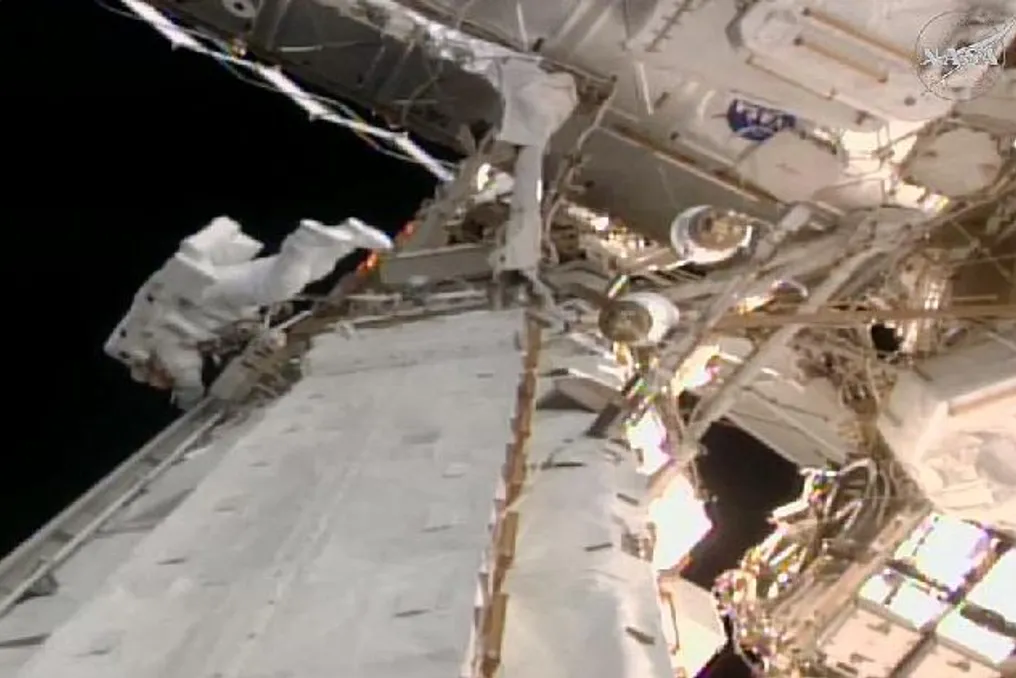
NASA and ESA Astronauts Conduct Spacewalk Outside ISS for Maintenance and Research
NASA astronaut Jessica Meir and European Space Agency (ESA) astronaut Sophie Adenot completed their spacewalk outside the International Space Station (ISS) on Tuesday. The mission aimed to conduct navigation work, scientific research, and technical maintenance of the station.
The pair began work at 8:40 AM Eastern Time (12:40 GMT). Over six hours and forty-nine minutes, Meir and Adenot installed a new retroreflector on the forward port of the station's 'Harmony' module to support spacecraft navigation during docking and rendezvous operations.
Additionally, they replaced a high-resolution camera on the station's truss and collected a sample from the exterior surface of the ISS for microorganism analysis. According to NASA, they also partially completed work on installing connecting cables for electrical systems and began preparations for a future spacewalk to replace the Alpha-magnetic spectrometer's heat-dissipating radiator.
During the spacewalk, Adenot experienced issues with the mobility of her left arm. Meir inspected Adenot's spacesuit and suggested that the glove's heating actuator was likely jamming, restricting movement in the left shoulder joint. As reported by NASA, the problem was resolved after disengaging the joint before the crew entered the airlock.
This spacewalk was the seventh for Meir and the third for Adenot, marking the 284th spacewalk supporting the assembly, maintenance, and modernization of the ISS.