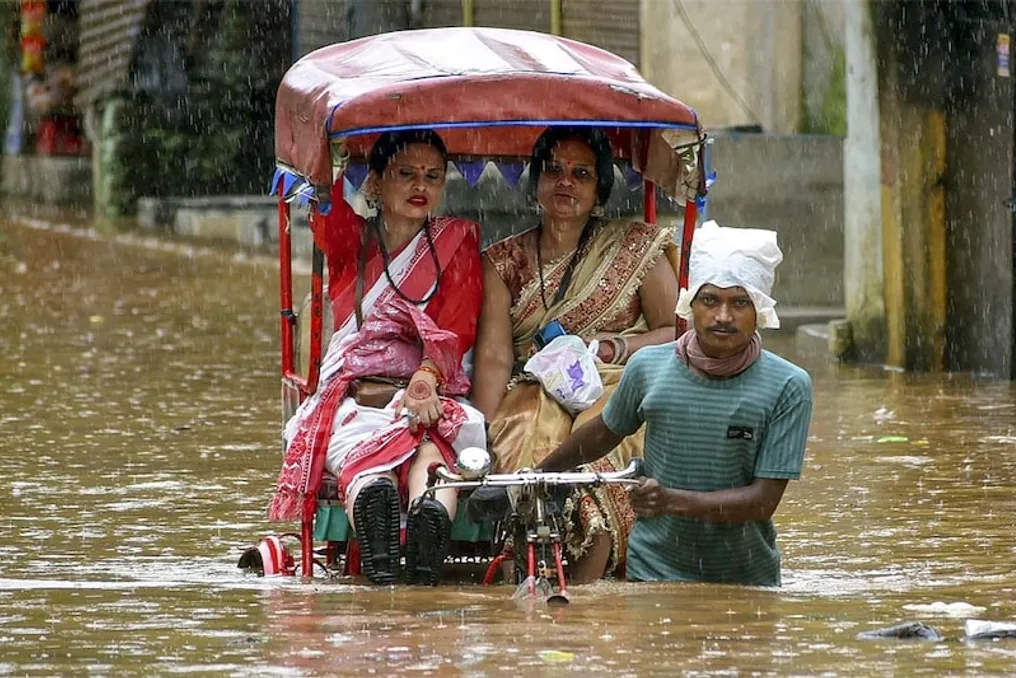
In August 2026, many regions of the country experienced intense rainfall; however, the total amount of rain across all of India was 16.3% below normal. According to the meteorological service, the cause of the heavy rains in the eastern, east-central, and northwestern parts of India was low pressure and western disturbances.
Six low-pressure systems formed over the Bay of Bengal in August, two of which developed into depressions. Additionally, there were eight active western disturbances. The low-pressure systems remained active longer than usual, functioning for 26 days throughout the month, compared to the usual 16.3 days. A similar trend was observed in July, when low-pressure systems were active for 24 days, exceeding the average of 13.56 days, indicating a stronger influence of these systems on rainfall in July and August.
The heaviest rains in August fell in the eastern, east-central, and northwestern parts of India. Low-pressure systems formed in the Bay of Bengal moved towards the northwest. According to the IMD, some systems slowed down or stalled instead of progressing further. IMD Director Mrityunjay Mahapatra explained this as a change in the trajectory of the low-pressure systems influenced by western winds and western disturbances.
The influence of western disturbances was also evident during the monsoon season. Western disturbances usually arrive in northwestern India in winter, forming near the Mediterranean Sea and moving towards India, causing snow in the mountains and rain on the plains. However, in recent years, their activity has increased even during the monsoons, which was noticeable in August 2026 when heavy rains in northwestern India were caused by the combined effect of low-pressure systems and western disturbances.
Despite abundant rainfall in several areas, the total amount of rain across the country in August was 16.3% below normal. For the entire monsoon season, from June 1st to August 31st, the precipitation deficit was 13.8%. Furthermore, about 47% of the country's districts received less or very little rain than normal. In northwestern India, rainfall in August was 9.5% below normal. In central India, rainfall in July was 33% higher than normal, but in August, it saw a decrease of 16.2%.
Eastern and northeastern India recorded a 16.9% decrease in rainfall in August. The precipitation deficit in this region from June to August reached 25.7%, the highest figure among all regions in the country. Southern India experienced a rainfall deficit of 27.1% in August, and from June to August, this deficit was 24.2%.
Significant deviations were noted among states: Andhra Pradesh had rainfall 42% below normal from June 1st to August 31st, Karnataka by 23%, and Kerala by 21%. The largest deficit during the monsoon season was recorded in Meghalaya, where rainfall was 58% less than normal. Meanwhile, Ladakh recorded an anomalous increase in rainfall of 195%.
Additionally, temperatures were elevated in August. The average maximum temperature in the country was the fourth highest for August since 1901, and the average minimum temperature was the highest in the last 126 years. Thus, although heavy rains occurred in some places, the overall precipitation across the country was low, and temperatures exceeded the norm.