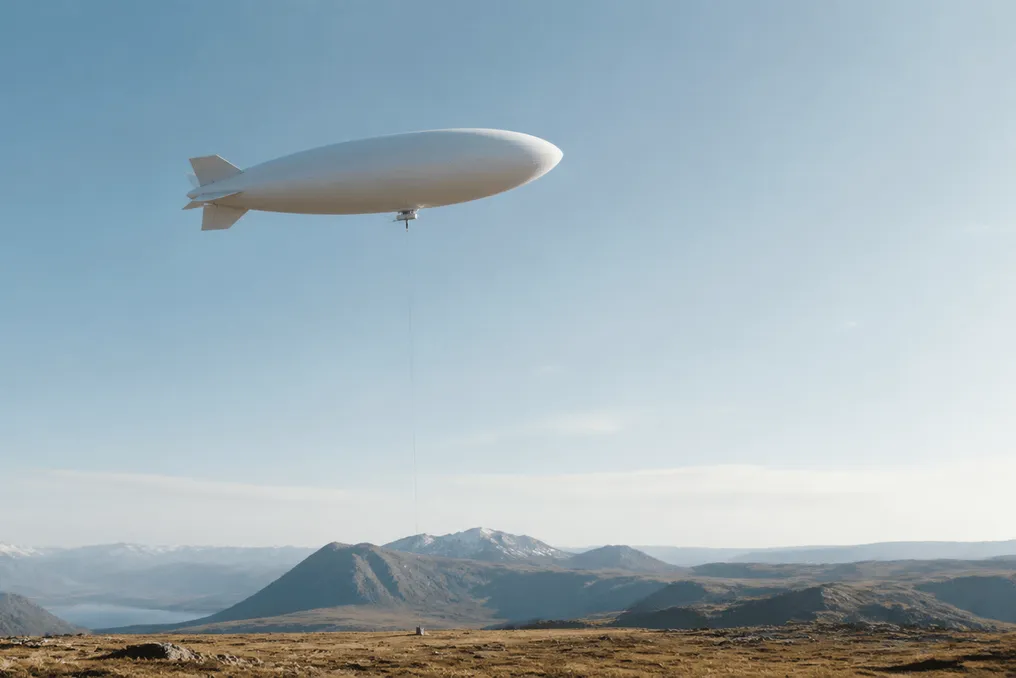
China has taken steps toward generating electricity from wind blowing at an altitude of four kilometers above the surface of the earth. Recently, a full cycle test of the domestically developed S4000 aerial wind energy system was completed. This system, shaped like a large airship, underwent trials at a test base in northwestern China, including launch, position holding, generation, and return.
The project involved an energy startup company from Beijing, which collaborated with Tsinghua University and the Institute of Aerospace Information Research of the Chinese Academy of Sciences. This achievement marks China's transition from iterative development of high-altitude wind energy technologies to their practical implementation.
The physical justification for using a flying power station lies in the sharp increase in wind speed with altitude, as friction with the ground decreases. Thus, a turbine at 4000 meters can generate in a year as much energy as several equivalent ground installations combined. While onshore wind farms typically operate 2000–3000 hours per year, high-altitude wind studies estimate a theoretical useful annual operating window at 4000 meters in the range of 5000–6000 hours.
Due to more stable wind, such systems exhibit characteristics similar to baseload, potentially allowing them to serve as a future supplement to traditional baseload generation.
The S4000 system measures 67 meters in length, 40 meters in width, and 23 meters in height. It is lifted by the buoyancy of a light helium-filled envelope instead of relying on foundations made of thousands of tons of steel and concrete. A high-strength cable holds it up and transmits kilowatts of energy back to the grid. The main equipment—generator, converter, and controller—is housed in a streamlined body.
The teams managed to solve 17 key technical challenges, including platform orientation control, lightweight generation, and high-voltage transmission over long distances. The hybrid structure of the rigid ribs and membrane increases wind resistance by 45 percent compared to conventional soft airships.
To counteract turbulence, the system uses an onboard servo drive to correct its position and maintain stable positioning, demonstrating continuous generation for 72 hours. Laser radar and ultrasonic anemometers predict wind and gusts ahead, while a conductive static layer and onboard lightning arresters manage lightning strikes, and a microwave or electric anti-icing coating prevents ice formation.
The cable itself is a materials science breakthrough: it is an adaptive carbon fiber core cable that is three times stronger than steel at one-quarter of its weight. It combines load-bearing capacity, high-voltage transmission, and fiber optic control in a single line. S4000 follows earlier smaller prototypes at altitudes of 500 and 2000 meters, which were built at a new factory for high-efficiency envelope materials in Zhoushan to ensure the supply chain.
The first S4000 demonstration projects now represent an observation period before fleet deployment. High-altitude wind resources are being considered for deserts, remote islands, and mountain posts where power lines could never reach.