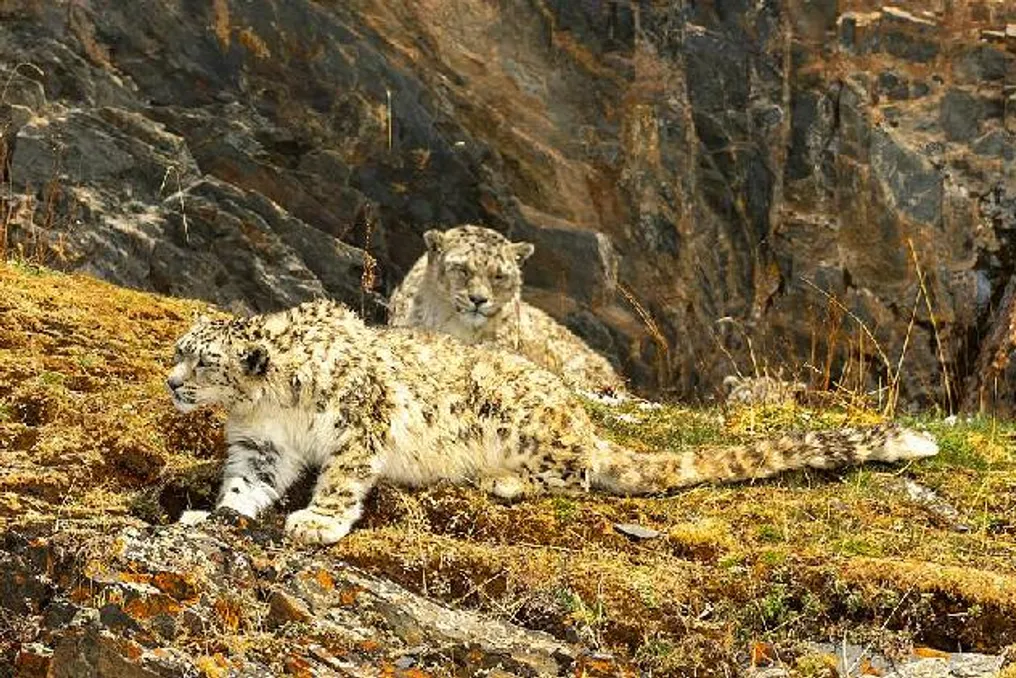
The countries of the Shanghai Cooperation Organisation (SCO) are joining forces to address environmental problems through joint solutions and cooperation—from the high-altitude habitats of the snow leopard to the shrinking landscapes of the Aral Sea.
China, as one of the world's most biodiverse countries and one of the first parties to sign and ratify the Convention on Biological Diversity, is deepening its partnership with regional partners to promote biodiversity conservation and environmental restoration.
Protecting the 'King of the Snow Mountains'
The snow leopard, known as the 'king of the snow mountains,' inhabits high-altitude regions from Central Asia to the Qinghai-Tibet Plateau and the Mongolian Plateau. Many SCO member states are home ranges for this species.
In the context of climate change and the global biodiversity crisis, protecting snow leopards is crucial for maintaining ecosystem stability. SCO countries and other nations in the Asian range have agreed to work together to conserve the species and the natural ecosystem upon which it depends.
Cooperation began back in October 2013 when 12 countries in the snow leopard's range, including China, gathered at the first Global Forum on Snow Leopard Conservation in Bishkek, Kyrgyzstan. The Bishkek Declaration on Snow Leopard Conservation was signed there, and the Global Snow Leopard and Ecosystem Protection Program (GSLEP) was launched to implement the commitments made.
In 2018, the Shenzhen Consensus on Global Snow Leopard Conservation was adopted in the southern Chinese city of Shenzhen. In 2025, under the leadership of the World Wildlife Fund in China (WWF-China) and WWF Mongolia, the two countries launched the 'United for Snow Leopards' project—the first joint initiative for snow leopard conservation between China and Mongolia. This five-year program focuses on strengthening international conservation and cooperation, supporting community-led conservation initiatives, and raising public awareness.
Seyed Gulam Mustafa Shah, Deputy Speaker of the National Assembly of Pakistan, noted that the snow leopard population in the country is recovering thanks to cooperation and joint protection among SCO member states.
Restoring the 'Dry Tears' of Central Asia
The Aral Sea, which spans Kazakhstan and Uzbekistan, was once the fourth largest lake in the world. Since the 1960s, excessive water consumption and climate change have caused it to shrink by more than 90%. Increased soil salinity has turned over 50,000 square kilometers of the dried lakebed into a desert, tragically nicknamed the 'Dry Tears' of Central Asia.
Countries around the Aral Sea are taking measures to solve this environmental problem, with Chinese scientists contributing expertise and practical solutions.
In 2013, the Institute of Ecology and Geography of the Xinjiang Branch of the Chinese Academy of Sciences and research institutes in Central Asia jointly established the Central Asian Ecology and Environment Research Center, headquartered in Tashkent, with branches in Kazakhstan, Kyrgyzstan, and Tajikistan. The Center supports cooperation in water resource conservation, combating desertification, managing saline-alkaline lands, and ecological restoration.
Chinese research groups conducted field surveys, created over 80 monitoring points, and used high-resolution remote sensing to study the decline of the Aral Sea and the causes of this phenomenon. They also divided the region into seven main ecological types and 14 subregions based on soil, vegetation, biodiversity, and water resource indicators, providing a scientific basis for targeted restoration.
China has also shared its experience in treating saline-alkaline lands. Five salt-tolerant plant gardens have been jointly established in Uzbekistan, with plans to create two more. These salt-resistant plants can help reduce soil salinity and improve degraded lands.
Erkin Mukhitdinov, head of the Forestry Agency of the Ministry of Ecology, Environment Protection and Climate Change of Uzbekistan, stated that the country plans to use these gardens as seed and nursery bases, as well as expand the planting of salt-tolerant species such as saxaul and tamarisk.
Since 2018, Uzbekistan has planted about 2 million hectares with halophytes. The expansion of vegetation cover has helped reduce the intensity of sand and salt dust storms in the region.
The International Innovation Center for the Aral Sea Basin in Nukus has also worked with China and other countries on restoring vegetation on the dried lakebed. By studying halophyte cultivation methods in China, the center introduced over 40 species of salt-tolerant plants for studying their local adaptability and application.
Experts note that the long-term restoration of the Aral Sea will depend on the protection and rational use of water resources throughout the basin. Since 2011, Chinese and Central Asian research institutions have collaborated on developing efficient irrigation technologies. Pilot projects in Uzbek cotton fields have allowed for a 50–70% reduction in water consumption while maintaining yields above 400 kilograms per mu (approximately 0.067 hectares).
Climate and Biodiversity Cooperation
Actions to combat climate change have also been strengthened within the SCO framework. In 2022, the heads of SCO states adopted the SCO Council Heads of State Statement on Climate Change, which became the organization's first document dedicated to this issue. In 2024, the SCO decided to establish a special working group on climate change.
At the SCO Forum on Green and Sustainable Development in April 2026, the Ningbo Initiative on Sustainable Development Cooperation adopted a proposal calling for deeper interaction in biodiversity conservation and sustainable resource use, as well as coordinated efforts to implement the Kunming-Montreal Global Biodiversity Framework.