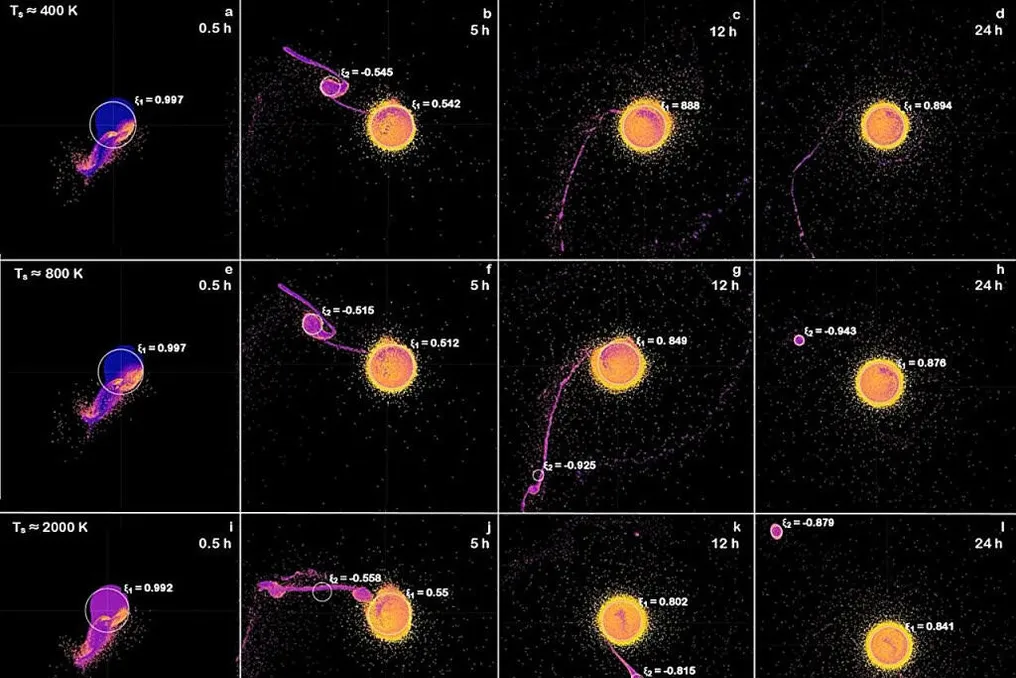
The Moon may have formed much faster than traditional models suggest. New calculations conducted by the Southwest Research Institute (SwRI) in collaboration with researchers from the University of Arizona (USA) show that Earth's natural satellite could have appeared virtually whole approximately five hours after a giant planetary collision.
The study revisits the hypothesis that the Moon originated after a Mars-sized celestial body named Theia impacted the forming Earth. The main novelty lies in including the geological strength of the materials involved in the collision into the simulations, and how this property changes depending on temperature.
The results demonstrate that this characteristic, previously considered insignificant in studies due to the immense energy of the impact, can significantly alter the process of lunar formation.
One of the key factors identified in the work is temperature. Hotter bodies are more brittle than colder ones. Consequently, the temperature of Earth and Theia at the time of impact may determine whether the impact completely destroys the body that struck the planet or if part of that body remains virtually untouched.
In some scenarios, the impact destroys Theia and scatters a huge amount of material around Earth. This material forms a debris cloud, which subsequently coalesces into the Moon. However, in other cases, the strength of the materials allows the impact to be captured by an almost intact Moon.
Denton explained that 'depending on how hot Earth and Theia were before the collision, the impact could destroy Theia and create this huge cloud of debris that will eventually form the Moon.'
But when using the same parameters as in the initial models of lunar formation in the new simulations, including internal structures with equivalent temperatures, the researcher found a different result: an intact Moon appeared after about five hours.
Thus, the results point to two possible paths. The first is that the collision turns part of the involved bodies into a large amount of debris that continues to orbit the Earth. Over time, this material merges and forms the Moon. The second is that a specific combination of material strength and temperatures allows the impact to create an almost intact Moon just a few hours after the collision.
Simulations with various surface temperatures—approximately 126.8 °C, 526.8 °C, and 1726.8 °C—demonstrated how the evolution of the system changes depending on the thermal conditions of the involved bodies.
According to the researchers, protoplanets usually begin their history very hot and gradually cool down. This creates a potential link between the moment of the collision that formed the Moon and how the satellite initially formed.
This study is the first to show that material strength and temperature play a central role in determining whether the Moon will form intact or be built later from a disk of material processed by the impact. The results may also provide clues about the timing of the impact that generated the Earth-Moon system.
Robin Canup, Vice President of Planetary Science and Research at SwRI and one of the researchers responsible for previous work on the giant impact hypothesis, stated that the findings could establish a link between the physical properties currently observed on the Moon—including possibly its volatile content—and the thermal state of Earth and Theia at the time of impact. According to her, this link could help scientists better narrow down the period when the event that formed the Moon occurred.
However, the composition of Earth and the Moon remains an open question. One theory suggests that Theia and proto-Earth formed in a similar region of the protoplanetary disk, while Mars formed further out. Denton compared: 'Since Earth and Mars formed in the same region of the solar system, they are like brothers. But the Moon and Earth are more like close twins.'
The study was published in The Astrophysical Journal Letters. The article 'Lua pode ter se formado inteira em apenas cinco horas após colisão com a Terra' first appeared in Olhar Digital.