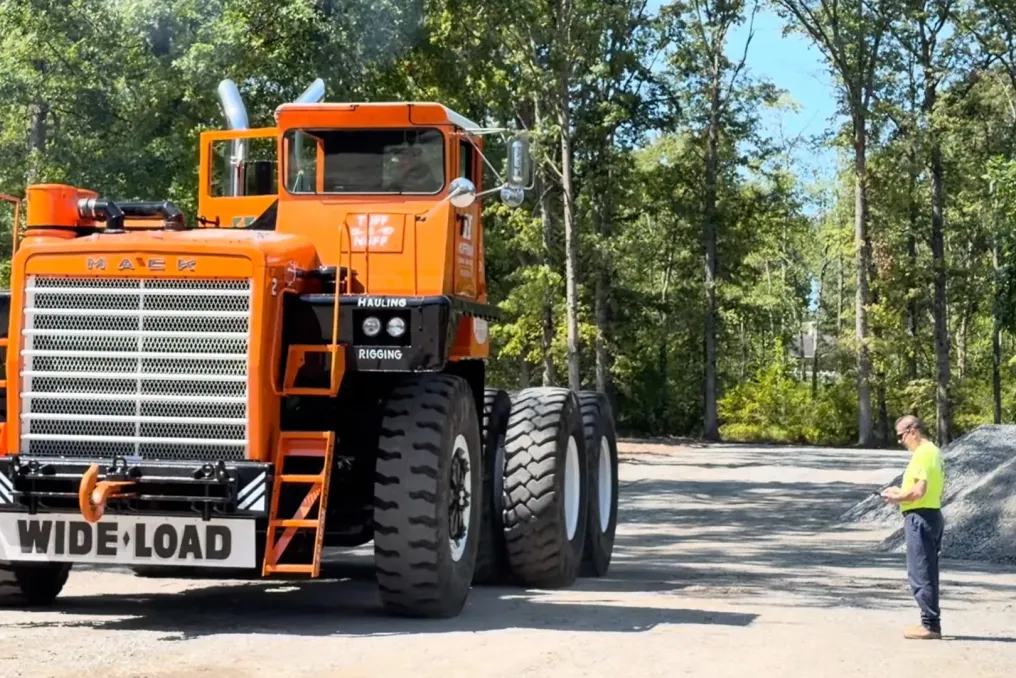
Regardless of the preference for compact and agile vehicles, it is impossible to ignore the fascination with gigantic motorized machines, designed to perform extremely specialized tasks that require highly qualified operators.
Mining machinery can reach impressive dimensions, reaching 15 meters in length, almost eight meters in height, and weighing over 200 tons, with a gross weight exceeding 600 tons. Trucks like the Caterpillar 797F exemplify this scale, utilizing the Cat C175-20 ACERT engine, a four-stroke engine with 20 cylinders and four turbochargers, displacing 105.8 liters and generating 4,055 hp (3,845 hp net) at 1,750 rpm, plus 1,682 kgfm of torque. Its consumption is measured in volume, as the tank holds 3,800 liters of diesel oil, consuming between 5,500 and 6,000 liters in a working day.
Although the Caterpillar 797F sets the current standard for brute force in mining, the sovereign of the 1960s was the Mack M100SX. Even nearly 70 years after its production, the M100SX remains the largest truck manufactured by Mack. These Mack road trucks are notorious for being gigantic, and the M100SX even surpasses larger road models.
The specifications of the M100SX include 9.78 meters in length, 4.26 m in width, and 4.11 m in height; even without the steel body, the chassis weighs 43.3 tons. When loaded to its maximum payload capacity of 100 tons, it reaches a gross weight of 150.5 tons.
The M100SX was part of the M Series, an industrial structure developed by Mack in the 1950s and 1960s to dominate the global mining and heavy construction markets. Previous models, such as the M30, M45, M65, and M85, indicated the nominal load capacity in tons.
Advancement in each model required increasingly complex structural solutions, including the use of high-strength steel in the chassis and V-reinforcements in the bodies to absorb impacts from giant rocks. The biggest challenge, however, lay in propulsion. While smaller models used conventional diesel engines (often from partners like Cummins), the M100SX required an extreme power plant.
The choice fell upon the legendary Detroit Diesel 12V149T. Detroit Diesel, founded in 1938 as a heavy engine division of General Motors (GM Diesel), aimed to create powerful, compact, easy-to-repair, and durable diesel engines for use in war tanks and heavy machinery.
The two-stroke diesel engine family from Detroit Diesel is highly admired for its architecture, which allows it to deliver maximum power with reduced physical dimensions. In a two-stroke engine, combustion occurs with every piston downstroke, resulting in a linear and instantaneous power and torque delivery comparable to a four-stroke V24 engine.
Due to the absence of a dedicated cycle for fresh air intake and gas exhaust, the two-stroke Detroit engine requires continuous forced induction, using a roots-type mechanical compressor. This combination earned it the nickname 'Screaming Jimmies' due to the sharp and deafening sound it produced.
These engines were widely used in road trucks from renowned American manufacturers, such as Peterbilt, Kenworth, International, and Mack. Within the Mack hierarchy, the 149 Series represented the pinnacle. The 12V149T code describes an engine with 12 V-cylinders, with 149 cubic inches (2.44 liters) per cylinder. The total displacement was 29.3 liters, generating 1,000 hp and 345 kgfm of torque at 1,900 rpm, assisted by two turbochargers and a roots compressor.
To operate such a massive engine, the M100SX utilized an Ingersoll-Rand pneumatic starting system. The V12 block and its components occupied the entire width of the chassis, forcing Mack to position the operator's cab entirely on the right side.
Braking such mass, even at low speeds, required a robust system. Mack implemented a dual and redundant pneumatic system, with two independent compressed air circuits to prevent catastrophic failures. The parking brake operated with high-pressure springs to maintain the lock, releasing the wheels only with compressor air pressure.
To alert the driver of any pressure loss, the M100SX featured the Wig-Wag visual alert: a metal rod with a red indicator light on the cab roof. As long as the pressure was normal, a pneumatic pin kept it hidden; in case of pressure drop, the rod would fall, serving as an immediate physical warning.
The transmission of all this power was ensured by a chassis of double laminated steel longitudinal beams and oversized Twin Disc drive shafts. The M100SX platform was also adapted for transporting oversized loads, replacing the body with a fifth wheel, allowing companies like Texas Transport Systems to couple gigantic semi-trailers.
These setups could have up to seven axles (2+4 or 3+4 configurations), totaling between 48 and 56 tires, with an estimated load capacity between 450 and 500 tons, transporting industrial parts such as electrical transformers weighing over 300 tons.
Only three units of the M100SX were produced in the second half of the 1960s, and only one survived. This specimen, completed in April or May 1967, received the chassis number 'M100SX1003' and was delivered to Hoffman Rigging and Crane in New Jersey on January 21, 1970. Subsequently, it was used in Texas for Mashburn Trucking, where it was modified for enormous trailers. Due to its calibration for tractive effort, its maximum speed was only 46 km/h, which meant the return trip from Texas to the East Coast took two weeks driving at 40 km/h. Back in New Jersey, the M100SX was crucial for the expansion of Newark Airport.