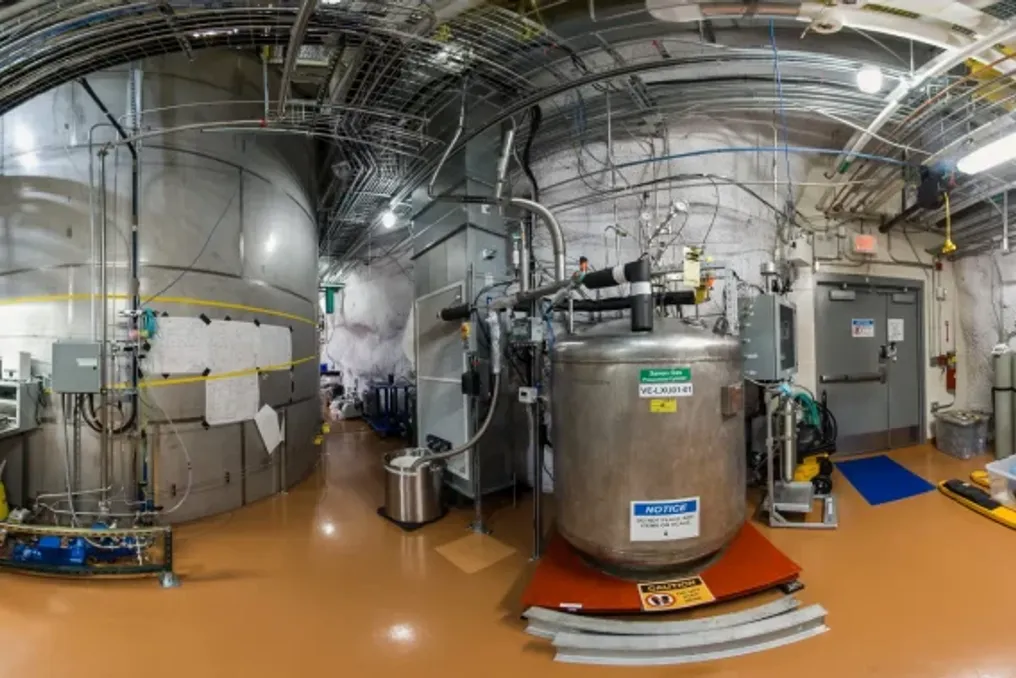
Scientists have registered an event that may contribute to the search for dark matter. This signal was recorded in the LUX-ZEPLIN (LZ) experiment, which is located 1.6 km underground in an old gold mine in South Dakota, USA.
The observed behavior corresponds to an interaction involving a WIMP particle and a xenon atom. However, there is a hurdle: it was only a single event. Therefore, researchers do not yet consider this result a detection of dark matter.
The LZ experiment was designed to detect extremely rare interactions between hypothetical dark matter particles and ordinary matter. The equipment contains 10 tons of liquid xenon.
If a WIMP collides with the nucleus of a xenon atom, the collision can cause a faint flash of ultraviolet light. The impact also leads to a slight displacement of the nucleus, known as nuclear recoil. This is the type of interaction that appeared in the data obtained.
The result was presented at a scientific conference in Japan and described in a study submitted to the journal Physical Review Letters.
Key Findings of the Study
Sam Eriksen, a particle physicist from the University of Bristol in the UK and the study's lead author, characterized this result as an important suggestion. He noted: 'We observed something interesting that we want to share with the scientific community to get their opinions.'
Everything we can observe directly—from stars and planets to people—belongs to ordinary matter. It accounts for about 15% of all matter in the Universe. Most of it, conversely, is dark matter. It does not emit or reflect light, making direct observation impossible. Nevertheless, its presence is manifested in gravitational effects acting on galaxies and galaxy clusters.
One hypothesis suggests that dark matter formed from particles that arose at the beginning of the Universe. WIMPs are among the candidate particles being investigated.
Scientists are searching for signs of this cosmic component through various avenues. Since only one event was recorded, it is insufficient to reach the statistical level required to confirm a discovery. Researchers must now check whether the signal has another source.
Need for Caution
Eriksen emphasized: 'With one event, we do not want to rush. We are not claiming to have discovered dark matter.'
Astrophysicist Alvine Kamaha from UCLA, a co-author of the study, also stressed the need for extreme caution: 'We might be observing something extraordinary, but we need to be extremely rigorous before drawing such a conclusion.'
Thus, this result does not solve the mystery of dark matter. It merely adds an unusual event to the LZ data, and future analyses will determine if there is anything truly new behind the signal.