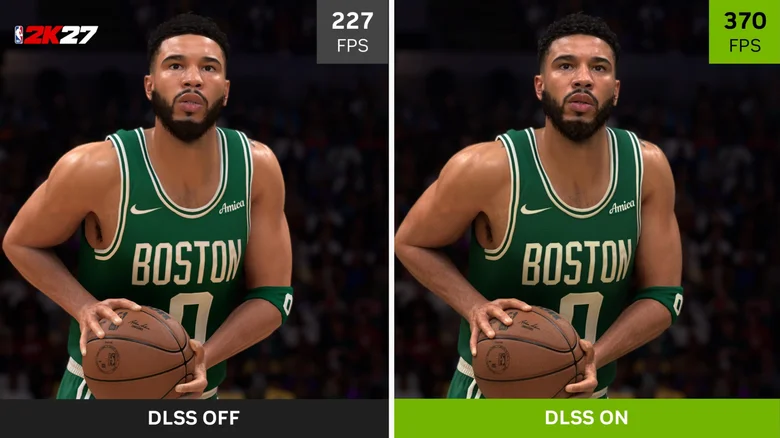
Nvidia launched DLSS 5 this week, a new iteration of its neural rendering technology. This feature will initially be presented in the game NBA 2k27 on Thursday, September 3rd, and will only be accessible to owners of GeForce RTX 50 series graphics cards or subscribers of GeForce Now.
Although revealed in March and facing various criticisms, even becoming a subject of ridicule on social media, Nvidia assures that DLSS 5 uses neural rendering to bring graphics closer to photorealism in real time. Edward Liu, the company's director of applied research, explained that this technology reduces the difference between conventional rendering and the physical simulation of the real world.
Unlike applying a mere filter to the final image, Nvidia's new technology examines minute scene data through the G-Buffer. This complex dataset covers primary colors, depth perception, material roughness, and motion vectors.
To ensure fluidity during gameplay, DLSS 5 has been optimized to process each frame individually, preventing screen latency. Additionally, developers will receive specific scene tools, allowing them to apply masks in the graphics engine to isolate elements and adjust parameters with precision.
Among the available adjustments are structure intensity, which enhances reflections and ambient occlusion, and tone intensity, focused on dynamic contrast and lighting control.
Achieving the graphical level expected by Nvidia requires robust hardware. When DLSS 5 was shown to the public in March, the technical demonstration required the simultaneous use of two GeForce RTX 5090 cards. However, the system has received optimizations over the last six months.
Currently, the feature can be operated on a single mid-range GPU, such as the GeForce RTX 5060. To do this, one must play at a lower resolution, such as Full HD (1080p), and enable 6x frame generation. Without this support, the technology consumes significant processing power and can halve raw performance.
This hardware requirement became clear before the official launch. The modding group RenoDX managed to extract DLSS 5 files from a beta version of NBA 2K27 and forced the activation of the feature in older titles, such as Control, Cyberpunk 2077, Grand Theft Auto V, and Skyrim.
Unofficial tests released online showed high video memory (VRAM) consumption and significant frame rate drops. Despite being officially limited to the RTX 50 series, these same tests allowed its activation on top-tier previous-generation cards, such as the RTX 4080 and RTX 4090.
The community's reception to the initial presentations of DLSS 5 was divided. Many users criticized changes perceived as drastic in character appearance, expressing concern that artificial intelligence might distort the original artistic intent of the studios by generalizing facial expressions and textures.
In response to these objections, Jensen Huang, NVIDIA's CEO, stated that players were mistaken in assuming the technology removed creators' control. Gabriele Leon, NVIDIA's content technology director, corroborated this position, clarifying that the tool was designed to offer consistency without altering the visual essence of scenes and protagonists.
At the initial stage, the results observed in NBA 2K27 show more subtle improvements in material shading, enhancing details such as jersey texture and athlete skin.
Looking ahead, Nvidia plans to expand DLSS 5 compatibility to a wide range of games, including titles such as Assassin’s Creed Shadows, Hogwarts Legacy, and Starfield.