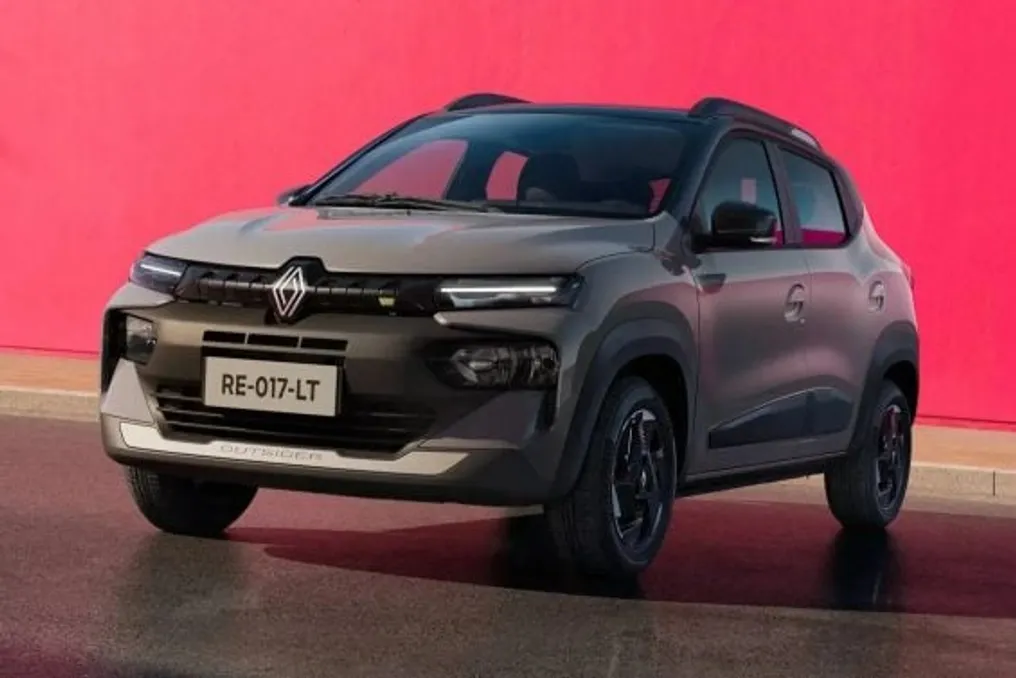
The restyled Renault Kwid, available in Brazilian stores, has an initial price of R$ 82,790. In contrast, in India, where the same model is manufactured and sold, the hatchback has a starting value of 4.53 lakh rupees, which corresponds to approximately R$ 24 thousand. Although both vehicles share the platform, three-cylinder engine, and general concept, the cost of the Brazilian model is almost three times higher.
This price disparity is due to both content and accounting, but the largest contribution is tax-related. Anfavea points out that Brazil has the highest automotive tax burden globally. According to the association, taxes such as IPI, PIS/Cofins, and ICMS represent between 24.7% and 32.3% of the value of a gasoline car, depending on the engine. If we consider taxes embedded in the chain, the entity's own estimates raise this percentage to 43.7%.
An aggravating factor is the cascading effect of taxes, as each tax is applied to a price that already incorporates previous ones. India followed the opposite path. A reform called GST 2.0, implemented on September 22, 2025, reduced the rate for cars up to 4 meters with a gasoline engine up to 1,200 cm³ from 28% to 18%, in addition to abolishing the cess, a surcharge that ranged from 1% to 22%. Thus, the effective tax burden, which was close to 30%, was reduced to 18%, and manufacturers passed on this reduction, making the Indian Kwid more affordable.
It is important to note that the Indian price is only the ex-showroom price and does not include additional costs such as licensing, mandatory insurance, or state fees. Adding these items, the Kwid can cost between 5.42 lakh and 6.66 lakh in Mumbai, representing an increase of 20% to 47% over the advertised price. One lakh equals one hundred thousand rupees.
The models also have technical differences. The Brazilian Kwid uses a 1.0 flex engine, generating 68 hp on gasoline and 71 hp on ethanol, and has been updated with a 10.1-inch multimedia center and a 7-inch digital instrument panel. The Indian model runs only on gasoline, had a more discreet redesign in July, and is offered in two versions: Evolution and Climber. In terms of safety, the 2026 Indian line offers six airbags.
Market scale also influences prices. In Chennai, Renault competes in a market where the Maruti Suzuki Alto K10 costs 3.50 lakh, putting downward pressure on the price. In the Ayrton Senna Complex, in Paraná, the Brazilian Kwid shares the environment with suppliers, salaries, and charges of another magnitude.
In Brazil, the line prices are R$ 82,790 for the Evolution version, R$ 87,590 for the Techno, and R$ 91,890 for the Outsider. Due to the launch, the entry-level version is available on promotion starting from R$ 71,190. The CMF-A platform, dated 2015, and the five-speed manual transmission remain unchanged.