As the cities of Saudi Arabia undergo expansions driven by ambitious cultural projects, the firm Syn Architects concentrates much of its work on analyzing what precedes this transformation. The firm's participation in the Venice Architecture Biennale in 2025 resulted from years dedicated to documenting Najdi architecture, a declining urban fabric, as well as studying local materials and forms derived from traditional knowledge. For Syn, the value of heritage lies in its capacity to be recorded, tested, and reintegrated into practical use.
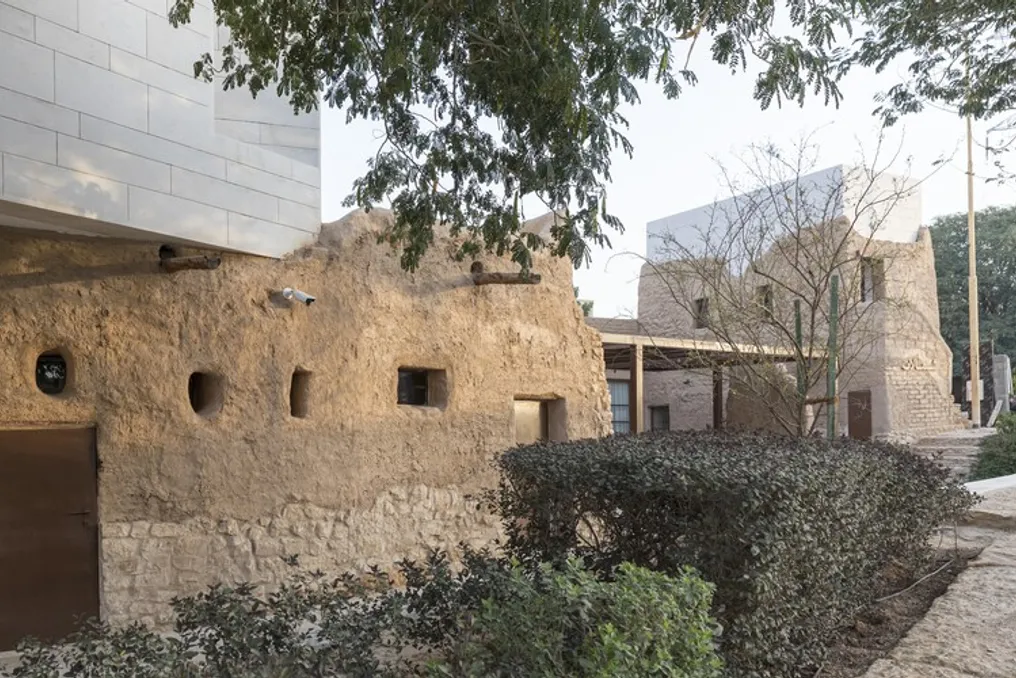
This philosophy was exemplified at the Shamalat Cultural Center, a 615 square meter intervention located in the peripheral area of Diriyah. This project began with an old earth house, acquired and transformed into a cultural center by Saudi artist Maha Malluh. The development occurred in two stages: restoration and expansion. Part of the original earth structure was maintained, while a new volume was added around the old courtyard, organizing itself alongside the remains of the adobe wall. Riyadh stone serves as an intentionally modern backdrop for the textured earth walls. The main focus of Shamalat is what the two phases allow the building to house, enabling it to remain functional by offering galleries, an artist residency, a darkroom, and workshops, rather than becoming just a static historical artifact.
The concern for keeping existing architecture active extended beyond isolated buildings. In 2020, Syn co-founded SaudiArchitecture.org, a non-profit organization dedicated to researching and documenting modernist and postmodernist constructions across the country, especially those at risk of demolition or considered of great architectural relevance. The organization's collection is not limited to the adobe brick architecture typically associated with Saudi Arabia, but also encompasses modern buildings that deserve documentation before they disappear.
This same impetus gained a more defined investigative character through the Um Slaim Collective, established in 2021 by partners Sara Alissa and Nojoud Alsudairi. This collective investigates the evolution and displacement of Najdi vernacular architecture in downtown Riyadh, combining observation and documentation with the practice of designing new architectural projects.
This fusion of research and design was crucial to Syn's recognition by ArchDaily as one of the Best New Practices in 2024. The selection highlighted the firm's involvement with Saudi Arabia's local architectural legacy and contemporary spatial approaches, presenting it as a reflective alternative to the futuristic imagery often linked to the Kingdom's architectural development. The recognition emphasized a specific working method: meticulously studying the existing environment so that this research shapes future architectural projects.
Syn's method also extends to experimentation, going beyond mere preservation. At the Islamic Arts Biennale in Jeddah in 2023, the project 'Anywhere Can Be a Place of Worship' used natural elements such as sand and palm leaves to create a temporary architectural intervention. This work drew inspiration from temporary prayer sites historically created during pilgrimage routes, where occupation and ritual were as important as the physical structure itself.
A year later, the firm shifted from the field of cultural memory to geological memory with 'When the Earth Began to Look at Itself' in Desert X AlUla. Instead of inserting an autonomous object into the landscape, Syn excavated a long, narrow path in the desert, using the removed earth to form rammed earth retaining walls and a communal space in terraces. The project arose from a question of how architecture could establish a physical connection with the geological formation of AlUla.
In both cases, the pre-existing condition dictates the starting point of the architecture: in Shamalat, it was an earth building; in AlUla, it was the soil itself. The team describes its work through material gestures, time, memory, and occupation, utilizing found forms. Thus, the meaning of the intervention changes depending on the location and the people who frequent it.
Up to 2025, these issues expanded to a national and international sphere. Syn's contribution to the Saudi Pavilion at the Venice Architecture Biennale, titled 'Um Slaim School: An Architecture of Connection,' derived directly from the collective's research on Najdi architecture. The pavilion functioned as a living archive and simultaneously proposed a model for an alternative pedagogical initiative in Riyadh, placing architectural investigation in dialogue with situated knowledge and new teaching methodologies.
Research became an intrinsic part of the firm's production, manifesting through documentation, public learning, and forms of knowledge that transcend a single project. The Venice pavilion consolidated the idea that architectural knowledge can arise from collective investigation, and not just from formal institutions, continuing the work initiated by the Um Slaim Collective.
Currently, the firm also participates in projects of very diverse scales. Syn collaborates on the Royal Diriyah Opera House, a 46,000 square meter cultural complex designed by Snøhetta, scheduled to open in 2028. This project is deeply rooted in the surrounding desert landscape, Najdi construction traditions, and the historical context of Diriyah, with Snøhetta responsible for defining Syn's essential role in deepening the contextual understanding of the proposal.
In summary, while the challenge at Shamalat was keeping an existing building active, SaudiArchitecture.org and the Um Slaim Collective expanded this investigation to documentation and research. Temporary installations tested the potential of ritual, matter, and landscape as architectural factors. In Venice, research gained a public stage. Today, with the Royal Diriyah Opera House, Syn is involved in a cultural project of a completely different magnitude. What has evolved is the diversity of scenarios where this method can be applied: the firm navigates between restoration, research, archiving, installation, education, and large collaborations, treating all these aspects as components of a unified practice. This mode of operation gains special relevance in the rapidly transforming landscape of Saudi Arabia, as architecture does not always need to start by defining what is new; often, its starting point is dedicating enough attention to what already exists and questioning its future potential.