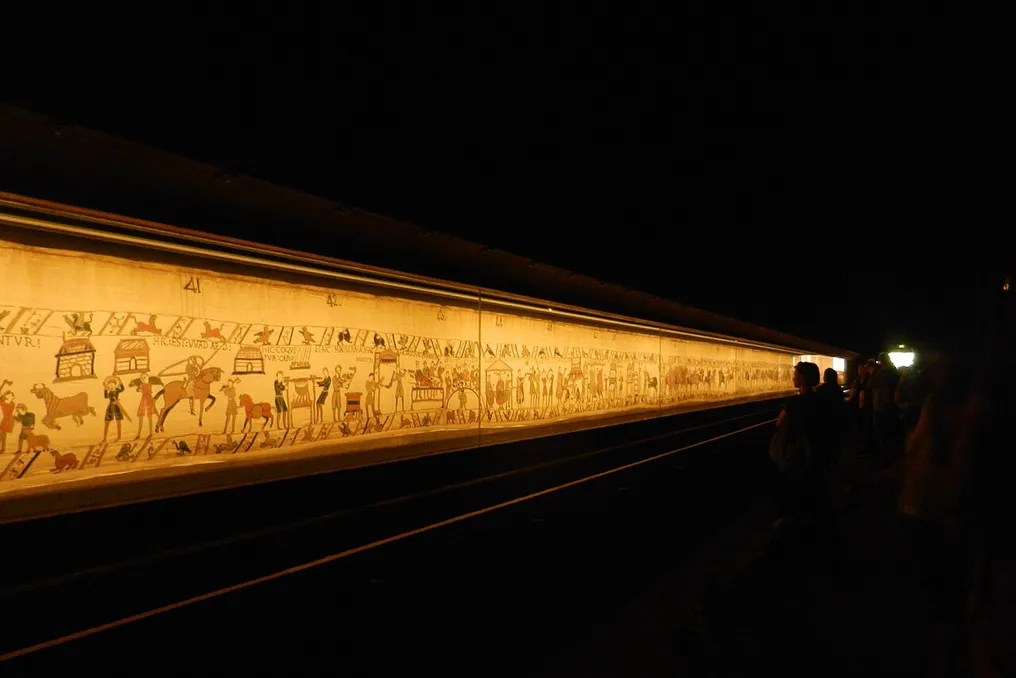
The Bayeux Tapestry, a medieval work of art recounting a key episode in English history, returns to England for the first time in nine centuries. This embroidery, created in the 11th century, was long kept in the French town that gave it its name.
Starting in September, the artifact will be available for viewing in England at the British Museum. This unprecedented loan will allow the historical object to be exhibited until July 2027.
The possibility of the display resulted from the reconstruction of the Musée de Bayeux, located 260 km from Paris, where the tapestry was traditionally exhibited. The French institution was closed last August for works and plans to reopen only in the second half of 2027, after which the tapestry will be returned.
Until now, London residents will have the chance to see this tapestry in the country it narrates, something that has been impossible for almost a thousand years.
Description and Historical Significance
The Bayeux Tapestry is an example of medieval art used both to record historical events and to decorate the walls of palaces of that era. It depicts the Norman conquest of England in 1066. This event forever changed the trajectory of the country's development in subsequent centuries, ending Anglo-Saxon rule and placing on the throne a king known as William the Conqueror.
The exact time of the tapestry's creation is unknown, but it is presumed to have been embroidered in the decade following the battles, possibly as a gift to William (William in English). Apparently, the work was made in England. Nevertheless, William was the Duke of Normandy in France before becoming King of England after the conquest in 1066. The tapestry remained on the other side of the English Channel, in its original location: Bayeux, a town that is still in the Normandy region of France.
From a practical standpoint, the Bayeux Tapestry measures about half a meter high and 70 meters long. Although similar works could reach impressive sizes, the one recounting the Norman conquest is not the largest of its period. The record among medieval tapestries belongs to the Apocalypse Tapestry, embroidered between 1377 and 1382 and displayed in the city of Angers in France; surviving parts of this tapestry measure 103 meters long and reach 4.5 meters in height.
The Bayeux Tapestry will be exhibited at the British Museum from September 10, 2026, to July 11, 2027, in Gallery 30 of the Sainsbury Exhibition Hall. The venue is open to visitors from Sunday to Wednesday from 10:00 to 18:00, and from Thursday to Saturday from 10:00 to 21:00.
Important Note
Visiting the museum, which is free, does not grant access to the gallery where the tapestry will be displayed; tickets must be purchased separately, starting from £25. Getting tickets is difficult: they are completely sold out until the end of 2026. Visitors should monitor the official museum pages to learn about the start of sales for the following year.