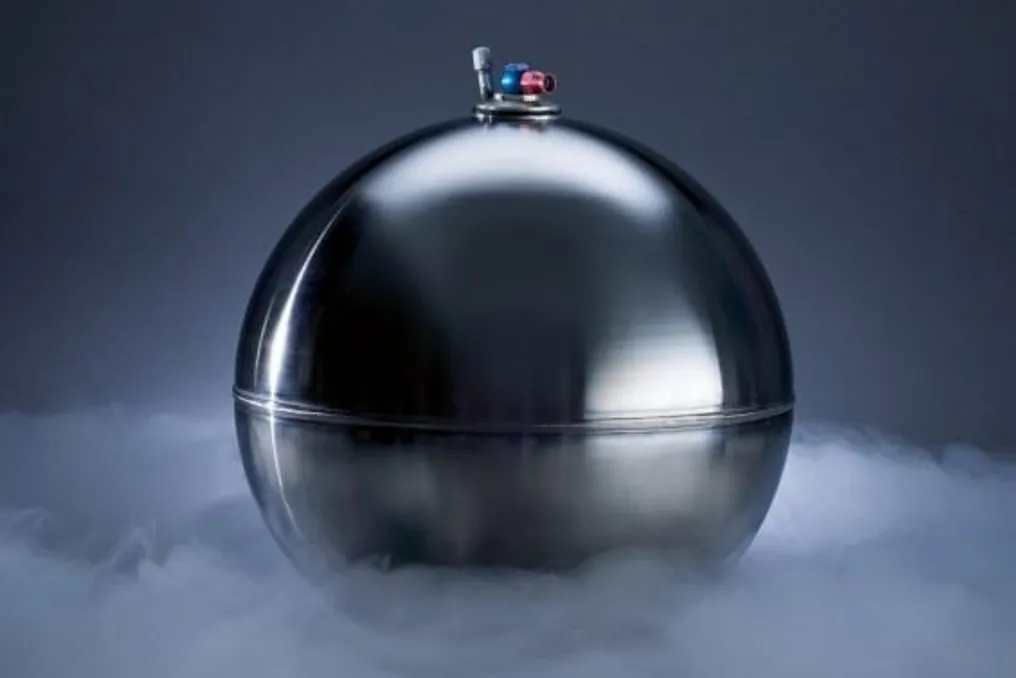
The Porsche 909 Bergspyder employed a spherical fuel reservoir made of titanium, sized like two soccer balls and secured by three straps, with the specific goal of reducing weight by seven kilograms. Porsche recently reviewed the history of this racing car, recognized as one of the lightest ever manufactured, and its unique operating system.
The launch of the 909 occurred on September 8, 1968, during the ascent of Gaisberg, which represented the penultimate stage of the European Mountain Championship, held in timed uphill competitions. The vehicle weighed approximately 400 kilograms, measuring 3.48 meters long, almost 1.80 meters wide, and 75 centimeters high.
Internally, inside the titanium casing, whose wall thickness was only 0.8 mm, there was a rubber bag where the gasoline was stored. Before the race, mechanics injected nitrogen into the space between the bag and the titanium, reaching a pressure of about 15 bar. A tube connected this assembly to the mechanical injection pump.
This gas pressure assumed the function normally performed by the fuel pump, responsible for sucking fuel from the tank and propelling it to the engine. By eliminating this pump, the 909 managed to save up to seven kilograms. The choice of the spherical shape was not arbitrary; it represents the ideal geometry for distributing internal pressure, allowing the use of the thinnest possible wall without risk of rupture.
The rest of the car followed a similar line of reasoning regarding lightness. The body was made of fiberglass and weighed 10 kilograms. Springs and brake calipers were constructed from titanium, the chassis was an aluminum lattice structure, the engine contained titanium and magnesium components, and the brake discs were made of beryllium, a material known for being light, rigid, and expensive, but which is now avoided due to powder toxicity.
The engine was a two-liter block with eight opposed cylinders, generating 275 horsepower. This configuration allowed the 909 to reach 100 km/h in 2.5 seconds, capable of reaching up to 250 km/h, depending on the gear ratio. Its power-to-weight ratio of 1.4 kg/hp approached the standards of Formula 1 of that era.
The internal arrangement was also quite innovative. The differential was positioned at the rear end, while the seat, engine, and five-speed gearbox were moved to the front. As a result, the driver's feet were located in front of the front axle, surrounded only by thin aluminum tubes and the plastic bodywork.
However, the experiment was not successful on the track. During the Gaisberg race, the engine suffered hiccups due to an excessively rich mixture and failed, resulting in Rolf Stommelen finishing third. In Mont Ventoux, France, the team opted to combine the sphere with a traditional gasoline pump, and Stommelen won second place. This was the last race for the model, as Porsche withdrew the car from the mountain championship to focus on the World Sportscar Championship and Le Mans. Only two 909 models were produced.
The weight distribution tested in the 909 was later applied to the 908/3 model, which proved nearly invincible on the winding courses of the Nürburgring and Targa Florio in 1970. With a total of nine titles in the European Mountain Championship, Porsche accumulated great achievements.