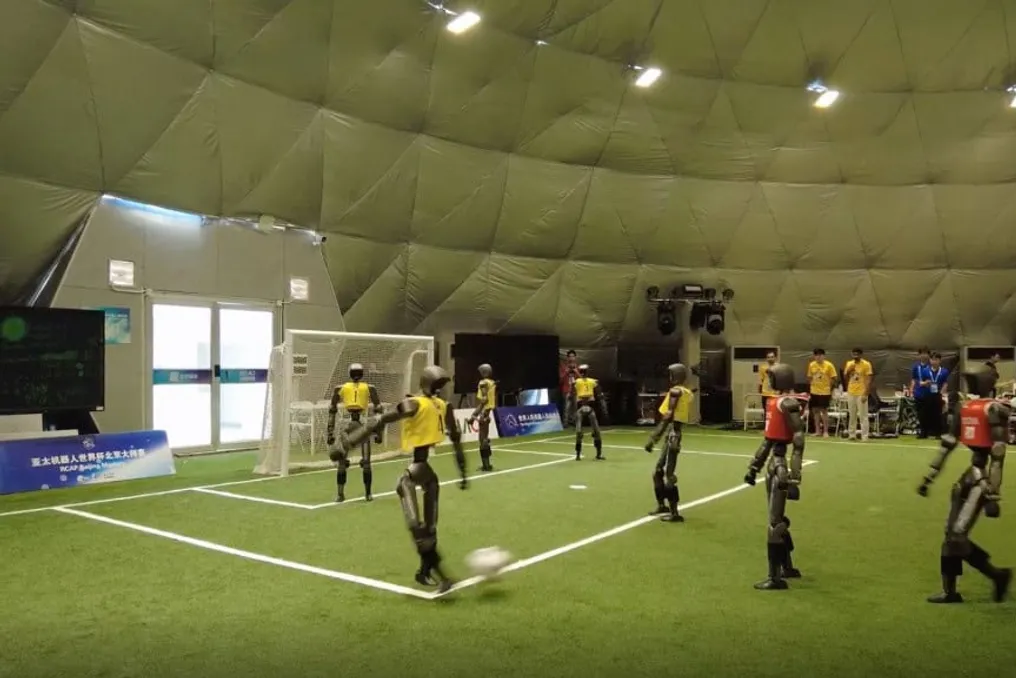
The second edition of the World Humanoid Robot Games, held in Beijing, concluded last week, featuring competitions in 51 different disciplines. In this event, the Brazilian robot team achieved remarkable performance in football, emerging as the tournament champion among international teams after defeating Italy in the grand final.
On the field, the robots had to demonstrate complex skills, such as environmental identification, controlling their own movements, and the ability to work together. The Brazilian success was led by Flávio Tonidandel, a robotics researcher and Vice President of RoboCup Brazil. Speaking to Olhar Digital, Tonidandel mentioned one of the biggest challenges: the use of novel robots provided by Booster Robotics, which were responsible for the football robots.
These robots utilized the T2 model, which had been distributed for programming by the teams. According to Tonidandel, although the robots came with basic functionalities, such as pre-trained kicks, locomotion, and balance, the goalkeeper showed poor performance, requiring participants to work intensively on various parameters to adjust it.
The approach adopted by Brazil consisted of replicating tactics observed in traditional football. For this, each robot was assigned a specific function that needed to be executed, as detailed by Isabela Moura, a student at the Federal University of Pernambuco (UFPE) and a member of the Brazilian team. She explained that the team divided tasks, with people focusing on the goalkeeper, the attacker, and the positioning of the robots.
Initially, the team's work was based on three-on-three games, but the competition required a five-on-five format, forcing consideration of more robots and functions during the matches.
During the international final against Italy, a robot designated as the leader was tasked with constantly chasing the ball. Guilherme Escudeiro, a student at FEI University Center, in São Paulo (SP), reported that initially there was apprehension due to the lower responsiveness of the Brazilian leader compared to the opponent, who seemed to reach and kick the ball more quickly. However, after the team adjusted its defense, its actions were effective, allowing the Brazilian leader to consistently regain possession of the ball. The opponents noticed this change and questioned the Brazilian team about what they had implemented.
Currently, the Brazilian team is preparing for the next edition of the event with the goal of achieving a two-time championship.
The second edition of the Humanoid Robot Olympics in China recorded other notable achievements. In athletics events, the Chinese robot Tiangong Ultra surpassed the human record for the 100-meter dash, completing the distance in just 8.64 seconds, which is almost a second faster than the human mark of 9.58 seconds set by Usain Bolt in 2009.
The attraction generated by robots breaking human records serves as a goal for future editions in the Asian country, but the purpose of the tournament goes beyond races or jumps. A crucial challenge for robotics and technology companies at the 2026 World Games is demonstrating the practical utility of their models, showing that they can be applied both in industrial production lines and domestic environments.
Of the 51 events, 30 were sports-related (including athletics, football, and table tennis), while 21 were based on practical scenarios, such as rescue, hospitality, and factory tasks. Overall, the event served as a showcase for the notable advancement in the physical power and speed of the models, despite some moments generating viral content.
However, humanoid robots still face difficulties in two essential aspects for their real-world application: autonomy and fine precision. Only after overcoming these obstacles can the models operate outside highly controlled environments.
Anderson Moreira, Professor of Control and Automation Engineering and coordinator of the robotics team at Mauá Institute of Technology, commented that 'a house is, from a robotics point of view, much more unpredictable than a factory.' The professor also emphasized that 'a competition demonstrates technological capability, not industrial maturity,' distinguishing athletic record breaking from real utility in a factory context.