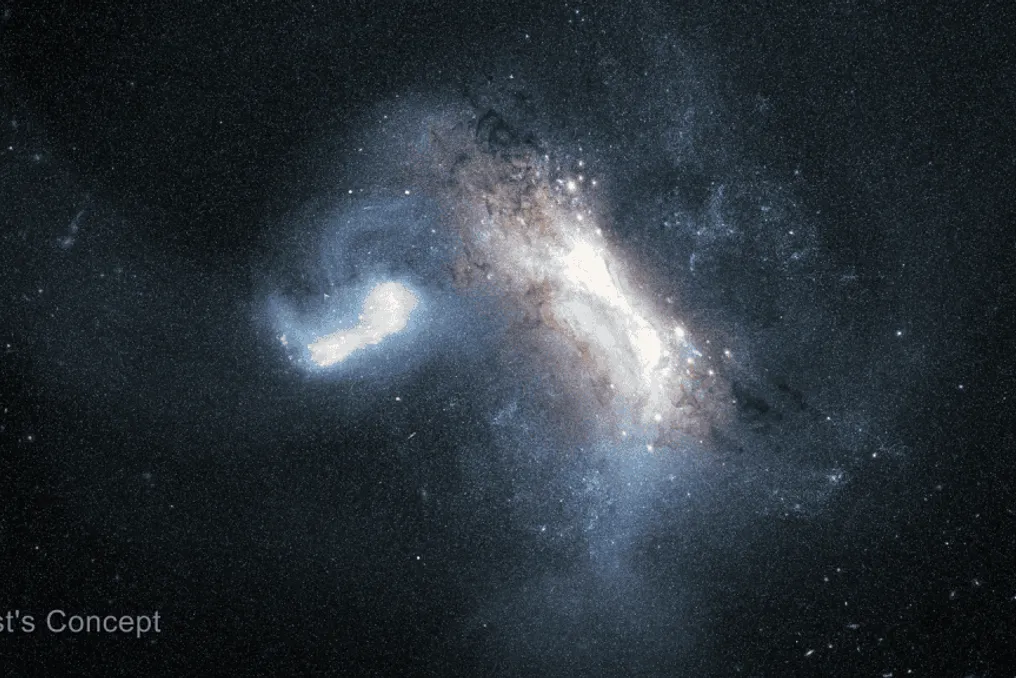
The Milky Way absorbed an ancient galaxy approximately 12 billion years ago when it was in its early stages of formation. Currently, astronomers have been able to reconstruct this episode in greater detail by studying star clusters that retained traces of that past.
In an article published in The Conversation, astrophysicist Sven Buder from the National University of Australia explains how new research led by David Massari allowed for an estimation of the merger time and the characteristics of the absorbed galaxy.
Galaxies grow partly through mergers. When a smaller system approaches a larger one, gravity disperses its stars. However, some of these stars continue to bear characteristics that reveal their origin.
These are the records that astronomers are trying to decipher in the Milky Way. One known example is Gaia–Sausage–Enceladus (GSE), which resulted from a major merger that occurred about 10 billion years ago.
The new research went even further back in time. Researchers linked this event to stellar populations previously known as 'Kraken,' 'Heracles,' and the 'low-energy group.' The structure compiled based on this data was named Low-energy–Kraken–Heracles (LKH).
The team studied globular clusters—structures capable of housing hundreds of thousands of stars formed around the same period. Detailed observations using the Hubble Space Telescope helped determine their relative ages.
Metallicity was also included in the analysis. This term refers to the presence of elements heavier than hydrogen and helium, which are formed and accumulated over generations of stars.
Comparing this information revealed three distinct sequences. The authors calculated that the LKH collision occurred approximately 1.8 billion years before GSE. The galaxy involved in the collision had stars equivalent to about 500 million Suns, corresponding to the stellar mass of GSE. A significant portion of this material ended up in the inner regions of the Milky Way.
Previous studies already pointed to this merger. But now it has been possible to better define its timeframe and understand the history of the involved galaxy in more detail.
Thus, one can ask not only when these galaxies collided, but also what they were like and how they evolved before that?
Sven Buder, an astrophysicist from the National University of Australia, notes in his article in The Conversation that there are caveats: not every primitive galaxy necessarily formed many globular clusters, and some may have disappeared. Reconstruction also depends on models.
The James Webb Space Telescope provides another piece of this puzzle by observing distant galaxies as they were more than 12 billion years ago. In the Milky Way, however, astronomers can study the surviving stars and clusters from that same era.
More information:
Buder explains: 'Extragalactic astronomy gives us snapshots of young galaxies. And 'galactic archaeology' gives us their fossils.'
Combining these two approaches helps transform the first billion years of the Milky Way's existence, which were previously perceived as very vague, into an increasingly detailed history of our galaxy's growth.