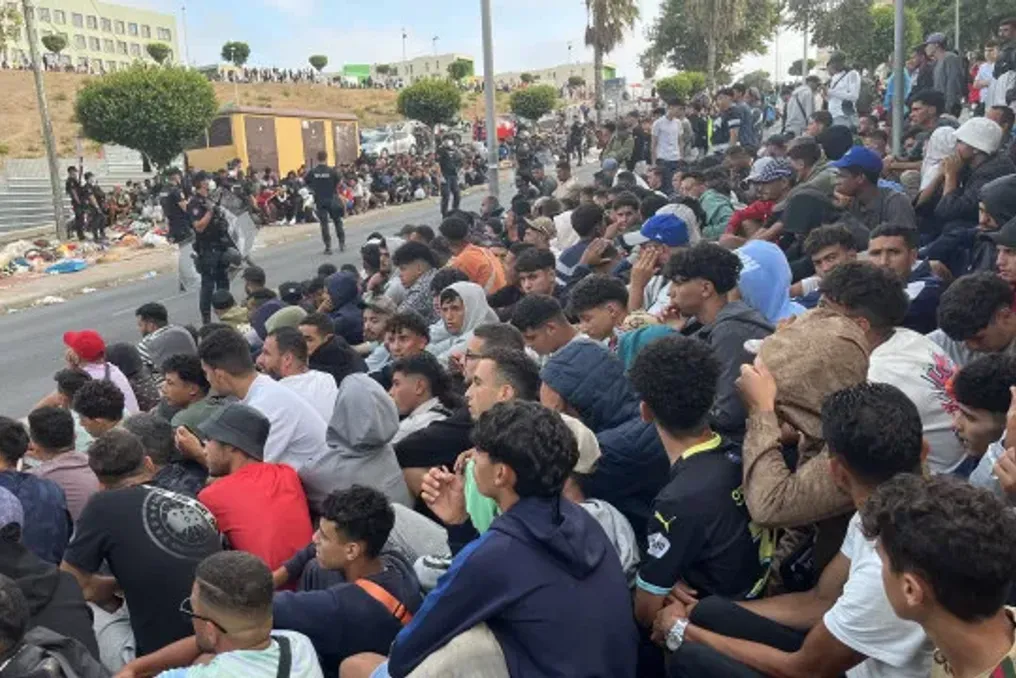
The Spanish Government approved a 'shock plan' worth 309 million euros for Ceuta, aimed at addressing the migratory and humanitarian crisis in the city, as well as the economic impact generated by the illegal entry of 72,000 individuals.
The spokesperson for the autonomous city government, a Spanish enclave located in North Africa with a border with Morocco, told journalists that he could not assess whether the amount of money was adequate, as the primary focus should be the return to normalcy. He emphasized that there is still a long way to go, facing daily crises and incurring new costs without the total investment having been evaluated.
Alejandro Ramírez maintained that the restoration of normalcy in Ceuta will only be achievable through the repatriation of people remaining in the city, including thousands who are still on the streets due to a lack of places for registration and temporary accommodation.
The spokesperson requested the Spanish Government to implement persistent actions and adopt the necessary structural measures to prevent recurrence, in addition to promoting a specific plan with a defined timeline for the returns to Morocco of individuals who illegally entered Ceuta on July 30 and 31.
Ceuta authorities report that there are between 8,000 and 9,000 of these people in the enclave, while the Spanish Government estimates the number to be approximately 5,000. Alejandro Ramírez mentioned that local authorities base their estimates on population data and various associations, but considered that the real number is as low as possible.
He warned that even if the number were 5,000, it would still represent a problem, citing the increase in tension in the city's streets, both among migrants without access to housing or other conditions, and between migrants and the local population.
Ramírez emphasized that, regardless of the amount of resources mobilized to face the migratory and humanitarian crisis, normalcy will only come with repatriation, stating that the funds would be useless without this scenario, according to the Spanish news agency EFE.
Ángel Victor Torres, Minister of Territorial Policy of Spain and responsible for coordinating the crisis in Ceuta, communicated that 3,400 new temporary accommodation spots for migrants were created in recent weeks, bringing the total to 6,000.
Torres explained that only with these accommodation facilities is it possible to register all people who continue to sleep on the streets and initiate the relevant processes, whether for repatriation or for granting asylum, when applicable.
The minister guaranteed that the objective is the return to Morocco of all individuals who illegally entered Ceuta at the end of July, but stressed that this process must occur in accordance with the law, without setting definitive deadlines.
He reported that more than 90% of the people who illegally entered during the July wave left voluntarily in the following days, totaling 3,519 people between August 10 and 31. Torres highlighted the importance of this last piece of data, as it concerns migrants who 'know there is no hope and that they will not receive asylum.'
Additionally, the Spanish Government reported the expulsion of 214 people for committing crimes in recent weeks. Regarding unaccompanied minors, authorities maintain 1,612 records with open processes in Ceuta, of which about 1,200 arrived on July 30 and 31.
Before this crisis, the city had between 500 and 600 spots for temporary accommodation for illegally arriving migrants, and its total population amounts to almost 83,500 inhabitants. Ceuta, a small territory located in the extreme north of Morocco and bathed by the Strait of Gibraltar, constitutes one of the two land borders between Africa and Europe, alongside Melilla.