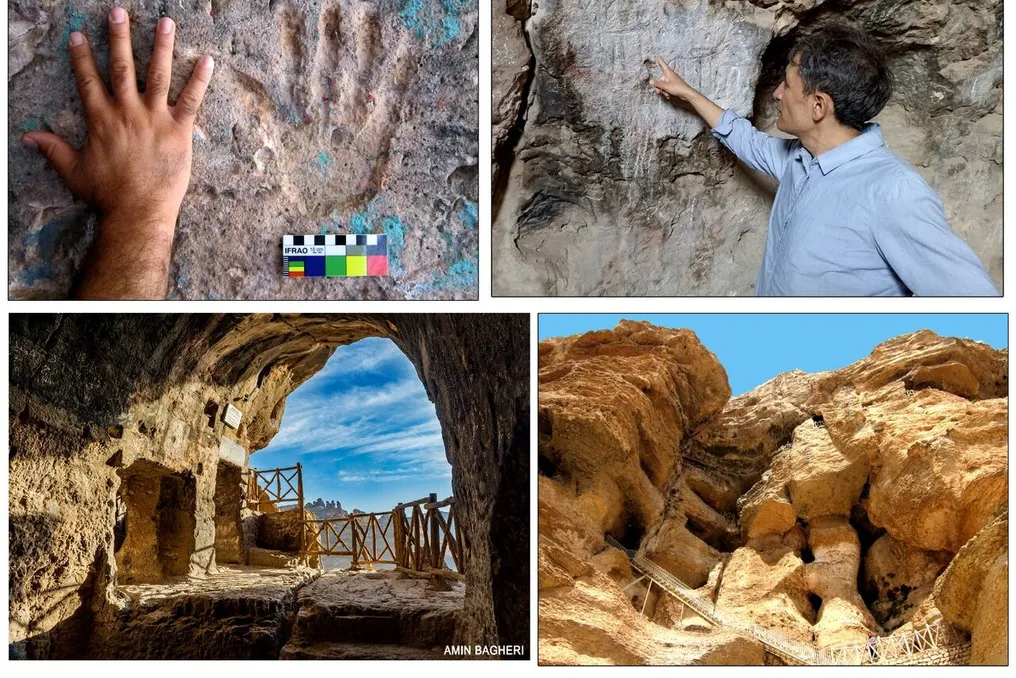
The Karraftu Cave, located in the mountainous limestone region of Kurdistan Province in Iran, is situated approximately 53 kilometers east of Sakkez and 46 kilometers northwest of Divandarreh. This complex represents one of the most enigmatic and significant archaeological sites in the country.
This outstanding ensemble, consisting of natural and artificially carved caves, often referred to as the 'House of Hercules' due to a Greek inscription on the walls, testifies to a multilayered past spanning from the late prehistoric period to the Islamic era. The cave stretches for about 750 meters and is divided into four separate levels, where natural karst formations harmoniously combine with complex troglodytic architecture. Artificial sections include rooms, corridors, stone staircases, windows, and shafts for lighting, demonstrating engineering skills comparable to the architectural traditions of that period.
However, it was the rich collection of rock art and the famous Greek inscription that attracted the attention of archaeologists and historians for nearly two centuries. The first European to write about Karraftu was British military surgeon Dr. John Cormick, personal physician to Prince Abbas Mirza. His unpublished diary later became a source for Robert Kerr Porter's travel notes in 1819, where Porter documented the cave and its inscription.
In 1838, Sir Henry Rowlinson visited the site and provided an improved reading, passing his copy to the topographer William Martin Lyc. Lyc astutely understood that the site was under the protection of Hercules, hypothesized that the two lines might be verses, and dated the inscription to the 4th or 3rd century BCE.
In the summer of 1936, Sir Aurel Stein explored the cave for three days, mapping the chambers and taking a cast of the inscription. This allowed Marcus N. Todd to confirm an early Hellenistic dating, belonging to the late 4th and early 3rd century BCE. Rudolf Naumann and Hubertus von Gall visited the cave in 1975, leading to an improved plan and the creation of the first interior photographs. The inscription above the door of one of the chambers reads: 'Hercules dwells here, no evil shall enter.'
Von Gall, building on earlier hypotheses by Johannes Franz and U. U. Tarn, proposed identifying Karraftu with Mount Sanbulos, mentioned by Tacitus in the 'Annals.' This mountain was located in Media, where local deities were revered during the Parthian conflict between Gotarzes II and his rival Meherdateses around 49/50 CE, among whom Hercules was the principal god. Von Gall supported Stein's conclusion that the rocks matched Tacitus' description, and that the rock chambers functioned as an oracle sanctuary dedicated to a local god whom the Greeks called Hercules.
Referring to comparative materials from Greek sanctuaries, he noted the precisely carved barrel vaults, internal door locking mechanisms, and lintel elements resembling wooden architecture—all signs of sophisticated design. He argued that the limited view and lack of residential quarters excluded a military or purely domestic function, while the remains of a wide staircase pointed to solemn ceremonial processions, and traces of a mihrab confirmed its use in the Islamic period for prayer. Ultimately, Von Gall suggested that the chambers likely served multiple functions: some as halls for feasts and gatherings, others for religious rites, drawing parallels with the Girganni caves described by Strabo, where people gathered amidst picturesque landscapes for sacrifices and pleasures, suggesting that Karraftu also combined the sacred and the social.
Tahar Gasimi, a PhD student in archaeology at Mazandaran University and a leading specialist in Iranian rock art, conducted extensive research in Karraftu. He believes that one of the most serious problems in studying Iranian rock art was the lack of a clear chronological framework. Many researchers traditionally attributed such motifs to the late Pleistocene and early Holocene, but recent field studies, especially in Karraftu, provide new information that may change our understanding.
Gasimi and his colleagues argue that Karraftu can serve as a chronological basis for studying rock art across Kurdistan Province. His previous fieldwork suggests later dates for many motifs, and the findings in Karraftu played a crucial role in recalibrating the regional chronology. The interior walls and surrounding rock shelters are decorated with a diverse set of petroglyphs, which Gasimi's team has categorized into four groups: human figures, animal motifs, complex human-animal forms, and geometric or symbolic patterns. Among the most significant are images of riders shooting backward, a technique known as the 'Parthian shot,' associated with Parthian military tactics.
In his analysis, Gasimi draws parallels with similar images on Parthian and Sasanian silver and gold tableware. Together with the Greek inscription, architectural features, and ceramic finds, he concludes that some complexes of motifs, especially in the man-made spaces, were likely created during the Seleucid-Parthian or Sasanian periods. The cave also contains numerous geometric motifs, including diamonds, circles, horseshoe symbols, and handprints found both inside and in nearby rock shelters. Similar motifs on Iron Age monuments, such as the Kul Tarike cemetery, indicate the continuity of symbolic expression over millennia.
According to Gasimi, the cave seemingly served various functions over time: temporary shelter, place of worship, and refuge during conflicts, although its role as a sanctuary remains particularly important. In November 2022, the site was included in the preliminary list of UNESCO World Heritage Sites, as its unique combination of natural beauty, historical architecture, and artistic heritage makes it a strong candidate for international recognition. Nevertheless, the rock art has suffered greatly from natural erosion and human activity, including graffiti left by visitors over the last century. Fortunately, most of the graffiti was cleaned under the supervision of Ali Khajabari in 2015.
Gasimi's research emphasizes the urgent need for conservation efforts, noting that most surfaces bearing these motifs have been damaged since the late 1800s, making it difficult to distinguish their details. For Gasimi, Karraftu is more than just an archaeological site; it is a living archive of human creativity and faith, a complex of natural caves whose entrances and some passages were modified in the historical (Parthian) period, and whose walls bear witness to the artistic and spiritual expression of peoples who sought refuge and meaning in their chambers throughout the millennia.