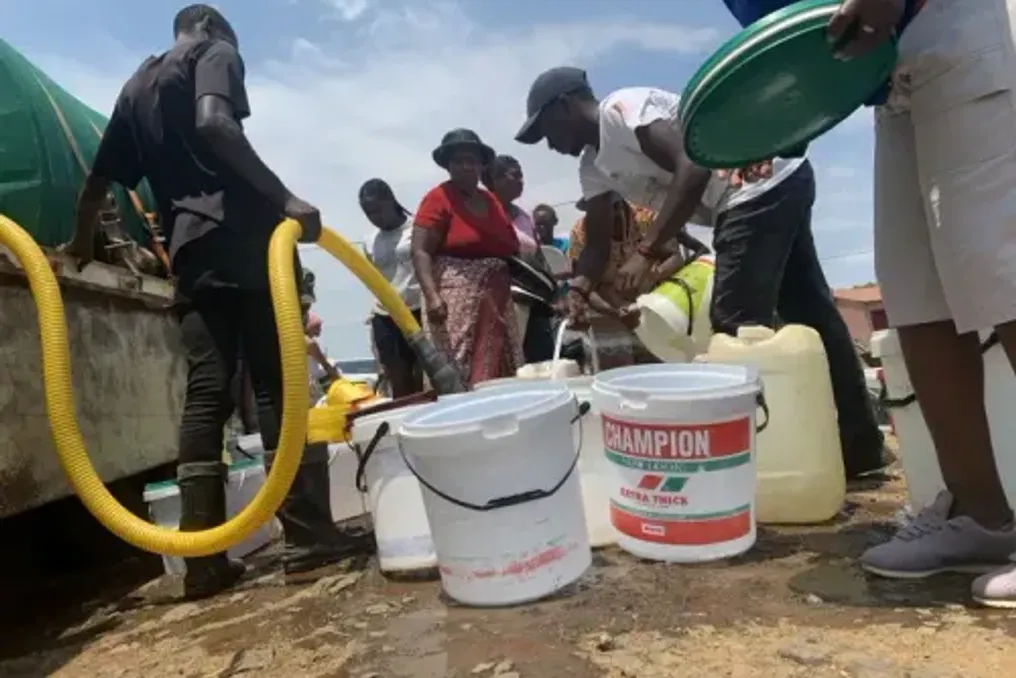
The water supply crisis in South Africa has reached a critical point, forcing residents to travel long distances daily to collect water in containers because household taps have been dry for many months. Using containers to collect water has become a common occurrence.
One of those affected is Zamokule Humalo from the village of Imbali in Pietermaritzburg, KwaZulu-Natal. He considers himself luckier as he uses his car to fetch water. His neighbors have to carry heavy wheelbarrows, and the elderly and people with disabilities are forced to spend part of their monthly allowances on water delivery services.
Humalo reported that the crisis in his area has been ongoing for many years. He noted that sometimes water is absent for two days or even a whole week, and the water tanker does not always arrive. 'If the tanker doesn't come, I drive to other areas to find water,' he said. He also mentioned that despite the lack of water, the Munduzi Municipality continues to issue bills.
A representative of the Munduzi Municipality, Ntobeko Ngkobo, explained that the municipality began a gradual reduction in water supply in August 2025 to help the uMngeni-uThukela Water (UUW) company increase the volume of the Midmar reservoir by June 2026. She added that the goal has been achieved and the volume will be maintained. According to a notice dated August 28, the municipality received information from UUW about the reduced water supply, which is attributed to limitations on licensed water abstraction set by the Department of Water and Sanitation.
Concerns over nationwide water shortages prompted the People's Forum on Water Issues (PWF) to join the protests of Melville residents in Johannesburg on Friday. Chairperson Dr. Ferrial Adam stated that the Melville area has been experiencing water problems for several weeks. She emphasized that the issues exist nationwide, and in some places, the situation is much worse than in Joburg. Adam named Limpopo, Free State, Eastern Cape, and KwaZulu-Natal as the most affected provinces, arguing that this is not a natural crisis but a result of poor management and failure to conduct timely maintenance.
In response to the situation, Johannesburg Water stated that it is implementing various measures to restore network functionality. Its representative Nolwazi Dlamini reported the implementation of a Water Conservation and Demand Management Programme aimed at reducing losses and ensuring stable water supply. However, the PWF, in its statement of March 13, called on the City of Johannesburg to take responsibility for the financial management that led to the crisis, accusing the city of shifting blame onto the national government, homeless people, illegal migrants, weather, and the private sector.
PWF pointed out that the cause was the city's inability to pay its service providers. As of mid-July, about 75% of bills from the previous fiscal year remained unpaid, and the total debt to creditors amounted to approximately 1.8 billion rand. Although a National Treasury grant was released to pressure municipalities, it was used to settle the City's accounts with Rand Water and Eskom, and Johannesburg Water only received about 400 million rand through small and irregular payments.
The non-profit organization WaterCAN expressed concern over the dry tap and unreliable water supply in KwaKwa, Free State. It referenced reports from the Department of Water and Sanitation indicating that Free State municipalities rank among the least effective in terms of drinking water quality. A WaterCAN representative in Free State, Dipuo Khlalele, stressed that a dry tap is not just an inconvenience but a factor affecting families' ability to cook, bathe, go to school, or live with dignity.
The South African Human Rights Commission (SAHRC) published a report on the water crisis in Makhanda, under the jurisdiction of the Makana Municipality, Eastern Cape, on June 10. The investigation found that the crisis was largely caused by management failures, deteriorating infrastructure, and inadequate maintenance. The Commission determined that the crisis resulted from managerial failures, infrastructure degradation, inadequate servicing, weak accountability, institutional instability, and implementation failures, even though sufficient water volume was available.
In response to the situation, a representative of the Department of Water and Sanitation, Visane Mavasa, did not provide direct comments; however, in a media statement on July 23, President Cyril Ramaphosa presented his National Water Action Plan, in which he spoke of increasing investment in water infrastructure, reforming municipal service delivery, and combating corruption in the water sector.