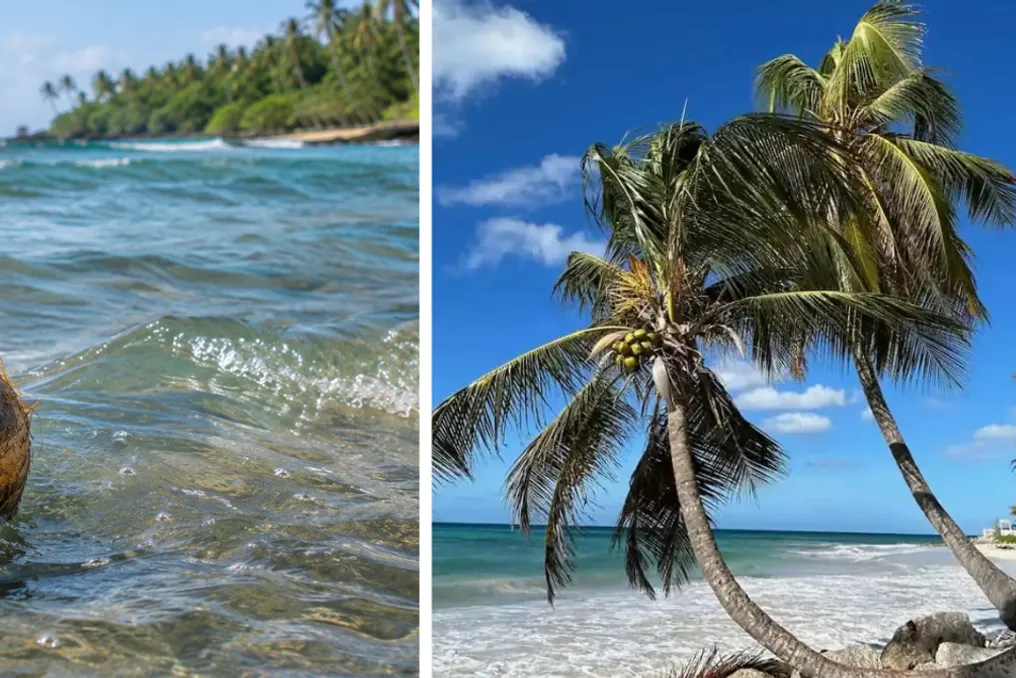
A coconut that falls from a palm tree into the sea can begin a journey that carries it thousands of kilometers. Passing through days and weeks, waves and currents push it forward, while the seed inside remains viable until the coconut reaches land.
This seems unlikely, as most seeds require suitable soil, water, and conditions to survive. However, the coconut possesses unique characteristics: its entire fruit is designed to protect its contents.
Scientists believe that the coconut's ability to float and remain viable contributed to its natural dispersal across tropical islands and coastlines long before humans began transporting it from one place to another. One study estimates that a wild coconut can remain viable in the sea for about 110 days, potentially covering a distance of up to 4800 km with favorable currents.
The coconut functions as a natural boat
The first secret lies in the thick fibrous husk surrounding the coconut. This coarse outer layer is not just waste removed before consuming the fruit; it plays an important role in maintaining the seed's buoyancy. Inside the coconut is a hard shell, an edible kernel, and a cavity that aids its flotation.
The combination of these elements allows the fruit to stay on the surface of the water rather than sinking to the ocean floor. Studies of coconut fruit biology describe the thick husk and internal cavity as important adaptations for swimming in seawater. It can be imagined as a seed enclosed in its own protective casing.
The seed is protected from saltwater
Buoyancy is only half the battle. The coconut must also sustain the life of the embryo inside while surrounded by seawater. Its thick husk and hard inner shell help protect the developing plant from the external environment. This is especially critical because the seed cannot afford to start growing in the middle of the ocean; a coconut seedling that appears in seawater will not survive long.
Therefore, delayed germination is crucial. Studies show that slow germination may have been one of the traits that aided the spread of coconuts across islands. A coconut that germinated too quickly would exhaust its reserves while still at sea. A coconut that waited could travel further before moving to the next stage of life.
The coconut contains its own nutrition
The coconut does not reach the beach without supplies. The seed contains a large reserve of nutrients in the form of endosperm, which eventually becomes the familiar coconut flesh. This reserve sustains the young plant during germination and early growth. The Indian Coconut Board notes that coconut seedlings feed on endosperm during early development. Under nursery conditions, high varieties usually begin to germinate within 60–130 days after sowing, while dwarf varieties may germinate earlier.
This food reserve is important because a newly arrived coconut cannot immediately rely on rich soil; it needs enough energy to form the first shoot and roots. Then the ocean must deliver it to the right place.
Survival during transit does not mean the coconut can grow anywhere. Its natural habitat is typically the tropical coast. When a coconut washes ashore, its shape and husk can help prevent its immediate return to the sea. Once it remains above the high tide line and receives fresh water, germination may begin. Researchers have suggested that the angular shape of the fruit may prevent it from rolling back into the water, giving emerging roots a better chance to anchor on the beach. This is why coconut palms are so closely associated with tropical shores.
Context is needed for the 4800 km journey
The famous figure of 4800 km is based on an estimate derived from the coconut's ability to germinate after floating in seawater for up to 110 days. The distance was calculated using the speed of a favorable ocean current. This does not mean that every coconut can simply float 4800 km and grow upon reaching land. Initial evidence was limited, and later researchers questioned how broadly this figure should be applied.
It is much clearer that coconuts possess several characteristics that make oceanic dispersal possible: they float, protect their embryo, carry their own food, and can delay germination.
A seed designed for island life
This makes the coconut more than just a fruit that floats by chance. Over evolution, these traits have allowed coconuts to reach islands where vegetation might be sparse and there are relatively few competing plants. Researchers studying coconut dispersal suggest that this ability to reach beaches, germinate, and establish itself has helped the palm spread across coral atolls and tropical coasts.
Later, humans transported coconuts much further, planting them in tropical regions for food, water, oil, fiber, and other purposes. India itself has a long history with this crop, and ICAR Central Plantation Crops Research Institute continues to develop coconut varieties suitable for various growing conditions.
So, the next time you see a coconut washed up on the beach, take a different look at it. This hard shell, thick husk, and seemingly ordinary fruit carry something fragile inside. The coconut does not need a ship to cross the sea. With the right current, its own natural design can give the seed a chance to cover thousands of kilometers, wait for land, and then start all over again.