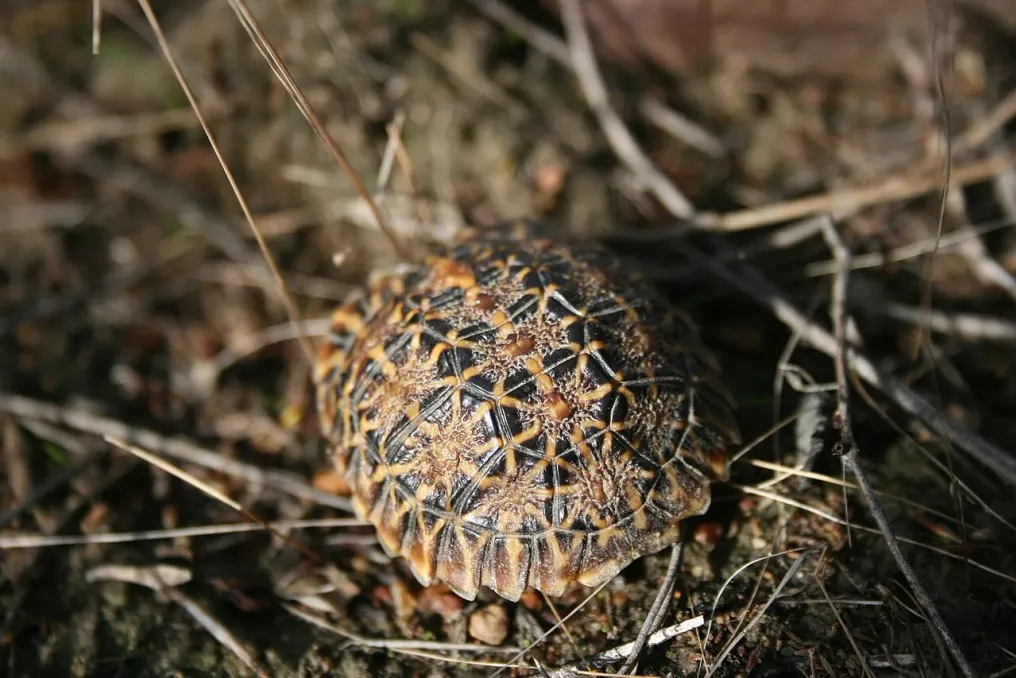
The wildlife map of South Africa is full of surprises. Besides the well-known lions, elephants, and rhinos, the country is home to tiny frogs, secretive rabbits, mountain birds, and reptiles that may consider a specific landscape their only home.
For travelers, this means that a wildlife trip does not always have to involve visiting a large reserve. Some of the most exciting encounters in the country only require a pair of binoculars, a good field guide, and a willingness to explore lesser-known habitats.
The Western Cape is one of the best places in South Africa for observing animals shaped by a unique environment. The Cape floristic region supports a huge number of endemic species, including the geometric tortoise, the Cape sugarbird, and the Cape rock climber.
The geometric tortoise is highly localized and found in the lowland landscapes of the Renosterveld and Cape fynbos. The Cape sugarbird, in turn, is closely associated with the protea-rich fynbos, where its long tail and characteristic call make it easier to spot compared to some of its smaller neighbors.
The Cape rock climber is another valuable species, though it should be noted that it is not exclusive to the Western Cape. Its range extends through the mountain fynbos into the Eastern Cape, where populations occupy high-altitude rocky slopes and ridges.
For amphibian enthusiasts, the fynbos wetlands of the province are home to several localized frog species, many of which are threatened due to habitat loss and climate change.
The arid Northern Cape may seem like an unlikely place to find rare wildlife, but its river corridors provide a vital habitat for one of South Africa's most elusive mammals—the river rabbit.
This species is critically endangered and extremely difficult to spot; it lives among dense vegetation along seasonal rivers. Its habitat is highly fragmented, making the conservation of remaining river corridors particularly important.
The province also offers mountain habitats for Hartmann's zebra and specialized reptiles adapted to the harshest conditions in the country.
The Eastern Cape is another province where wildlife rewards those who look beyond the obvious. The Cape mountain zebra is one of its iconic species, while Addo Elephant National Park is home to the famous dung beetle.
This remarkable beetle has evolved alongside large herbivores in the Addo landscape, reminding us that conservation is not just about caring for charismatic mammals. Protecting elephant populations can also save an entire network of smaller species dependent on the same ecosystem.
The subtropical coast and wetlands of KwaZulu-Natal support extremely localized wildlife. The Pickerel reed frog is perhaps the best example. Endemic to a narrow strip of the KwaZulu-Natal coast, it survives in fragmented wetlands, with an estimated occupied area of only 9 km².
The species is critically endangered, and conservation programs focus on protecting and restoring its remaining breeding sites. The forests and grasslands of KwaZulu-Natal also serve as habitat for samango monkeys and oryx, although neither of these species is exclusive to the province.
The Limpopo's northern forests and river systems offer a completely different wildlife experience. Narin's trogons can be found in mature forests, while the Pala fish owl is one of the most sought-after bird species in the province.
The latter is closely linked to large rivers and woodlands, where its dependence on healthy aquatic ecosystems makes it an indicator of river health. The Barberton Makhonjwa Mountains are known for their extraordinary geological history, but this region is also biologically unique. Its rugged terrain and isolated habitats support specialized reptiles and other species adapted to the unique conditions of the area.
The nearby Barberton mac is another layer to the story. Technically a plant, not wildlife, but it demonstrates why biodiversity hotspots cannot be neatly divided into animals and landscapes. Protecting one unusual landscape can save an entire community of life.
The Free State grasslands may lack the visual drama of mountains and forests, but they support some strikingly specialized species. The Boa thrush is one of the province's rarest birds. Its range extends into southeastern Mpumalanga, so it is technically not a Free State endemic, but eastern Free State remains an important part of its limited range. Habitat transformation and unsuitable land use have contributed to its decline.
Endemic and highly localized species are ecological specialists. If their habitat disappears, they often have nowhere to go. Therefore, their survival depends on the protection of specific wetlands, mountains, forests, rivers, and grasslands.
The takeaway for travelers is simple: wildlife viewing is not just about finding the biggest animal. Sometimes the most valuable sighting is the one that exists nowhere else in such a form.
Maintain distance, stay on marked trails, and never touch, feed, or intentionally disturb wild animals. For sensitive species, especially frogs and reptiles, avoid turning observation into a chase. Photography is not worth the damage to the habitat.
Travelers can also contribute to conservation by responsibly documenting sightings. iNaturalist allows users to document plants and animals, and observations help build knowledge and research on biodiversity.