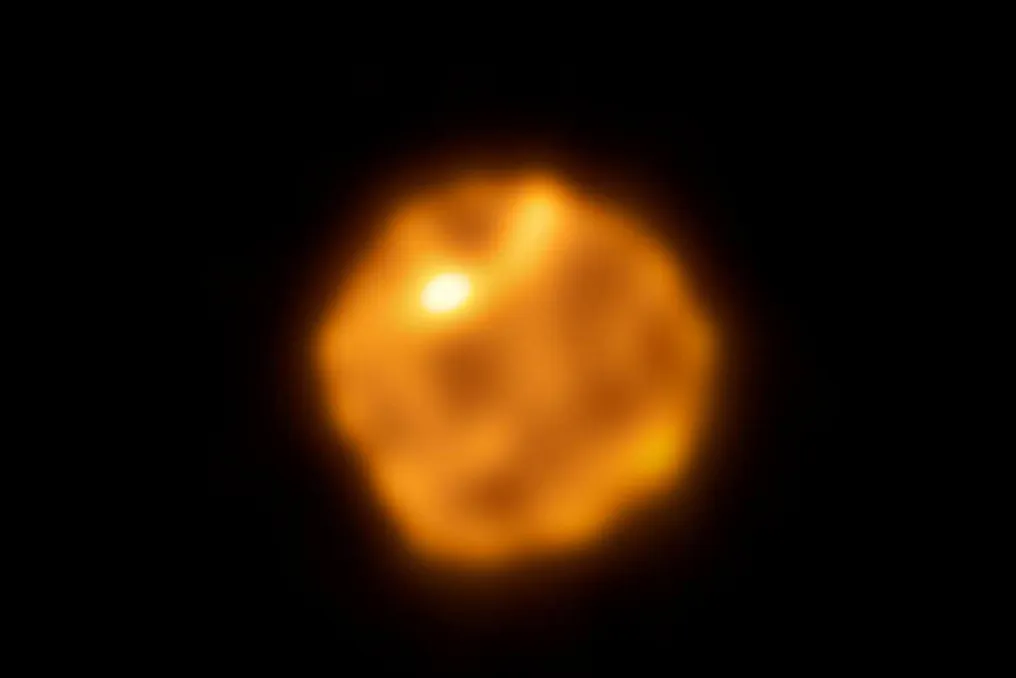
The Atacama Large Millimeter/submillimeter Array (ALMA) radio observatory, belonging to the European Southern Observatory (ESO), unveiled new images of the supergiant Betelgeuse and its turbulent surface last week (on the 24th).
This supergiant is one of the most studied stars in modern astronomy. Its mass is nearly 20 times that of the Sun, and its size is increased by almost 800 times. The first image of this star was taken in 1995 by the Hubble Space Telescope and became the first direct photograph of a star other than the Sun.
The new images obtained by ALMA in 2023 are the first to more clearly demonstrate the star's surface and contribute to deepening its study. These images show that Betelgeuse does not have a stable surface; the outer part of the star consists of vast regions of gas that are moving and have different temperatures.
ALMA discovered two particularly hot regions: one is located in the northeast, and the other in the southwest. The hottest of these has a temperature approximately 530 degrees Celsius higher than the surrounding gas. The overall temperature of the star is about 2030 degrees Celsius.
These regions may be related to the movement of gas inside Betelgeuse. Hotter material rises to the outer layers of the star and potentially causes changes in its atmosphere. However, one of the most interesting aspects of the observation is the comparison with previous images. One of the hot regions detected in 2023 is located almost in the same place as during ALMA observations in 2015.
This suggests that the structure might have persisted for at least seven years. This finding is noteworthy because, according to models used by astronomers, such large regions should change or disappear much faster.
The observations also show that Betelgeuse is not perfectly spherical. The visible size of the star varies in different regions, and the gas forming its atmosphere extends far beyond the visible surface. Furthermore, comparing the 2015 and 2023 data shows significant changes in some parts of the atmosphere over this period, indicating that different regions of the star may behave differently over time.
More information:
Betelgeuse is a star in an advanced stage of its life. Studying its surface and atmosphere helps astronomers better understand the functioning of red supergiants and how they lose matter into space. The persistence of hot regions can also help improve models attempting to explain the movements within these stars. Future observations will show whether these structures remain in place or if they too undergo changes over time.
Currently, the ALMA images provide a new perspective on a star that, despite being about 600 light-years away from Earth, can be studied with ever-increasing detail.