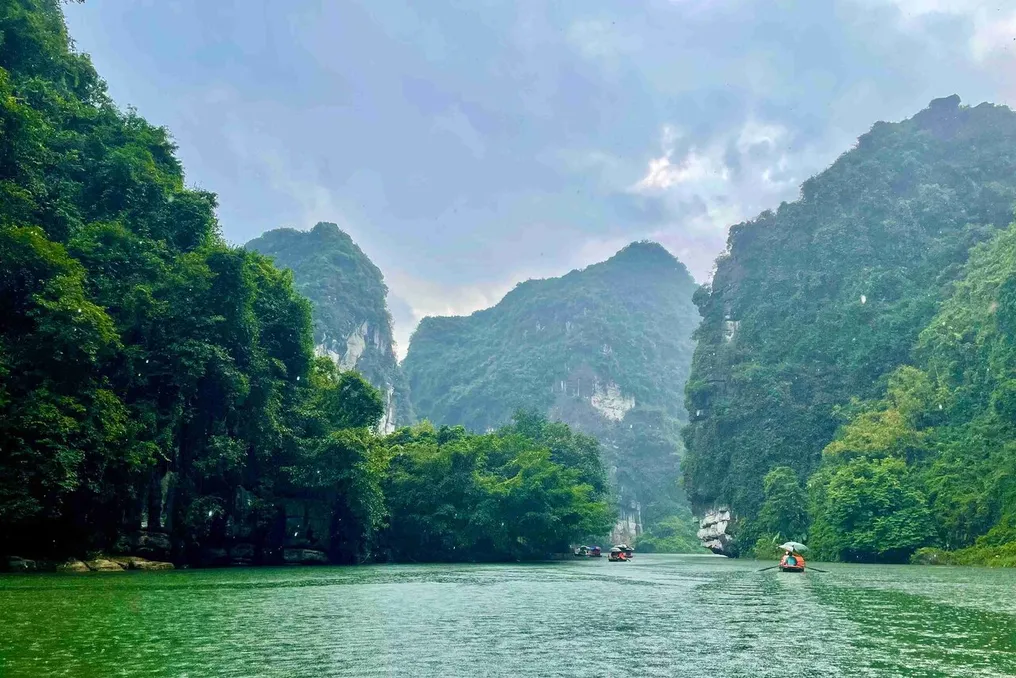
During a trip to Vietnam in November 2024, the author, a travel journalist, visited numerous locations—from the bustling streets of Ho Chi Minh City to the lantern-lit alleys of Hoi An, the imperial citadels of Hue, energetic Hanoi, and the emerald waters of Ha Long Bay. This experience left a deep impression not only due to the country's beauty but also its strategic genius. Vietnam has successfully transformed tourism from a secondary activity into a key pillar of the national economy, a true engine of prosperity.
For Iran, which possesses a rich heritage but suffers from insufficient tourism revenue, the lessons learned from Vietnam's experience are extremely relevant and practically applicable.
Vietnam's commitment to tourism is backed by concrete and ambitious figures. In 2025, the country welcomed nearly 21.2 million foreign visitors, marking a 20% increase and setting a new record. Tourism revenues reached approximately $85 billion, accounting for about 6-8% of GDP annually between 2021 and 2025.
However, this is just the foundation. According to the recently signed Politburo Resolution No. 26-NQ/TW, Vietnam aims for tourism to contribute 10-12% of GDP by 2030, with total revenue reaching $80-90 billion. By 2045, the sector is expected to account for 14-15% of GDP, attracting 70 million international visitors and ranking among the world's top 30 most competitive tourism economies.
Furthermore, the indirect effects of tourism are enormous. In the first half of 2026, despite global geopolitical tensions and inflationary pressures, Vietnam's GDP grew by 8.18% year-on-year, and services increased by 8.09%. Retail sales of consumer goods and services reached 3,889.5 trillion Vietnamese dong, showing a 12.9% growth, largely driven by the recovery of tourism. This industry already supports about 2.3 million direct jobs and 3.5 million indirect jobs, with plans to achieve 1.5 million hotel rooms and a workforce capable of sustaining this growth.
On-site observations confirmed the provisions of political documents: Vietnam's success is based on four interconnected elements.
Firstly, governance and political will. The Politburo Resolution explicitly states the need for tourism to generate 'stronger spillover effects in other sectors, helping to stimulate economic growth and innovation while promoting sustainable development.' This is not a minor ministerial issue but a national priority signed by the General Secretary of the Party and the State President. Responsibility for implementation is distributed across the entire political system—from the National Assembly to provincial party organizations—ensuring consistency and accountability.
Secondly, infrastructure as a catalyst for growth. Vietnam plans to develop three major tourism hubs in Hanoi, Ho Chi Minh City, and Da Nang, along with 10 key tourist centers and 20 national tourist zones. Priority is given to multimodal transport infrastructure, including aviation, railways, inland waterways, ports, and marinas. During a cruise in Ha Long Bay, the author personally witnessed how investments in modern vessels and passenger terminals enhance visitor experiences and extend their stays, directly increasing per capita spending.
Thirdly, shifting from volume to value. This resolution marks a decisive move away from a tourism model focused primarily on visitor numbers toward one centered on quality, efficiency, higher added value, and unique experiences. Visa policies are being reformed with expanded exemptions for key markets. New models are actively supported—night economy, coastal and riverine economies, and integrated complexes of tourism, culture, sports, and entertainment. Shopping tourism is stimulated through research into VAT refund mechanisms. The goal is not merely to increase the number of tourists but to attract visitors who spend more and stay longer.
Fourthly, digital and green transformation. Vietnam is creating a national smart tourism ecosystem that includes a national tourism database and a digital platform. Big data and artificial intelligence will be used in promoting and managing destination reputation. Simultaneously, green tourism is actively promoted through wastewater treatment, plastic reduction, and circular economy models. This dual focus on technology and sustainability positions Vietnam as a progressive and competitive destination.
For Iran, a country with 30 UNESCO World Heritage sites—more than Vietnam—and possessing a millennia-old civilization, the gap between potential and actual results is vast. Currently, tourism in Iran accounts for 5% of GDP, a negligible share compared to Vietnam's achievements. Nevertheless, the opportunities are immense, and the lessons are clear.
Firstly, tourism must be elevated to the level of a national strategic priority. Iran lacks an equivalent to Vietnam's Politburo Resolution—a binding high-level document that places tourism at the center of economic diversification. The Supreme Leader and the Iranian government must issue a similar directive, clearly distributing responsibilities among ministries, provinces, and the private sector. Tourism should be viewed not as a cultural secondary task but as a leading economic sector, alongside oil and gas.
Secondly, massive investment in infrastructure is required. To compete globally, Iran needs around 3,000 new four- and five-star hotels and a modernized air fleet. Vietnam's goal of 1.5 million hotel rooms by 2030 should serve as a benchmark. Iran must prioritize multimodal transport—modernizing airports, expanding railway networks, and developing cruise terminals along the Caspian Sea and Persian Gulf. Public-private partnerships, which Vietnam actively encourages for destination management and large projects, must be institutionalized.
Thirdly, reform of visa and entry rules. Iran's visa regime remains complex for many potential visitors. Vietnam is expanding visa exemptions and implementing more flexible rules for key markets. Iran should immediately introduce visa-free access for citizens of major source countries and adopt an electronic visa system to simplify entry. This alone could significantly increase arrivals.
Fourthly, shifting from quantity to quality. Iran must stop counting heads and start measuring value. The focus should be on attracting high-spending tourists—those interested in cultural heritage, wellness travelers, MICE delegates (Meetings, Incentives, Conferences, Exhibitions), and luxury adventurers. Developing the night economy, shopping (with VAT refunds), and integrated resort complexes will allow Iran to replicate Vietnam's strategy and sharply increase per-tourist spending.
Fifthly, adopting digital and green transformation. Iran lags in digital tourism infrastructure. A national tourism database, AI-driven promotion, and digital booking platforms are essential. Concurrently, Iran must invest in sustainable tourism—waste management, eco-friendly transport, and heritage preservation—to protect its assets and meet growing global demand for responsible travel.
Sixthly, human capital development. Vietnam targets a tourism workforce of 2.3 million direct employees. Currently, Iran has only about 50,000 trained tourism specialists, whereas at least 200,000 fluent in key languages are needed. Investment in hospitality education and professional training is not an option but a fundamental necessity.
Conclusion: Window of Opportunity
The first half of 2026 demonstrated Vietnam's resilience and diversified growth, where tourism, manufacturing, and domestic consumption contributed to an 8.18% GDP expansion. Iran, facing its own economic difficulties, cannot afford to ignore this model. By adopting Vietnam's strategic focus—political will, infrastructure investment, visa reform, quality orientation, digital innovation, and human capital development—Iran can realistically achieve an annual tourism revenue of $20 billion and create 150,000 new jobs by 2030. More importantly, this would reduce dependence on oil, diversify the economy, and present a more balanced and hospitable image to the world.
My journey through Vietnam was an eye-opener—not just to its natural beauty but to its national strategy. Iran possesses heritage, climate, and geography. What it lacks is resolve. The lesson learned from Hanoi to Ha Long Bay is undeniable: tourism is not just leisure; it is a means of livelihood, growth, and national prosperity. Iran would benefit greatly from internalizing this lesson.