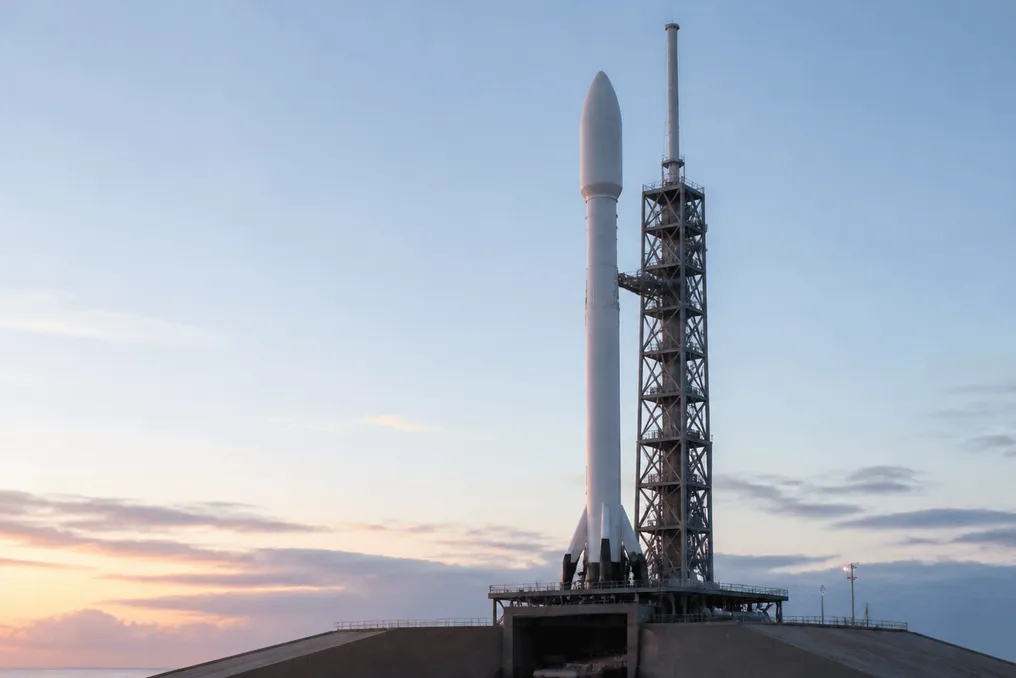
The commercial space company based in Beijing has reached a significant milestone. Galactic Energy, previously known for its Ceres series solid-fuel rockets, has successfully launched its first liquid booster, the Zhishenxing-1. The launch took place on September 1st at 10:00 local time from a specially equipped launchpad in the Dunfeng commercial aerospace innovation zone in Jiucyuan.
The rocket reached the planned orbit according to calculations. The company named this mission 'Guiding the Green Dragon to the Milky Way,' emphasizing that it marks the company's transition to a dual business model covering both solid and liquid fuels.
Prior to this, Galactic Energy's commercial flights were conducted using the Ceres family of solid-fuel rockets, which were used to launch small and medium satellites, as well as for deploying and replenishing constellations. The first flight of Zhishenxing-1 officially marked the beginning of the liquid rocket program tests.
This booster is a medium- or large-scale liquid launch vehicle designed to serve large low Earth orbit satellite networks and execute missions with heavy payloads. Zhishenxing-1 features a two-stage configuration with the option of installing an additional upper stage. It has a length of 52 meters, a body diameter of 3.35 meters, a liftoff mass of approximately 283 tons, and a liftoff thrust of 350 tons.
According to the declared design targets, the rocket is capable of placing payloads weighing between 5 and 7 tons in a single launch and is designed for at least 25 reuses. The first stage is powered by seven independently developed Cangqiong-50, or CQ-50, engines, which operate in parallel on liquid oxygen and kerosene.
Each engine, built with a pintle injector design, supports deep thrust regulation from 32 to 105 percent and is capable of multiple restarts, with a total test stand operating time exceeding 23,000 seconds. The selection of a cluster of seven engines is partly due to ensuring fault tolerance: if one engine fails, the design allows the remaining six to complete the mission.
This first flight was a basic check aimed at achieving orbit and testing general control and propulsion systems; there was no attempt at first-stage recovery. The recovery process will be phased: it will begin by utilizing flight data, then gradually test atmospheric entry control, steering, braking, and descent, concluding with the vertical landing of the first stage on the sea or land. The success of this launch strengthens Galactic Energy's position in the second race of China's commercial launch industry, as liquid rockets move closer to regular flights and reusability.