The story of this woman is part of The Better India's weekly series 'Did India Invent This?', which reveals Indian ideas, innovations, and minds behind inventions that have changed our lives. These stories cover both the brilliant solutions of scientists and engineers and technologies developed in response to India's biggest challenges, exploring the problem they solved and its long-term significance.
Working with satellites is complex: after the rocket launches into space, the apparatus faces a delicate journey. The satellite must be maneuvered and gradually placed into the precise orbit to begin its work. Incorrect calculations or timing can jeopardize years of work and a very expensive machine.
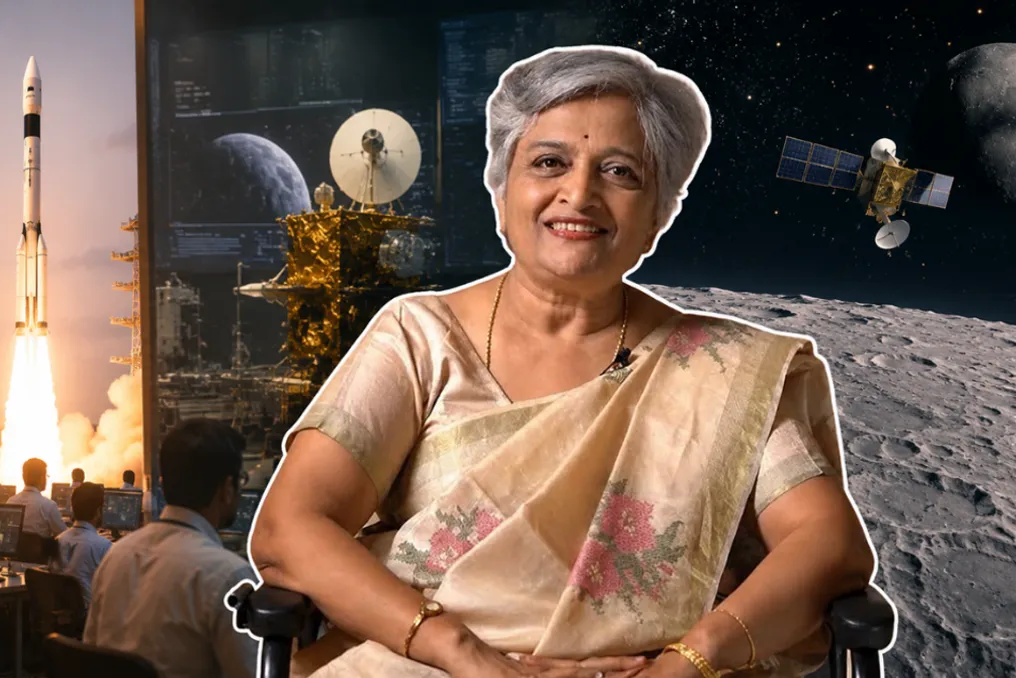
In 2011, Indian space scientist T. K. Anuradha was working on exactly this problem. As the director of the GSAT-12 mission project at ISRO, she helped develop and implement an innovative method for controlling a geostationary satellite during its transfer to the final orbit. This methodology contributed to the success of the mission and continues to be used in satellite operations.
When the Moon landing made space possible
Born in 1960, Anuradha grew up between Shivamogga and Bangalore, having three sisters. Her father, a Sanskrit professor, emphasized education, and her environment allowed her to ask questions, participate in discussions, and follow her curiosity. She was particularly fond of mathematics and science.
In 1969, like millions of people around the world, young Anuradha watched 'Apollo 11' land humans on the Moon. For her, this historic mission was not just a distant spectacle; it made space feel like a domain she could one day become a part of. She then studied electronics and communication technology at Visvesvaraya University of Engineering in Bangalore, where she became the top student in the university.
Three years later she joined ISRO
In 1982, Anuradha began her career working on satellite tests, interfaces, and systems that could assess the performance of spacecraft under various mission conditions. This experience proved invaluable, as launching a satellite is only the beginning.
The problem hidden after a successful launch
Take GSAT-12. When this communication satellite was launched aboard PSLV-C17 in July 2011, it entered a highly elliptical orbit. It then needed to be carefully moved to the planned geostationary position, approximately 36,000 km above the equator. This required a series of meticulously calculated orbital raising maneuvers.
The first maneuver was particularly challenging: the satellite moves fastest when closest to Earth, leaving engineers a narrow window to fire engines while optimizing fuel consumption. This is where Anuradha's work came in handy. Her approach to controlling geostationary satellites helped the team place GSAT-12 into its final orbit. This was not some novel thing you could hold in your hand; it was quieter—a new way of working with a complex spacecraft thousands of kilometers above Earth. Sometimes, it is these quiet innovations in space technology that make everything else possible.
The control center where three women took charge
Another historic moment was unfolding on Earth. At the ISRO Control Centre in Hassan, Karnataka, Anuradha led a team composed exclusively of women that monitored the critical maneuvers of the satellite. Alongside Mission Director Pramodhai Hegde and Operations Director K. S. Anuradha, she tracked every movement of the spacecraft through rows of screens and antenna systems.
At one point, when the satellite's antenna deployed, applause erupted in the control center. Reports state that Anuradha described the feeling of watching the first steps of the satellite she worked on as 'the birth of a child'. However, gender breakthrough was not her initial goal; she was focused on the mission. The significance of three women being present in such a critical operation became apparent after the achievement was reported. By then, Anuradha had spent nearly three decades accumulating expertise in a field where precision is valued over labels.
The woman behind the innovation
Ultimately, Anuradha became the first woman at ISRO to hold the position of satellite project director. Over her 38-year career, she worked on several communication, remote sensing, and navigation programs, including GSAT-10 and other GSAT missions. Nevertheless, perhaps the most interesting part of her story is that her greatest breakthrough did not come from trying to prove that women could work in space. It came from doing what she loved since childhood: understanding how things work, asking questions, and finding the best way to solve a problem.
Her advice to young girls follows the same philosophy: focus on achieving what you want, do not pay attention to the opinions of others, and follow your path with clarity and conviction. Because sometimes, the innovation that helps a satellite move through space starts with something much more ordinary—a curious mind that refuses to stop asking: 'Can this be done better?'