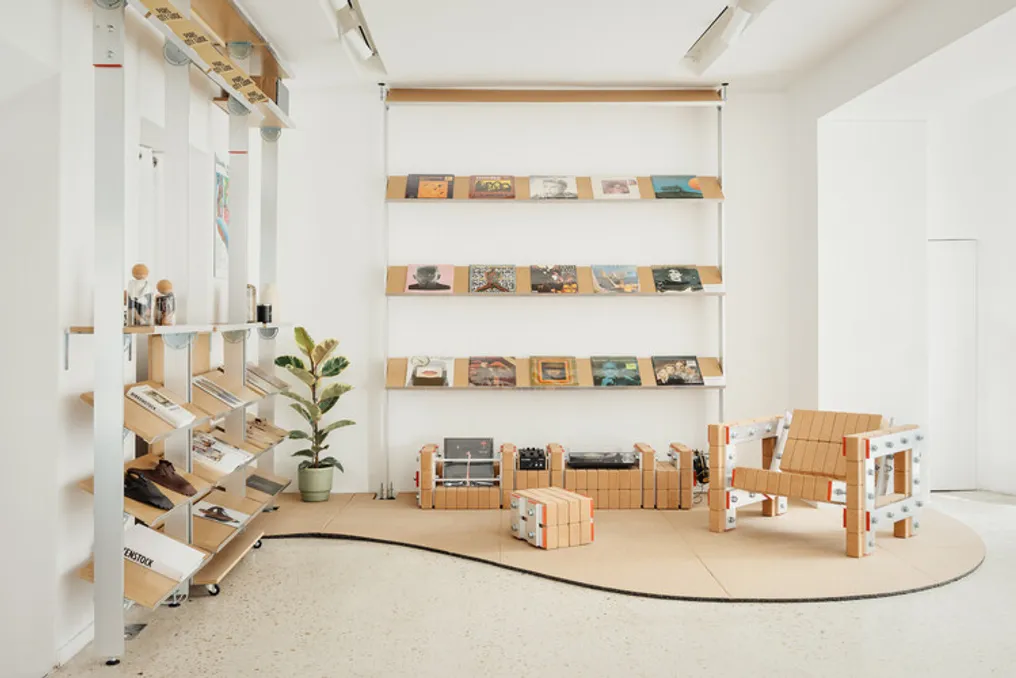
Atelier CRAFT, based in Saint-Ouen, Paris, is dedicated to investigating the narratives contained within materials and how the visible marks of artisanal work can interact with manufacturing processes and industrialization. The studio's philosophy proposes that the act of thinking through execution becomes the central guide of a project, combining wood, industrial inputs, and reused items, following the principle of reversible architecture, summarized in its manifesto: 'Transforming the project through making.'
Since its founding in 2016, the office has focused on projects that cross architecture, design, and set design, operating in cultural, commercial, and social environments. Atelier CRAFT also pays great attention to circularity, prioritizing the reuse of techniques, materials, assembly systems, and objects. By dissolving disciplinary boundaries, each undertaking becomes an opportunity to build a collective narrative and foster new forms of cooperation.
One example illustrating this vision is the AMBACTOS project, named Kitchen of the Embassy of Tomorrow (scheduled for 2025). This project emphasizes the importance of valuing creators, placing workers at the center of diplomatic representation, where the kitchen functions as a place of hospitality and a stage for French cuisine.
The studio redefines the concept of ornamentation from the perspective of current issues, altering the visual language of power and representation. Elements such as manual skill, technical competence, environmental responsibility, and the use of raw materials are crucial in diplomatic spaces. For instance, a structure made of oak wood recovered from an old farm comprises the reception pavilion, and a mold from the Manufacture de Sèvres is reinterpreted as a suspended light fixture.
In a conversation with Atelier CRAFT, the creative process was detailed, how craftsmanship revitalizes various elements, and the value of the artisan's touch in contemporary architecture.
Atelier CRAFT's project development process
The project process at Atelier CRAFT always begins with a story; the team researches historical, social, and cultural narratives. Thus, the decisions made for each client or project are always anchored in the context, whether through historical references or material selection. After years dedicated to practice, the studio begins to define a constructive language and identify its priorities: the re-signification of objects, the inherent beauty of raw material, and the artisanal craft. Its philosophy is synthesized in the phrase: 'Transforming the project through making.'
When asked about the role of artisanal making, Atelier CRAFT describes a mixed creative practice of designer and executor. The union between conception and execution has always been a fundamental principle, motivated by the need to transcend the boundaries between architecture, design, and craftsmanship. Having the design studio integrated with the workshop allows for organic and free creation, as many solutions arise during experimentation in the workshop, dispensing with complete drawing.
Although they do not strictly define themselves as artisans, the studio is deeply influenced by craftsmanship due to the unique connection it establishes with manufacturing processes and materials. The transparency of the construction process, which aims to ensure the reversibility of the projects, is what often leads to the comment of an 'artisanal aesthetic,' which is merely a result of the adopted method.
Added value of material reuse
The studio's environmental commitment involves reducing material acquisition sources to five ways: rental (for temporary events), borrowing (from suppliers or clients), second-hand purchase, use of the workshop's own stock, or new acquisition, always maintaining the possibility of reversibility. This commitment, although present in all works, is not an isolated end; it must coexist with storytelling, the creation of desirable imaginaries, and the proposal of innovations.
Existing objects bring historical connections that would be difficult to imagine if the object were created from scratch. They serve as an inexhaustible source of inspiration. Using antique pieces is seen as a tribute to the traditions and artisans who produced them, but the studio avoids creating pastiches, using the old item only as a starting point to adapt it to modern uses.
Dialogue between artisanal making and industrial systems
Atelier CRAFT's work positions itself between the manual and the semi-industrial. While industry offers efficiency and optimization, its failing lies in its inability to adapt to specific contexts, tending to decharacterize. DIY (Do It Yourself) guarantees uniqueness but hinders replication. The goal is to question industry, recovering its technical knowledge to apply it on smaller and more contextually appropriate scales. The fusion between craftsmanship and mass production allows for responses that are simultaneously optimized and contextualized.
In the most recent project for Birkenstock (September 2025), for example, recycled cork was chosen, given that the client manufactures cork soles. Complemented by industrial materials such as aluminum trowels and MDF, the intention was to make the concept visible, allowing anyone to intuitively understand the manufacturing of the furniture and objects. All created spaces function as vehicles for these narratives.
Approach to circularity and spatial identity
For the studio, there is no conflict in using stock, reused, or pre-existing materials in new projects with their own identities. Working with raw materials, they can be freely transformed to contribute to new sustainable visions and narratives. Circularity is seen as a basic requirement, but not as a dictator of spatial rules; materials circulate, but the narrative and uses are unique in each project.
Dialogue between past stories and contemporary present
In the Palanquin 1804-2024 project, it was fascinating to work with a high-technical piece of furniture from the 19th century. Initially, the studio knew the furniture only from photos, but upon receiving it, the artisanal nature of the piece clarified the limits of what could be done to respect the original work. Although 220 years old, the desk remained intact and in excellent condition. The proposal was to honor the producer's mastery, adding an authorial touch through reassembly with a new structure that gives it an unprecedented function and narrative, while maintaining the possibility of original reconstruction.
Thus, the purpose is to generate timeless spaces and objects based on the past, adapting them to current uses so that they can endure in the future, thus reconciling three temporalities.
Looking to the future, harmonization between mind and hand is expected at Atelier CRAFT, promoting greater permeability between disciplines such as craftsmanship, design, and architecture. This implies that practical and artisanal learning must be reintegrated into architecture curricula. Due to the scale, timeline, and economic logic of current civil construction, predominantly industrial methods are used. However, the renovation of old buildings aligns with the studio's practice, requiring a more artisanal making or, at least, a mix between craftsmanship and industry, focusing more on the process than on the final result.