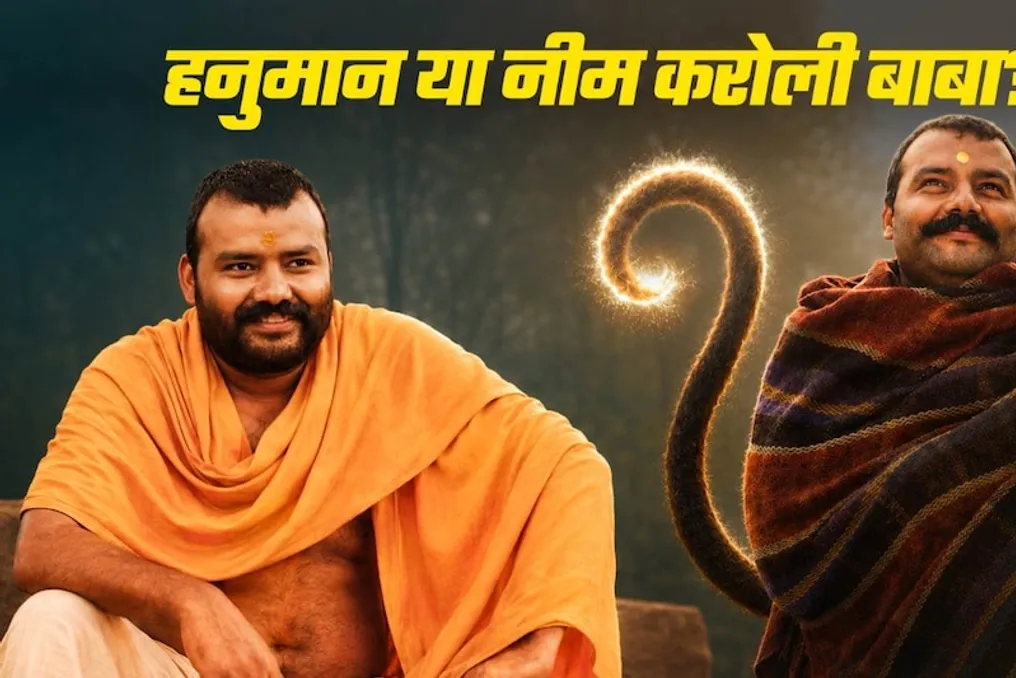
The film 'Hanuman Ansh' is currently achieving significant box office success. Having been made on a budget of two crore rupees, it has already earned 40 crore rupees. However, this film raises the question: is it the story of the God Hanuman or Nim Karoli Baba? Notably, the film tells both stories, and this is where the main plot twist lies.
This film, directed by Vishal Chaturvedi, is inspired by episodes from the life of Nim Karoli Baba and his deep devotion to Hanuman. Although the film's title mentions the Hindu god Hanuman, much of its spiritual world stems from the life of a man whom his followers later came to call Nim Karoli Baba.
The story begins with a child searching for his mother, but this search gradually transforms into a quest to find God. Eventually, he begins to understand that the path to God may lie through serving others.
The film finds a very beautiful way to connect these two worlds. When a boy named Lakshman is told that his mother went to God Rama, for him this is not an abstract spiritual concept. For him, his mother exists, and he wants to find her, but the question arises: how does one reach God Rama?
Lakshmi, whom his father loved to call this name, and who later becomes known as Lakshman Das, and subsequently as Nim Karoli Baba, seeks his own answer through the path of Hanuman. Since Hanuman is the greatest devotee of Rama, he is considered the one who can bring someone to Rama.
It is here that the two seemingly different stories—that of Nim Karoli Baba and Hanuman—merge. Lakshman's search for his mother becomes a search for Rama. The search for Rama leads him to Hanuman, and this devotion subsequently shapes the man known as Nim Karoli Baba.
Therefore, the title 'Hanuman Ansh' refers not only to Hanuman but also to the personality of the person who considers himself part of Hanuman, his servant, and devotee. Perhaps understanding this is the most important key to comprehending the film. It explains spirituality not through complex philosophical doctrines or loud religious sermons, but embodies it in everyday life.
It speaks of mothers, hungry children, broken families, poor peasants, oppressed women, forgiveness, and most importantly, how one person can be useful to another.
According to the film, devotion to God Rama and Hanuman is not limited to worship. The real question begins after prayer. When you leave the temple and return to the same world, and a person appears before you who needs your help, what does your devotion do?
This is precisely what 'Hanuman Ansh' presents in a very simple manner. Perhaps this is why, despite the limited budget and lack of grandeur focused on a traditional superstar, the film resonates with modern audiences, especially the youth. The film does not force you to choose whether it is the story of Hanuman or Nim Karoli Baba. It asserts that it is both the story of Hanuman and the story of Nim Karoli Baba. Moreover, the path to one story passes through the other.
A miracle occurs in the story. In 1943, India was under British rule. One Indian revolutionary was hiding from the English, constantly fearing exposure. Furthermore, he had been hungry for 15 days. At this moment, a local sadhu comes to him and gives him food, as if knowing beforehand that this frightened and hungry man needed it most at that time.
This seems like the beginning of a miracle. The film could have made this very grandly here: divine intervention, bright music, the appearance of the sadhu as a superhero. But 'Hanuman Ansh' is more interested in the person from within whom this miracle emanates. The film shows the early life of 12-year-old Lakshmi, who would later be known as Lakshman Das, and then as Nim Karoli Baba. This role was played by actor Shobhinan Satya.
At the center of his story lies an extremely human feeling—a child who cannot accept that his mother has left him forever. His deep love for his mother leads him on a spiritual path. The search for the blessing of God Rama and Hanuman gradually turns into a journey where devotion and humanity begin to blend.
Here, the film goes beyond a typical religious story. The boy searching for his mother begins to search for something much bigger. Perhaps to reach God, one does not always need to look up; sometimes one needs to look around oneself.
This journey of the film develops not through grand sermons, but through small acts of service. From helping a widow suffering from exploitation by a merchant to awakening humanity in a cruel husband—encounters with ordinary people become the emotional and spiritual core of the film, where Nim Karoli Baba is found.