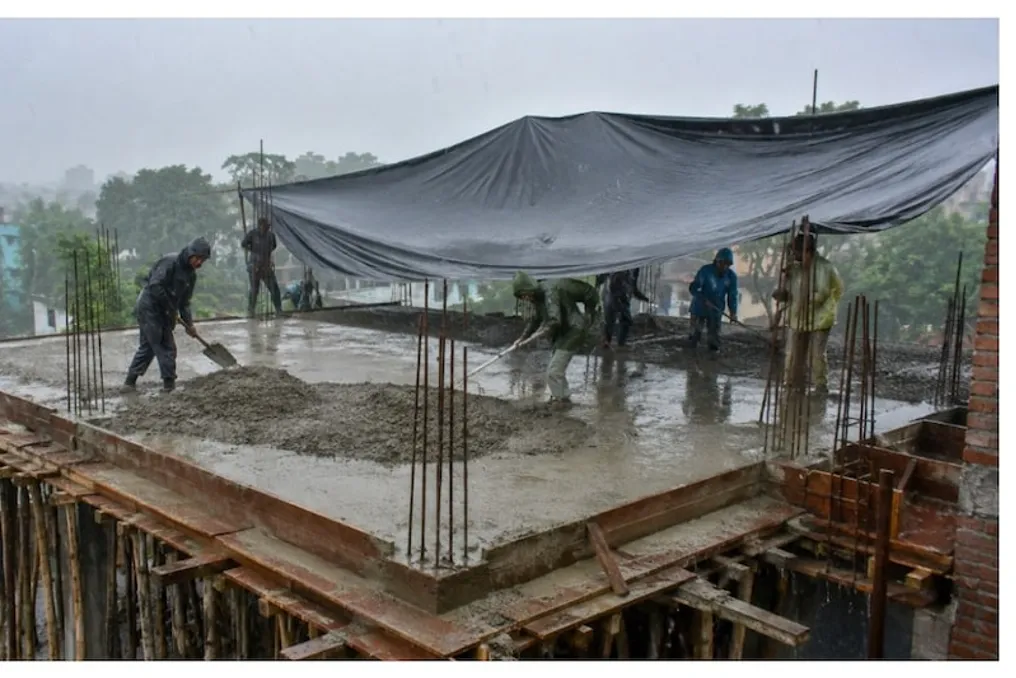
During the rainy season, people building houses often ask whether it is advisable to pour the footing at this time or better to wait until the rain stops. The answer is not straightforward; it depends on the intensity of the precipitation and the level of preparation of the construction site.
According to BIS standards, which establish quality and safety norms for products and construction practices, the ratio of water to cement in structural concrete must be between 0.40 and 0.55, determined by the exposure conditions. If rainwater directly hits fresh concrete, it disrupts the set ratio, negatively affecting both the strength of the concrete and the surface quality. In such cases, the concrete may weaken, and the surface may be damaged, so it is wise to refrain from pouring the footing when heavy or prolonged rain is forecast.
If only light rain is expected, there is no need to stop work. However, it is necessary to provide full coverage of the entire footing with a tarp or waterproof cover in advance so that the fresh concrete remains protected from sudden downpours. Although digging the foundation during the rainy season becomes more difficult due to the instability of wet soil, if the foundation is prepared in advance and construction is proceeding above it, work can continue under the supervision of a site engineer.
Interestingly, the accumulation of water from light rain on flat surfaces, such as roofs or terraces, is actually considered beneficial for concrete hardening, provided the concrete has completed its initial setting period.
In accordance with BIS IS 456 code, the minimum curing period for concrete is 10 days. Curing means keeping the concrete in a moist and damp state for a certain period after pouring so that it can properly strengthen. Nevertheless, this period can vary depending on the type of cement. For OPC cement, 7 days is usually recommended, while a longer curing period is advised for PPC/PSC cements. Curing is considered the most important and economical process for ensuring the strength and durability of concrete, but it is often ignored on sites.
Before pouring the footing, you must check the weather forecast for the next 24–48 hours. You must have a ready tarp to completely cover the footing. Avoid adding excess water to the concrete mix out of fear of rain, as this will disrupt the mixture proportions. It is important to ensure proper curing. Rain should not be considered a substitute for the curing process. Footing parameters, such as thickness, reinforcement, and structure, must be agreed upon with an engineer based on drawings and load.
It is impossible to name one month in India that would be best for construction everywhere. The timing can change depending on the climate, soil type, and local conditions. Nevertheless, generally, the period after the end of the most intense rainy season is considered most convenient for building structures. During the rains, special difficulties may arise when digging foundations because the soil becomes wet and unstable. According to Ultratech guidelines, problems with soil instability may occur during the initial foundation work in the rainy season. However, if the foundation is already ready and work on the structure has progressed, some construction work can continue even in light rain, but the control of the site engineer is necessary at every stage.