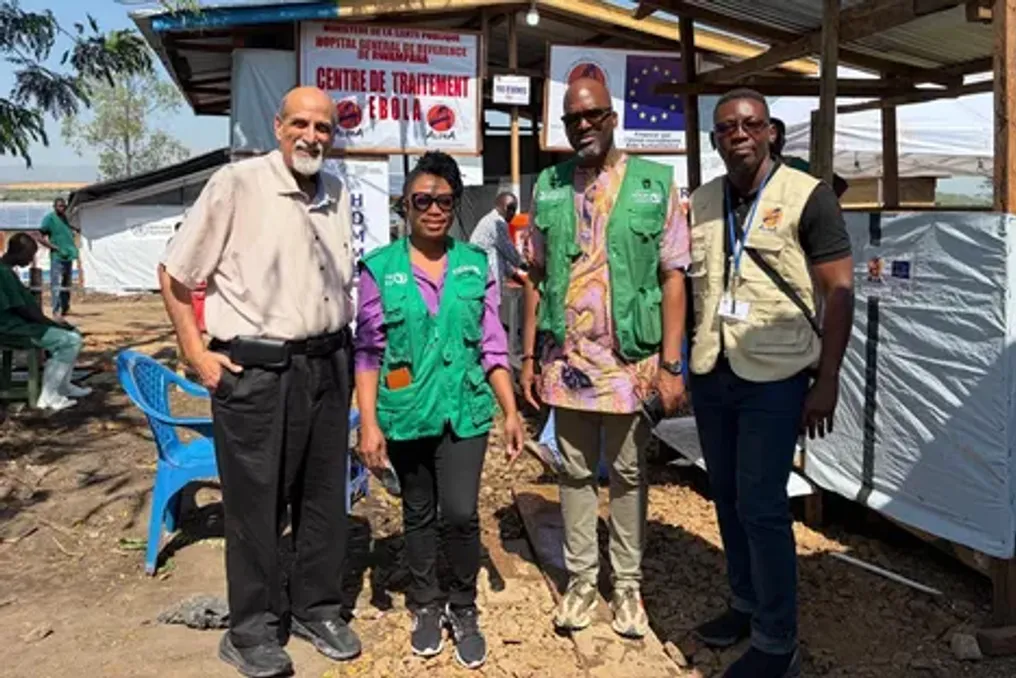
The World Health Organization (WHO) and Africa Centres for Disease Control and Prevention (Africa CDC) declared a public health threat related to Ebola in May due to the rise in cases in the Democratic Republic of Congo (DRC) and Uganda. Three weeks later, the author traveled to Kinshasa, and then to the epicenter of the outbreak—Bunya, the capital of the Ituri province in the DRC—to assist Africa CDC in responding to the Ebola outbreak.
There are three important aspects to this specific Ebola epidemic. Firstly, it is caused by the Bundibugyo virus, which has previously spread among humans only twice. Most of the 17 previous Ebola outbreaks in the DRC were caused by the Zaire ebolavirus, which is different from the Bundibugyo virus. The Bundibugyo virus is naturally found in fruit bats and some other animals, such as antelopes, so it is most likely that this epidemic began with transmission from bats to humans.
Secondly, although most standard Ebola diagnostic tests detect the Zaire strain, they do not recognize the Bundibugyo strain. Currently, only a few tests capable of detecting Bundibugyo are used in the DRC. There are no drugs or vaccines for the Bundibugyo virus.
Thirdly, Ebola is transmitted not through coughing or sneezing, but through contact with blood and bodily fluids. Consequently, it does not spread as rapidly as Covid-19, but it affects people who are closest to Ebola patients, especially those caring for them. Many doctors, nurses, and other healthcare workers have been infected by their patients. People involved in burying deceased Ebola patients also pose a high risk.
In Kinshasa, the author started by visiting the renowned Professor Jean-Jacques Muyembe at the National Institute of Biomedical Research (INRB). INRB is the national biomedical research laboratory for the Ministry of Health of the DRC. Professor Muyembe spoke about the first Ebola patients, and Professor Peter Piot discovered the Ebola virus in 1976; both scientists are considered pioneers of Ebola. It was in Professor Muyembe's laboratory in May that it was first discovered that the virus in patients dying with fever and bleeding in Bunya was the Bundibugyo virus. His laboratory is equipped with a complex high-containment facility for working with Ebola, built by the Japanese government, and is capable of conducting thousands of Bundibugyo virus tests daily.
Next, the author flew to Bunya, which proved to be a serious challenge. The airport in Bunya is closed to regular commercial flights to prevent the transfer of Ebola patients to other parts of the world. Therefore, he used a United Nations humanitarian flight at a temporary terminal near the main airport in Kinshasa to reach Bunya via a UN humanitarian air flight. Ironically, the flight number was 'Ebola.1.'
On his first drive through the streets of Bunya, the author recalled the town of Ladysmith in KwaZulu-Natal—picturesque, but struggling with infrastructure development. There are many potholes, drainage systems are disrupted in places, and some streetlights are not working. The beauty of Bunya hides a reality: outside the city are thousands of displaced persons living in tent camps—people forced to leave their homes due to the war in Ituri province. This is a city at the center of a long-standing conflict that has internally displaced hundreds of thousands of Congolese.
In Bunya, the author visited two Ebola treatment centers. He was impressed by the Evangelical Hospital, which is one of the largest for Ebola patients in Bunya. Half of the hospital was isolated for Ebola patients. Medical staff on the front lines here implemented a simple but effective method of isolating confirmed and pending Ebola patients from the general hospital population. However, lack of space became a problem. Waiting for test results increases the demand for individual isolation wards, as patients cannot be sent home or placed in a shared ward.
Speaking with doctors and nurses at the Evangelical Hospital, who wore personal protective equipment (PPE) to enter the Ebola ward, the author was struck by their willingness to enter this ward despite each patient being highly infectious and posing a serious danger to them. The greatest risk occurs when medical workers remove contaminated infectious PPE, as it often contains blood from Ebola patients. Items such as gloves and gowns usually come into direct contact with patients. Despite the obvious risk of entering Ebola wards, the doctors never hesitated.
At Rwampara Hospital, five out of 18 Ebola patients were healthcare workers, including two doctors and an anesthesiologist. The risk to doctors here is very real. Returning from the DRC to South Africa, the author realized that his country is not immune to the current Ebola outbreak or any similar outbreak. Localizing the epidemic in Bunya will be difficult due to political instability, not medical reasons. It is known what needs to be done to control the epidemic: finding every Ebola case, isolating them to prevent spread, burying Ebola victims safely and with dignity, and tracing all contacts of every Ebola patient in case of infection. But implementing these public health measures is almost impossible in a situation where most people are homeless due to war.
Covid-19 showed us that outbreaks recognize no borders and require a unified response. Although the current Ebola outbreak is mainly confined to the DRC, and to a lesser extent Uganda, viruses can spread further when detection, diagnosis, and control measures are weak. Therefore, rapid diagnostic technology is critically important. Every case must be quickly identified for immediate isolation and contact tracing. Time is of the essence.
On July 28, the Ugandan Ministry of Health announced the end of the Bundibugyo virus outbreak in the country after 42 days without new confirmed local cases. However, cases in the DRC continue unabated. In the midst of this terrible epidemic, the author was moved by the selfless dedication of thousands of volunteers helping Ebola patients. These volunteers know they are risking their lives in the middle of this Ebola epidemic. It is this selfless devotion that gives hope—hope that we can defeat the Bundibugyo virus despite the obstacles!