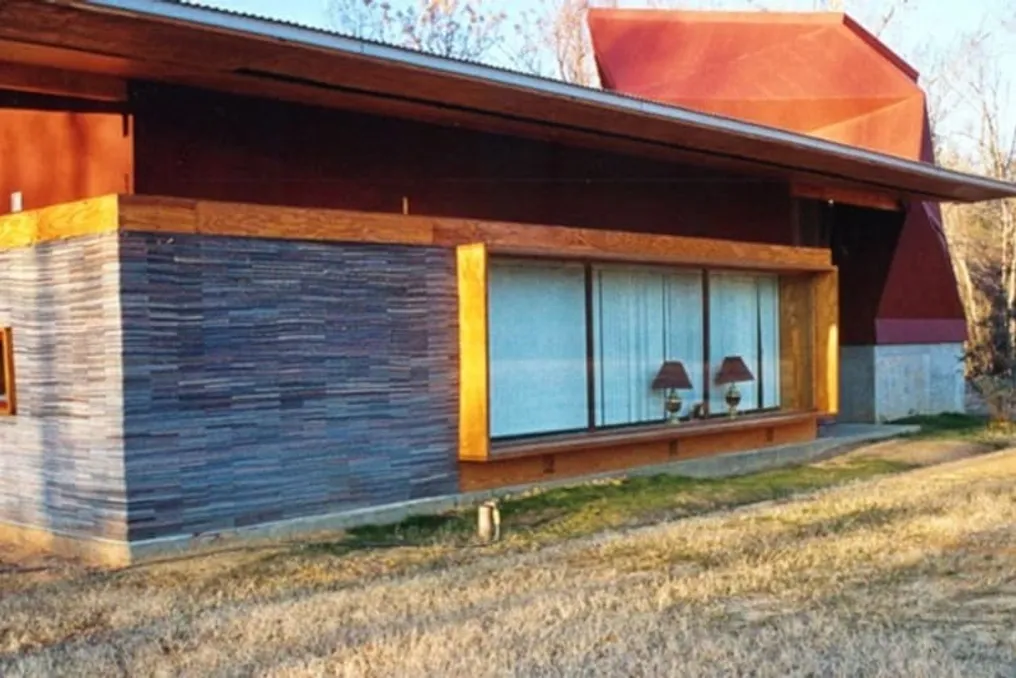
The experimental house located in Hale County, Alabama, demonstrates how people's needs can be met under conditions of limited resources. This project, known as the 'Lucy Carpet House,' has existed for over two decades.
The concept for this house was developed by six students as part of the Rural Studio program at Auburn University in 2002. The studio's co-founder, Sambo Mokbi, created the concept for this charitable housing for Lucy and Anderson Harris and their children. According to the Times of India, the goal of the project was to create affordable housing that addressed the family's needs.
The most notable feature of the house is its walls, which are constructed by laying 72,000 different carpet tiles on top of each other. These tiles are reinforced with massive wooden ring beams. The house includes a bedroom upstairs and a tornado shelter downstairs. Since the Alabama region is known for severe storms, special attention was paid to the house's design for protection against adverse weather conditions.
The project was funded by Interface Carpet, which provided $30,000 and 72,000 pounds of used carpet tiles. These tiles were stored for about seven years to allow all contained gases to dissipate and ensure their safety before being used in construction. The use of recycled carpet tiles significantly simplified the construction task under the students' limited budget, allowing funds to be allocated to fulfill Lucy's specific wish—to have a place for prayer in her new home.
Lucy's bedroom is designed as a separate tower that opens directly to the sky. Lying in bed, Lucy can observe the sky. The light and shadows falling on the various surfaces of the tower create a constantly changing picture inside the room. This design serves as an example of how a resident's personal needs can be integrated into an architectural solution rather than merely being an addition.
'The Lucy Carpet House' is part of the broader philosophy of Rural Studio, which views architecture not just as the process of building structures. In 1993, two professors from Auburn University visited Hale County. At the time, Newbern was a small town with dusty roads and churches, where many residents lived in old and unsafe homes. Their idea was to work within the student community, learning practical skills and helping to strengthen local infrastructure.
Since then, Rural Studio has completed over 200 projects and trained more than 1,200 students in the Black Belt region of Alabama. Approximately four dozen students participate annually in this context-based service learning program. They develop solutions by living and working alongside local residents. Thus, the design is not created in isolation in a studio but collaboratively with the community for whom the project is intended. Students are encouraged not only to consider what can be built but also what should be built.
Their projects must be resilient to local conditions, including tornadoes in the region known as 'Dixie Alley,' as well as extreme summer and winter temperatures. According to Rural Studio director Andrew Freer, the program's goal is to prompt young architects to recognize their moral responsibility for the social, political, and environmental consequences of their projects and construction.
Rural Studio's activities have gradually focused on the issue of affordable housing. In 2004, they launched the 20K initiative. Under this initiative, students were tasked with designing independent homes that could be built within economically viable costs for materials and labor. This initiative and other studies by the studio have provided extensive knowledge about methods for large-scale implementation of affordable housing. This work is further advanced through the Front Porch initiative, which attempts to implement designs for affordable and highly efficient rural housing on a national scale, collaborating with housing suppliers and other organizations.
Rural Studio aims to change existing models and methods of affordable housing by utilizing the designs developed within the 20K initiative and new financial models created in partnership with collaborators. Rural Studio's work in Newbern relates to the challenges faced by rural communities, which many small towns around the world encounter.