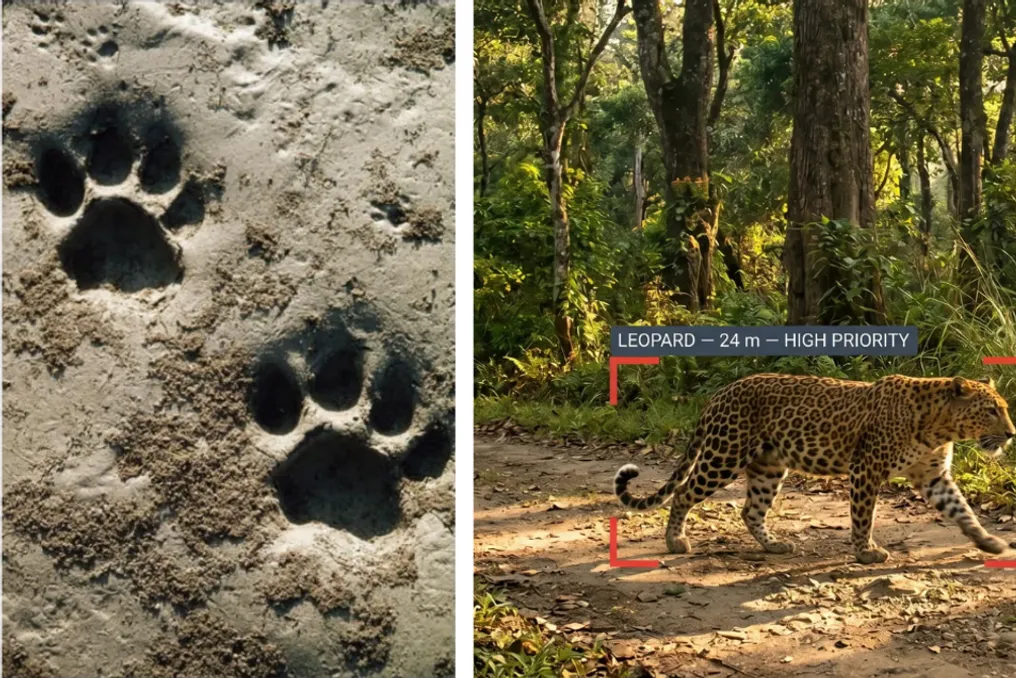
Previously, tiger traces in the forest were recorded by paw prints, but today artificial intelligence is actively used in this work. This story is part of the series 'How Technology Has Changed' from The Better India, which explores the transformation of various sectors, systems, and daily experiences, from travel and education to agriculture, construction, communication, and healthcare access. Technologies are capable of radically changing the work of an entire sector, making processes faster, smarter, safer, more accessible, and efficient.
In the past, the forest was studied mainly through tracks, excrement, and the vigilance of trained forest guards who walked kilometers of routes daily. However, today the same landscape can tell its story completely differently: a GPS device can record patrol routes, a camera trap can identify a specific tiger by its stripes, and an AI-enabled camera can potentially send an alert to a ranger within seconds.
When a Paw Print Was Proof
Before smartphones, camera traps, and artificial intelligence, tiger monitoring often consisted of studying their physical characteristics. Forestry workers traversed tiger habitats, searching for tracks and other signs, recording observations manually. Although paw print surveys were conducted to count tigers by measuring and comparing prints, this method heavily depended on the person recording the data, as well as local conditions, weather, and interpretation.
Patrolling was also predominantly a manual process: routes, wildlife observations, and suspicions of poaching were recorded in paper logs. Information existed, but transferring it from the forest level to those who could take action took a long time. The forest guard's experience remained the main tool, but the system had limited capacity to convert this experience into data that could be quickly mapped, compared, or used for decision-making.
Then the Forest Gained a Digital Footprint
The next stage occurred when technology began accompanying people moving through the forest. The M-STrIPES system—Monitoring System for Intensive Protection and Ecological Status of Tigers—introduced GPS, mobile applications, and digital databases into tiger reserve management. Forest guards could register patrol routes, wildlife sightings, crime scenes, and other field information with geotagging data. Managers could use this information to understand patrol areas and determine zones where conservation efforts needed to be intensified.
Next came camera traps. These cameras, placed along forest trails and activated by movement, could photograph animals without human presence. For tiger population conservation, this radically changed population assessment: individual tigers could be identified by their unique stripe patterns, and vast collections of photos provided a much fuller picture of the wildlife population. For example, the 2018 tiger population assessment in India utilized 26,838 camera trap deployment points and generated over 34 million wildlife photographs.
However, there was a drawback. A camera could record what was happening, but it couldn't always inform a ranger that it was happening right now. Images often needed to be physically retrieved and processed, making the technology very useful for monitoring and assessment, but less suitable for preventing an incident as it occurred.
From Forest Recording to Real-Time Listening and Observation
This is where the new generation of technology comes in, changing the situation. Modern systems are beginning to integrate artificial intelligence directly at the point of image or sound capture. Edge-AI cameras, such as TrailGuard, can analyze video locally, recognize humans, vehicles, or wild animals, and transmit relevant alerts instead of waiting for manual review of the entire photo collection. During trials in tiger habitats, alerts regarding the detection of tiger images reached smartphones in approximately 30 seconds.
Furthermore, cameras are no longer the only way technology learns to 'read' the forest. In Pench Reserve, an AI-driven bioacoustics alert system is being tested—essentially listening to the forest. The system analyzes distress or alarm signals from prey animals, such as deer, to detect signs of large predator presence. Alerts can then reach forest officials and nearby communities, giving people time to react before the encounter escalates.
Other real-time video surveillance systems are also being developed, including AI-enabled cameras and GSM-connected monitoring. Recent documentation by NTCA notes the implementation of systems like Garuda in Nagarhole, which combine AI, GSM camera traps, and real-time monitoring to support wildlife protection and conflict management.
The Biggest Change Is Time
The evolution is not simply a transition from paper to phone or from paw prints to cameras. It represents a shift from analyzing the past to the ability to respond at the moment of occurrence. A paw print informed the forest guard of a tiger's passage; a camera trap could show which specific tiger it was; a GPS patrol system showed where the guards were located. An AI system, however, can potentially recognize a tiger, a human, or a threat and send that information to someone who can act while the tiger is still moving through the landscape.
Thus, technology does not replace the forest guard or the knowledge accumulated over generations. It expands the guard's capabilities in terms of what they can see, record, and react to. And somewhere among the trees, the tiger continues to do what it always has: walk through its forest and leave tracks. The difference is that today, the forest can sometimes answer in real time.