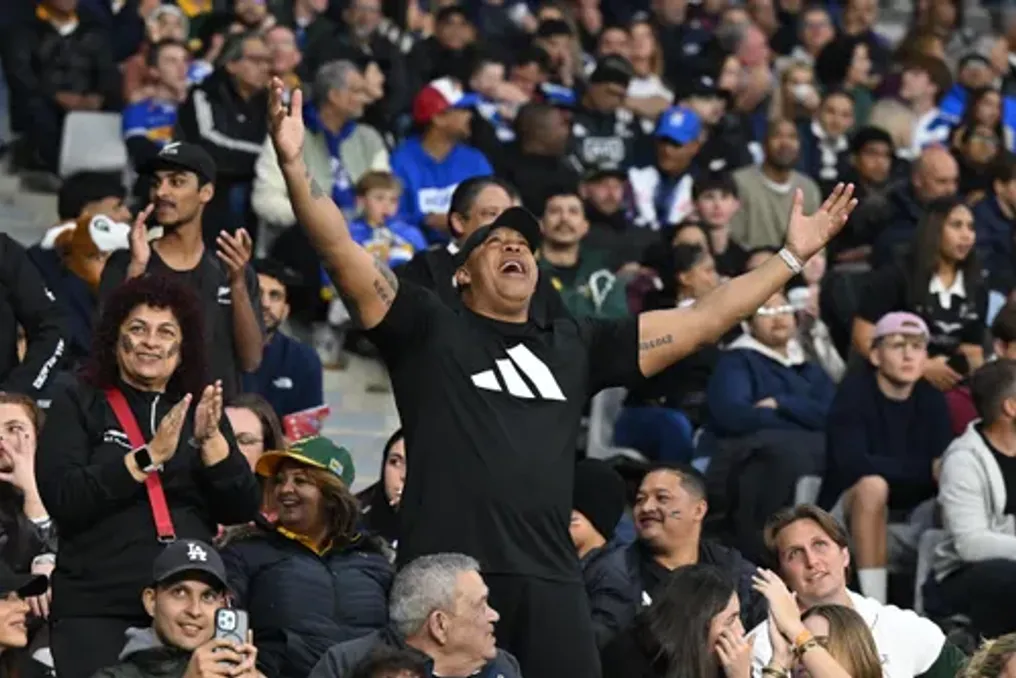
Springboks aim to defeat All Blacks in the 2026 final home match
Read more
IOL
iol.co.za

Springboks aim to defeat All Blacks in the 2026 final home match

Rassie Erasmus emphasized the importance for the Springboks of playing home matches in 2026, especially the third game against the All Blacks, which will allow them to avoid losing the series.

Erasmus explained that the series is extremely important for the team, which they desperately want to win. After losing the first game and winning the second, the team decided to keep the squad, considering it the best decision for one of the key matches of the series.

He noted: 'We cannot win (the series) this Saturday, but we can guarantee that we won't lose it, as the last match will be either a draw or (a complete victory in the series). Therefore, we just feel that this is the best team to achieve our goal this weekend.'

Next week, the 'Greatest Rivalry' tour will conclude in Baltimore, making the match at the FNB stadium near Soweto the last for the Boks in the country in 2026. Erasmus added: 'This is our last match on South African soil in 2026. We would like to give our fans a victory.'

If the team does not resolve its defensive issues, the All Blacks may take advantage of it. In the first two matches, the All Blacks repeatedly caught the Boks off guard in wide areas where an unprotected player was always present. The Kiwis scored nine points against four South Africans.

Erasmus commented on the Kiwis' game, noting: 'They were brilliant in the wide areas. That is what they do very well under Dave Rennie. Under his attacking coach, they are hard to stop.'

He also spoke about Mike Blair, the former Scottish midfielder recruited by Rennie: 'Their two halves were the result of individual defensive errors. They beat us and outsmarted us in the other two, and we must be ready for that. So this is an area where we must improve.'

Furthermore, Erasmus stated that the South Africans had to work harder for their points than their opponents because the Kiwis have players who individually surpass the Boks players physically: 'Undoubtedly, that is something we must fix.'

Erasmus formed a starting lineup that differs only slightly from the squad that won in Cape Town. Damian Willemse was replaced by Cheslin Kolbe at fullback, and Kurt-Lee Arendse plays on the flank instead of Kolbe. Recently, before last week's match, Erasmus fielded a reserve front line consisting of Gerhard Steenkamp, Dion Fourie, and Thomas du Toit in the starting lineup, while Ox Nche, Malcolm Marx, and Vilko Lou played on the bench.

Erasmus explained how this was possible: 'We did it, it worked. I see that there was some issue with this. But an hour before the match, when you submit your player list, if they are in your 23-man squad, you can change the entire bench and start other guys if you want.'

He confirmed the legality of this action: 'It complies with the rules of the game. Frankly, we thought it would be a very wet match, and there is no doubt that heavier players scrum better on heavy fields, and lighter ones on firm fields. This weekend we plan to stick to this starting lineup.'
Similar stories

Rassie Erasmus supported the referee's decision after the All Blacks scrum changed the course of the match at Ellis Park
Read more
iol.co.za

Rassie Erasmus supported the referee's decision after the All Blacks scrum changed the course of the match at Ellis Park

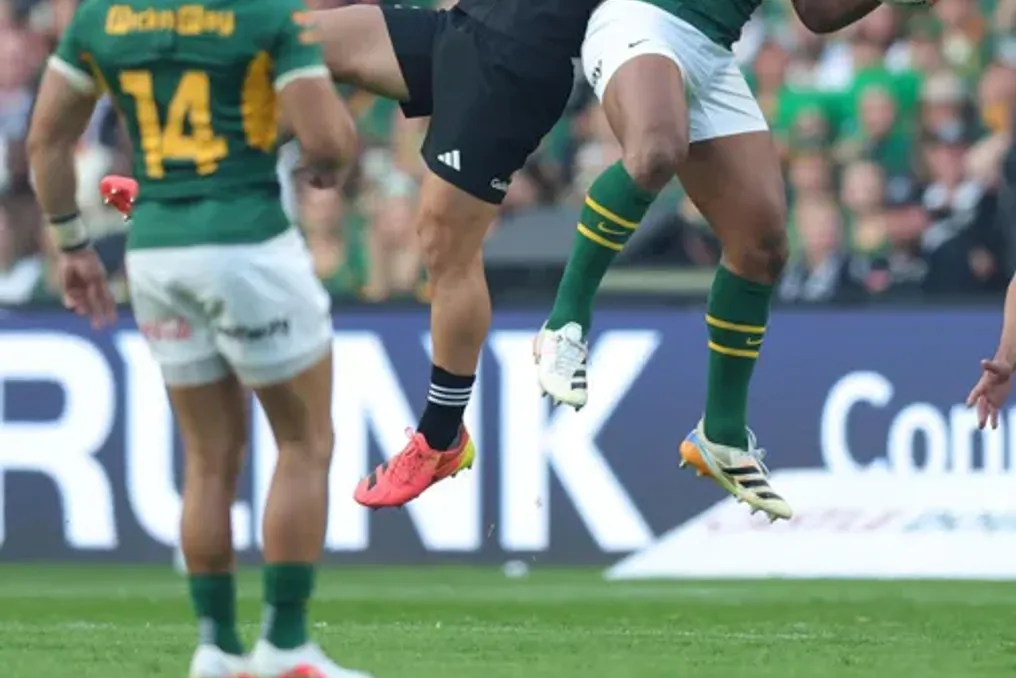
During the match at Ellis Park between the Springboks and the All Blacks, Springbok fullback Damian Willemse took a high pass under heavy pressure on Saturday. He was one of the few outstanding players for the 'Boks' in the losing team against the All Blacks.

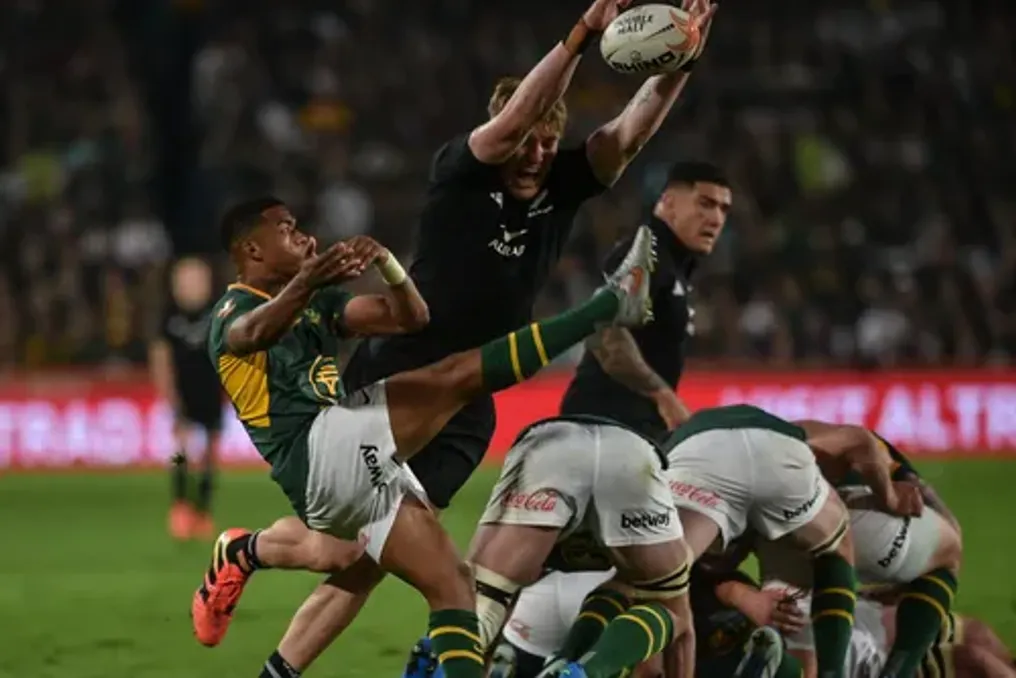
The Springboks controlled the game, pressed the All Blacks to their own goal line, and sought to earn decisive points that could change the course of the opening of the greatest rugby rivalry in Johannesburg. However, the referee's decision regarding the scrum was made against the world champions, and New Zealand managed to overcome the pressure and completely turn the game around a few minutes later.

The Greatest Rugby Rivalry

When the Boks were trailing 16-19 around the 58th minute and needed only three points to level the score, the All Blacks organized a powerful scrum on their goal line to avoid danger after the home side opted for a scrum following a penalty. They then advanced and scored, increasing their lead, which decisively shifted the momentum in their favor, ultimately winning 33-16 at Ellis Park.

Springboks coach Rassie Erasmus, however, felt that the referee made the correct decision regarding the scrum, although he admitted that Gerhard Steenkamp bypassed a player during the play.

Erasmus stated: 'I think it was the right decision, and I believe Gerhard bypassed (during the scrum).' He continued: 'The option from above (from the coaching area) was to take three points (from a penalty), because we were only behind by that amount at that stage. But undoubtedly, they played very well in the scrum. Since then, the momentum shifted.'

He added that many of the team's errors were caused by the good play of New Zealand. 'The ball wasn't slippery, and we cannot use that as an excuse; we are also not an inexperienced team that was playing. Probably it was the pressure they put on us during the ball breakdown and in open play.'

Erasmus also expressed regret that the Boks were only leading by one point at halftime, despite dominating most of the first 40 minutes of the match.

Despite having many attacking opportunities in the All Blacks' half and in the 22-meter zone, errors, including knock-ons, interrupted their progress, allowing the Kiwis to repeatedly exit dangerous areas without conceding points or missing just three, which suited them.

He noted: 'I am sorry, and perhaps that is their strength. They know how to stop you in the 22-meter zone in different ways; whether it's knocking the ball on, tackling on the ground, or harassing the midfielder within the rules, and we couldn't handle it.' Erasmus concluded: 'I thought that until the 50th minute we were truly dominant territorially and in possession, and we were in the game. But with such a classy team as the All Blacks, if you don't convert, they will give you a real punishment.'

All Blacks defeated Springboks 33:16 in match at Ellis Park
Read more
iol.co.za

All Blacks defeated Springboks 33:16 in match at Ellis Park

The All Blacks secured a convincing victory over the Springboks with a score of 33:16 in the first match of the Rugby's Greatest Rivalry Test series, which took place at Ellis Park in Johannesburg on Saturday. The fantastic performance by the All Blacks in the second half allowed them to crush the Springboks.

By the end of the first half, the All Blacks were in a difficult position: their scrum was under pressure, and penalties were accumulating. Despite going into the break trailing 13:12, the team managed to surpass the Boks and score the first try in the four-match series.

In the fifth minute, Cheslin Kolbe, who was responsible for kicks, gave the Springboks an advantage with a penalty kick. The early aggressive defense of the Springboks created immense pressure on the All Blacks, but the visitors managed to get into the Springboks' 22-meter zone after some disciplinary error by the South Africans. The hosts conceded many penalties and ultimately earned the right to an out-swing kick on their territory.

Winger Will Jordan scored a close-range goal, giving the Kiwis the first lead. However, the Springboks immediately responded when substitute André Esterhuizen broke through the goal line shortly after winger Kurt-Lee Arendse was substituted. Josh Moorby scored the second try for the All Blacks, after which Kolbe once again restored the Boks' advantage.

Closer to the end of the half, the South Africans concentrated their attacks in the All Blacks' 22-meter zone, but the visitors managed to hold on until the break. Kolbe converted another penalty kick, increasing the Springboks' lead by four points. Although the Boks dominated the scrum early in the second half, they failed to convert their superiority.

After the substitution of Ox Nché in the Springboks squad, the All Blacks began to level the situation in the scrum. They then scored three tries in the second half, completely overwhelming the Springboks, who finished the game with 13 players on the field. Fabian Holland, Luke Jacobson, and Jordan scored all three tries in the second half, posing a difficult challenge for the Boks to recover in the series next week in Cape Town.

The goals were scored as follows: Springboks — try by André Esterhuizen, conversions by Cheslin Kolbe, penalties by Kolbe (2). All Blacks — tries by Will Jordan (2), Josh Moorby, Fabian Holland, Luke Jacobson, conversions by Ruben Love (4).

Springboks coach Rassie Erasmus states he has no objection to South Africans supporting the All Blacks
Read more
iol.co.za

Springboks coach Rassie Erasmus states he has no objection to South Africans supporting the All Blacks

Springboks coach Rassie Erasmus stated that his team is unaffected by the massive support enjoyed by the All Blacks ahead of the RGR test match opening on Saturday.

Rassie Erasmus emphasized that he has no complaints about the large number of South Africans who continue to support the All Blacks during the tour, which is dubbed the 'Greatest Rugby Rivalry.'

During apartheid, many disadvantaged South Africans supported the multiracial All Blacks teams during their visits to the country. Although some of them later switched allegiance to the revamped Springboks team under Erasmus's leadership, a significant portion maintained their loyalty to the New Zealand team.

This was evident during the first match of the tour between the All Blacks and the Stormers in Cape Town on August 7th. Erasmus told a press conference in Johannesburg on Monday: 'When I grew up, I watched the series of rebellious New Zealand Cavaliers in 1986, and before that, the 1981 tour to New Zealand, when bombs filled with flour were thrown at players in Eden Park.'

He also mentioned his idols: 'My heroes were also the All Blacks, such as Murray McTestad and Zinzan Brooke. Danny Gerber was also my hero, but I wanted to play like McTestad, as well as Rob Law.'

Erasmus noted that there is nothing unusual about South Africans supporting teams other than the Springboks. He compared it to football: 'If you look at our coaching staff, some guys support Liverpool, others support Manchester United. We must allow this, provided that the team support does not become indecent and personal conflicts do not arise between people.'

The coach admitted that he understands the political reasons behind some South Africans supporting the All Blacks, while others simply admire the New Zealand style of play. In his opinion, this 'adds spice' to the competition. He added that the situation in Cape Town with mass support was characteristic since childhood, from his first match against them and his last match as a coach.

At the same time, Erasmus noted the growth of his audience: 'The other side of the coin is that several years ago we did not have such large support in South Africa. We grew from five or six million to 16 million active fans. So we have grown too.'

Erasmus believes that the upcoming first match between traditional rivals will be beneficial for rugby as a whole. He concluded: 'Such games make people want to watch rugby more. Because nobody knows who will win on Saturday. Nobody can say. So we have no problem with people supporting the All Blacks. If we cannot win them with how we play, how we behave as a team, and put our country first... Maybe these fans just like how the All Blacks play. Or maybe they look back in history and see what New Zealand meant to them or to their fathers. Who are we to tell them they cannot support the All Blacks?'

Popular