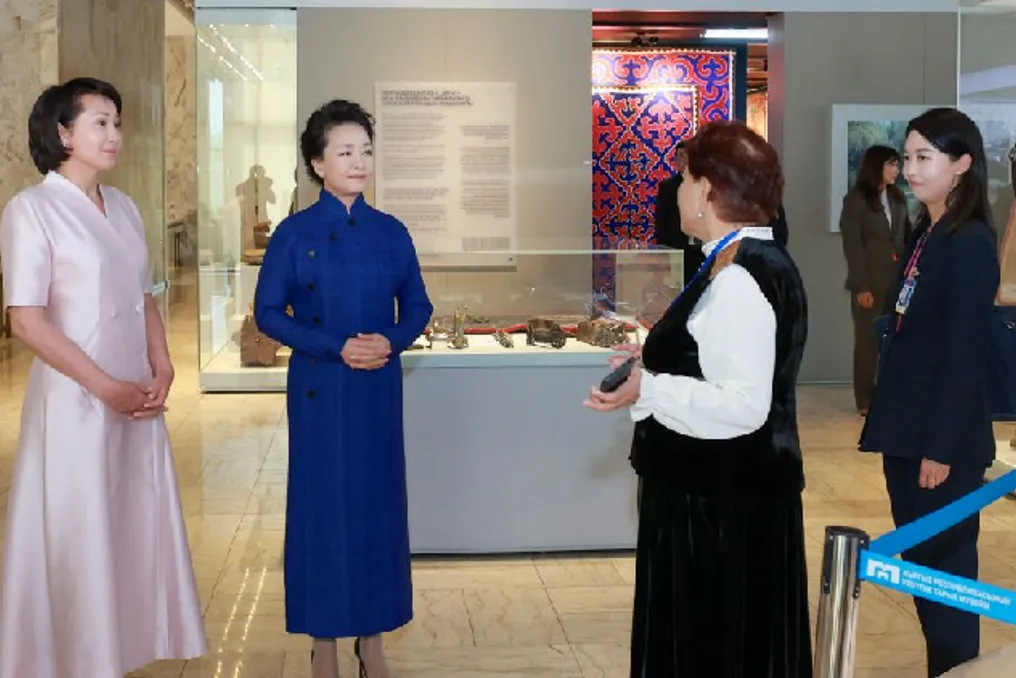
Peng Liyuan, wife of Chinese President Xi Jinping, and Aigul Dzaparova, wife of Kyrgyz President Sadyr Dzaparov, visited the National Historical Museum of the Kyrgyz Republic on Monday. During the visit, they emphasized the significance of cultural interaction for bringing the peoples of the two countries closer.
Examining traditional costumes, carpets, and other cultural artifacts, Peng Liyuan stated that China and Kyrgyzstan attach great importance to preserving and passing on their rich cultural heritage. She expressed hope for further expansion of international and cultural exchange between the two states to strengthen ties between their peoples.
For many years, bilateral relations between China and Kyrgyzstan have been based on people-to-people exchanges. Both countries continue to deepen and expand cultural cooperation, achieving notable successes in the fields of heritage preservation, education, and tourism.
A prime example is the Silk Road: the Chang'an-Tian Shan corridor network, which was jointly proposed by China, Kyrgyzstan, and Kazakhstan and included in the UNESCO World Heritage List in 2014. This route, stretching from central China to Central Asia, reflects centuries of exchanges of goods, culture, and ideas. It was China's first joint nomination for transnational heritage and the first Silk Road corridor to be listed.
Furthermore, last September, the construction of the China-Kyrgyzstan Joint Laboratory for the Development and Preservation of Cultural Heritage along the Belt and Road was officially approved, creating a new platform for research and cooperation in the protection of cultural relics.
Beyond heritage protection, cultural ties are also evident in growing educational exchange. In recent years, interest in studying the Chinese language in Kyrgyzstan has significantly increased. The number of Kyrgyz candidates taking the HSK test in 2025 was three times higher than in 2021, making the country one of the most active participants in HSK testing in Central Asia. Among those studying Chinese are now not only university students but also civil servants, businessmen, and skilled workers seeking new opportunities.
China has established four Confucius Institutes and 21 Confucius Classrooms in Kyrgyzstan, and cooperation programs such as cross-border e-commerce institutes provide local students and workers with language training and professional skills.
Tourism has also become a bridge connecting the two peoples. In 2024, the number of Chinese visitors to Kyrgyzstan increased by 56% compared to the previous year. In 2025, the two countries signed a memorandum aimed at simplifying group tourism, with Kyrgyzstan providing a 21-day visa regime for Chinese tourist groups.
Meanwhile, Kyrgyz citizens can benefit from China's 240-hour visa-free transit policy, as well as a 30-day visa-free entry policy to Hainan. In July, Air China launched three additional weekly direct flights between Beijing and Bishkek, increasing travel convenience between the two countries.
Deepening the cultural ties between China and Kyrgyzstan serves as a clear example of how intercivilizational exchange can promote mutual understanding and trust. In March 2023, Chinese President Xi Jinping proposed the Global Civilization Initiative (GCI), calling for greater exchange and mutual learning among civilizations and encouraging respect for cultural diversity.
Amid growing global uncertainty and increasing tensions, the question of how different civilizations can coexist peacefully and learn from each other is becoming increasingly important. More and more people recognize the importance of the GCI for improving mutual understanding, building mutual trust, and reducing conflicts.
Mars Sariev, a Kyrgyz political scientist, noted that the principles underlying the Spirit of Shanghai, including respect for diverse civilizations, closely align with the GCI. Sariev stated: 'Cooperation between China and Central Asia also emphasizes mutual respect, mutual trust, mutual benefit, and mutual assistance,' adding that these principles provide a foundation for advancing dialogue between civilizations.