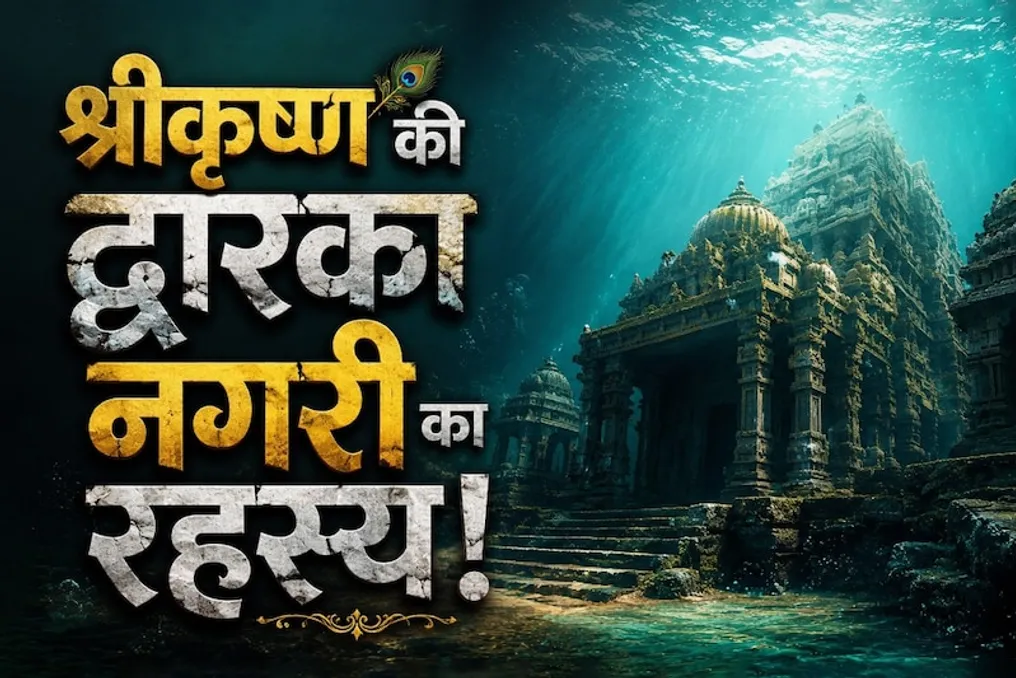
The question arises: how did the magnificent city of Dwarka, the capital of Lord Krishna, end up submerged under the sea? The story of this city is told, which once proudly stood on the shores of the sea. It was a settlement with luxurious palaces, wide streets, markets, and bustling maritime trade. However, over time, this entire city gradually disappeared from historical records.
According to ancient scriptures, Dwarka was the capital of Krishna. Its grandeur is described in the epics Mahabharata, Harivamsa, and Shrimad Bhagavatam. According to beliefs, after leaving Mathura, Krishna founded a new, safe city by the sea for the Yadavas.
The city served not only as a place of residence but also as a major center of trade, culture, and power. Merchants arrived here by sea from afar. The description of the city's structure and wealth is so grand that Dwarka is considered one of the most famous cities of ancient India. But then came the time after the Mahabharata war. The war ended, the Kaurava clan ceased to exist, and Gandhari was plunged into grief over the death of her sons. According to mythological traditions, it was during this period that she cursed Krishna, saying that the Yadava clan would meet the same end as the Kaurava clan.
Over time, internal conflicts among the Yadavas intensified, and the moment came when Krishna completed his incarnation mission. After Krishna's departure, Dwarka, according to mythological views, began its decline. It is said that the sea gradually swallowed this city. Palaces, streets, and buildings sank under the waves. Centuries passed. The name Dwarka remains in texts and religious traditions, but in the world of history, the question remained: did Krishna's city really exist?
When Did Searches Begin in the Ocean Depths
Then searches began in the ocean depths. Marine archaeological surveys were conducted in the 20th century off the coast of Dwarka in the state of Gujarat and its surroundings. Stone structures, ancient anchors, and numerous artifacts related to human activity were discovered underwater. These findings once again drew attention to the history of Dwarka.
Researchers used methods of marine archaeology, diving, and scientific technology to understand the history of the region. Artifacts found from various locations indicate that the coastal area of Gujarat was an important center of human settlement and maritime activity since ancient times.
Is Krishna's Dwarka Under the Sea?
However, the biggest question remains open: are all the underwater remains truly the Dwarka of Krishna from the Mahabharata era? Different opinions still exist among historians and archaeologists on this matter. Dating of various samples and structures points to different historical periods. Therefore, scientifically, it is currently impossible to assert that every discovered structure is the very Dwarka described in the Mahabharata and Puranas. Nevertheless, these discoveries clearly showed that the coastal region of Gujarat witnessed maritime activity and human civilizations for millennia.
The Mystery of Dwarka Between Faith and Science
The story of Dwarka becomes particularly interesting here. On one hand, there is Dwarka that exists in faith, where the capital of Krishna, his life, and the city that sank into the sea after his departure are told. On the other hand, there is Dwarka that science seeks in the ocean depths, where questions are asked about the past of every stone, every structure, and every archaeological object. Perhaps this is why Dwarka is not just a religious story and not just an archaeological find. It is a mystery where faith, history, and science meet.
Dwarka Sank, But the Story Continues
Dwarka has sunk, but its story will never end. Today, many historical questions are hidden beneath the waves of the Arabian Sea. Perhaps in the future, new technologies and the help of marine archaeology will lead to new evidence that will help us better understand the history of this ancient city. And perhaps then another chapter of history hidden in the depths of the sea will be revealed to us.