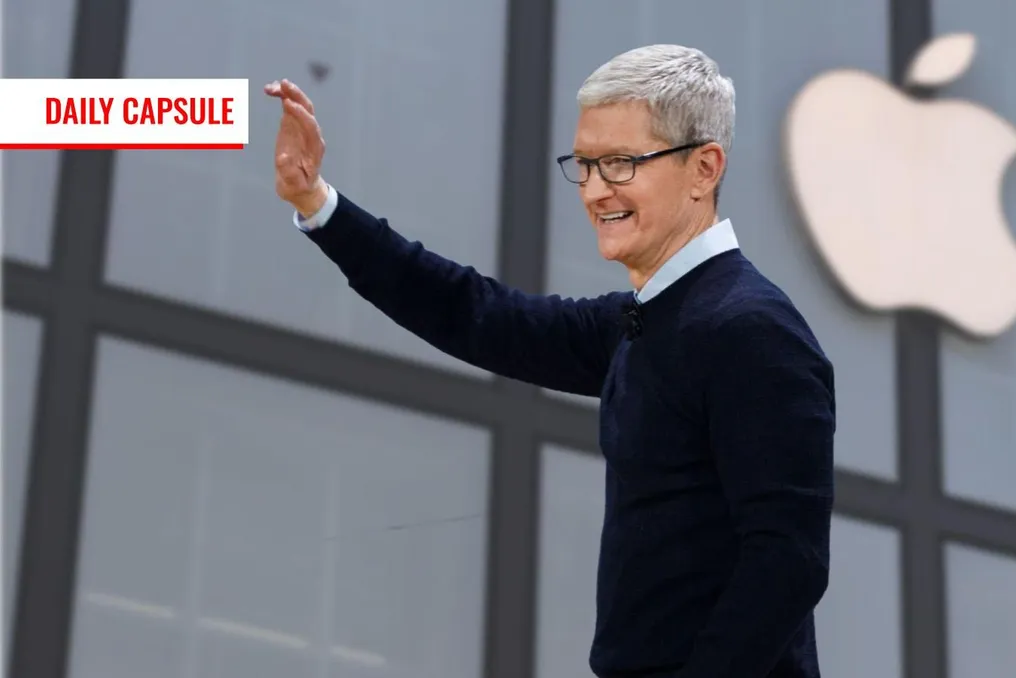
Although some argue that only Steve Jobs could have founded Apple, it is Tim Cook who managed to develop it to the level it has reached. This perspective is shared by Warren Buffett, one of the biggest shareholders in big tech and a prominent business figure, when commenting on Cook's departure from the company's CEO position this Tuesday (the 1st).
Tim Cook remained in the role for fifteen years but will not leave Apple; he will assume the position of Executive Chairman of the Board. In this new role, he will act as a mentor to the current head of hardware engineering and Apple's new CEO, John Ternus.
When questioned by CNBC about the legacy he leaves at Apple, Cook expressed that his reputation will be defined by others, hoping they tell him he was a good and decent individual, which would bring him satisfaction.
On his last day as CEO, Tim Cook addressed a letter to employees, thanking the team and highlighting the work built collectively over the years, detailing his connection with the company.
He wrote: “This is a moment I always knew would come one day, and yet, it is hard to believe it has arrived and that I am writing these words. (…) Few people understand what it takes to create world-changing products the way John understands, and I couldn't be more excited about his leadership.”
When Tim Cook took the helm at Apple in 2011, he faced strong skepticism. At that time, he was perceived as a “strict manager of costs and processes,” in contrast to Steve Jobs' image as a “superstar” and visionary, according to Arthur Igreja, a technology and innovation specialist, in an interview with Olhar Digital.
The specialist mentioned that many predicted Apple's product flow would decrease after Steve Jobs' death, anticipating crises at the company. However, the scenario was the opposite: the company celebrated its 50th anniversary grandly and frequently ranked among the world's most valuable corporations.
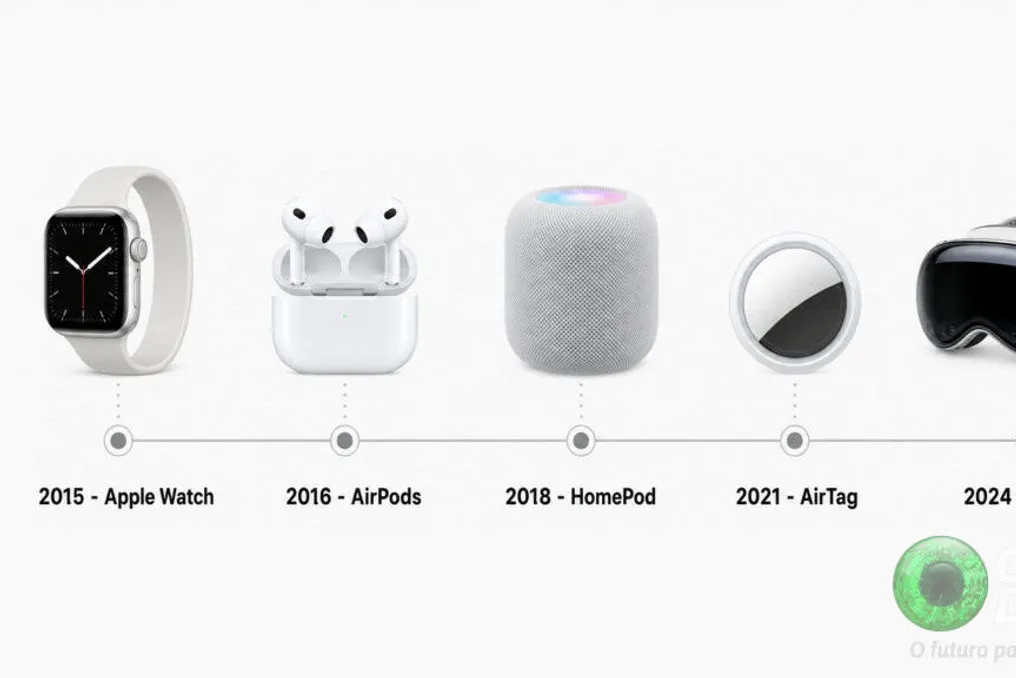
Between 2011 and 2022, Cook's management was marked by more successes than failures, increasing Apple's value. Wearable products (Apple Watch and AirPods) gained great acceptance. This growth persisted even amidst trade tensions between the United States and China, where the company's manufacturing was concentrated. Subsequently, the emergence of ChatGPT from OpenAI and the subsequent AI boom made the company, once a leader in technological trends, appear stagnant.
Since being hired by Steve Jobs in 1998, Cook's competence has manifested in two pillars: logistics and financial efficiency, remaining relevant throughout his presidency.
When he took over 15 years ago, Apple was valued at US$ 350 billion (about R$ 1.8 trillion at the current exchange rate). Currently, Cook delivered a company valued at nearly US$ 5 trillion (R$ 26 trillion), having reached the US$ 5 trillion mark at the end of July 2026.
Another notable indicator is the increase in annual revenue, which jumped from US$ 108 billion (R$ 558 billion) in 2011 to over US$ 416 billion (R$ 2.1 trillion) in 2025. Apple's shares appreciated by more than 2,000% under his administration.
Much of this revenue growth is due to the financial engineering implemented by Cook. Over the last 15 years, he restructured Apple's supply chain. His management involved closing proprietary factories, outsourcing production to Asian partners like Foxconn, and reducing idle inventory to near-zero levels, resulting in substantial profit margins.
Under Cook's leadership, Apple also expanded its portfolio. Since 2011, the company has introduced wearable devices. The success of models like Apple Watch and AirPods helped balance the company's revenue, decreasing exclusive dependence on iPhone sales for profit generation.
Another successful initiative was the migration to Apple Silicon in 2020, when the company replaced Intel processors in its computers (iMacs, MacBook, Mac Mini) with its own chips. Arthur Igreja classified this change as “a tremendously correct decision,” as it allowed the company to return to its initial phase of vertical integration between hardware and operating systems.
Igreja also highlighted a crucial transition: although Apple remains strongly tied to the iPhone, it was Cook who drove the entire ecosystem of applications and services, promoting a significant change in the company's revenue structure.
This consolidation demonstrated that Apple has existence and relevance beyond the figure of Steve Jobs, which can be considered Tim Cook's main legacy.
Cook demonstrated a unique ability to navigate the global geopolitical landscape, acting as a kind of corporate statesman through his discreet diplomacy. With a pragmatic and cordial stance, he mediated political disputes, keeping the iPhone empire functioning despite tensions between the US and China. He became one of the few technology leaders respected by the President of the United States, Donald Trump, while simultaneously pleasing the Chinese government and consumers.
This influence was evident when Cook participated in Trump's delegation to China in May 2026, accompanied by other Silicon Valley magnates, such as Elon Musk (Tesla and SpaceX) and Jensen Huang (Nvidia).
Even after leaving the CEO position, Cook will remain involved in world politics, as his new role as chairman of the board includes dialogue with international legislators.
Starting in 2022, the advancement of generative AI (which creates text, images, videos, and audio) became a point of attention in Cook's management. Although Apple has its own AI, with Siri launched in 2011 on the iPhone 4S, the popularization of tools like ChatGPT, Claude, and Gemini exposed the lag of Apple's assistant.
This fueled criticism of Cook's management pace, which was labeled as slow and excessively conservative. Critics argue that Apple prioritized financial discipline and operational efficiency over creative audacity. One example cited was the Apple Vision Pro, launched in 2024, which sold less than expected and did not generate the projected interest.
However, the issue of generative AI concentrated much of the final criticism of the Cook era. While competitors like Google and OpenAI invested heavily in technology, Apple reduced its CapEx spending (infrastructure and capital goods for AI), raising doubts among investors. Consequently, Apple lost the title of the world's most valuable company to Nvidia, the leader in the AI sector. Simultaneously, the Apple Intelligence package, announced in 2024, suffered successive delays in its promised functionalities.
Arthur Igreja points out two views: some analysts suggest that the historical concentration of the stock market in big tech leads to a more conservative approach from Apple, while others believe the company is technologically behind and needs to react.
The specialist warns that if consumers begin to signal the importance of AI, John Ternus will face a major challenge. Igreja concludes that Cook's legacy lies in the fact that a CEO does not need to be iconic like Steve Jobs; they can be someone more discreet or technical, which reassures the transition to John Ternus.
In 2011, Cook was seen as a “process manager” who needed to prove his ability to innovate. Despite ups and downs, his management left Ternus a giant valued at nearly US$ 5 trillion in 2026. From now on, the hardware engineer will define the course of this big tech during a revolution comparable to the rise of the internet, smartphones, and social media.
While Cook was more focused on processes, Ternus has a greater connection to technology and product. This contrast could generate mistrust, but Tim Cook's success established a climate of confidence. In his last conference call, he advised his successor to focus on offering products that “enrich” users' lives, ensuring a great business if this guideline is maintained.