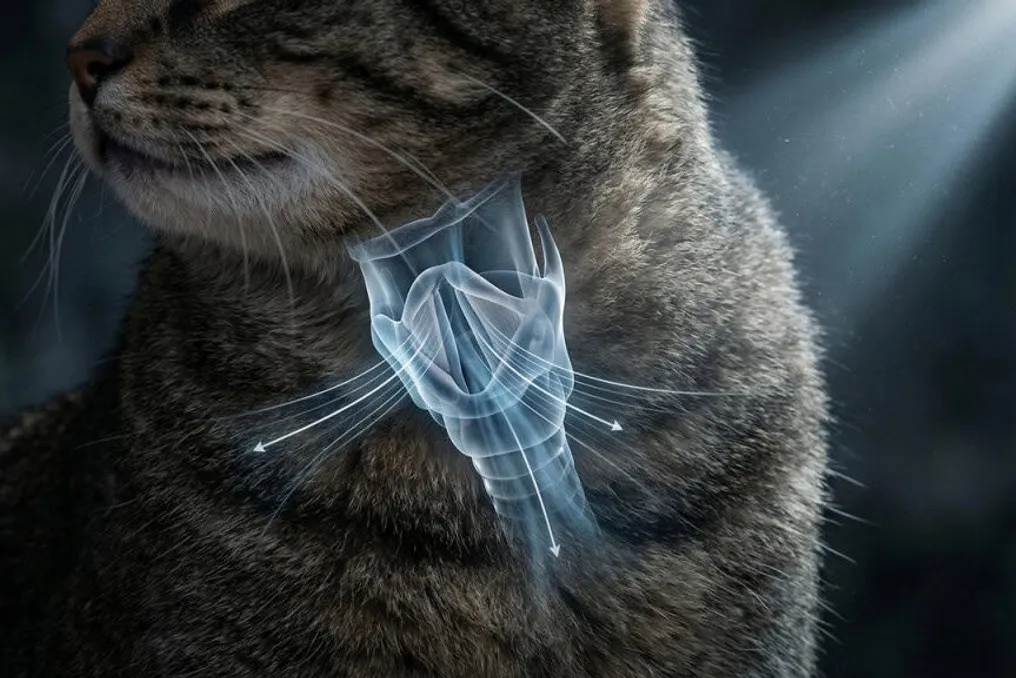
Cat purring is often associated with comfort, but its scientific relevance goes beyond that. A study conducted in 2001 analyzed the purrs of 44 felines and identified significant frequency components between 25 and 150 Hertz (Hz), the unit used to measure oscillations per second.
This frequency range sparked interest because it coincides with patterns observed in experimental studies involving mechanical vibration and bone tissue. This generated speculation in bioacoustics—the field that studies sounds emitted by living beings—that purring might have some physical function within the feline organism itself. However, it is crucial to distinguish this hypothesis from scientific proof, as current studies do not prove that purring cures fractures or accelerates tissue regeneration.
The study by Elizabeth von Muggenthaler, dated 2001, included the evaluation of 44 animals, encompassing domestic cats, cheetahs, jaguars, pumas, and servals. All examined animals exhibited strong frequencies in the 25 to 150 Hz range.
The theory arose because certain frequencies detected in purring are similar to those found in research on mechanical vibrations applied to tissues. An experiment published in the journal Nature in 2001, conducted by researchers from the State University of New York at Stony Brook and Colorado State University, applied low-magnitude, high-frequency vibration to the hind legs of adult sheep for one year. This stimulus, configured at 30 Hz, resulted in a 34.2% increase in the density of trabecular bone in the proximal femur compared to control animals.
Additionally, in another investigation involving 76 rabbits with fractures, scientists tested five vibrational frequencies and concluded that the frequencies of 25 and 50 Hz were the most efficient. Such findings indicate that specific vibrations can affect bone tissue in animal models; however, they do not establish that purring reproduces the same effect. In the trials, researchers controlled the frequency, intensity, and exposure period, which does not always occur when a cat is purring.
It is important to note that purring is not synonymous with happiness, as this sound can also be emitted in situations of pain, fear, or serious injury. Therefore, to assess the health and well-being of the feline, it is necessary to analyze the overall condition and behavior of the animal, and not rely solely on purring.
From a mechanical point of view, the cat's larynx has the natural capacity to generate low-frequency vibrations without exclusively depending on continuous muscle contractions or nerve impulses. Although these frequencies correspond to rhythms studied in physical therapies, the notion of a curative effect remains only a hypothesis. Purring does not restore bones, treat fractures, or replace medical or veterinary care.
In practice, the determining factor lies in the context: purring during moments of affection generally signals relaxation, but if accompanied by apathy or isolation, it should be considered a warning sign.