The Autech division represents a lesser-known facet of Nissan, operating as a parallel and distinct unit from the main production line. Its history is intrinsically linked to the evolution of the Japanese automotive industry, especially in the context of racing games like Gran Turismo 2, which popularized various tuner names and Japanese cars.
Many of the iconic models seen in games like GT2 were Japanese, and names such as RS Amemiya, Mine’s, Spoon, and TOM’S became well-known. Much of these companies are tuning shops or sports divisions that had close ties with major manufacturers, or were later incorporated into them.
Interest in Autech arose after observing a Nissan Silvia S15 Autech Version N/A, which was exported from Japan to the United States after completing 25 years of production. This vehicle exemplifies the unique character of Autech in the Japanese tuning scene.
The Legacy of the S15 and the Age of Power
The S15 generation marked the end of the S-Chassis lineage, a platform of light rear-wheel-drive sports cars that dominated JDM culture and drifting since the 1970s. Launched in 1999, the S15 was seen as the dynamic peak of the Silvia family, featuring aggressive design, a rigid chassis, and excellent weight distribution. However, its production ended in 2002 due to increasingly strict environmental regulations.
The year 1999 was a peak in performance competition in Japan, where the presence of a turbocharger, or even two, was almost mandatory to be taken seriously. Engines like the Nissan SR20DET and RB26DETT, and the Toyota 2JZ-GTE, were dominant. These machines received internal modifications, displacement increases, and larger turbos, allowing for powers exceeding 500, 600, or 700 hp. The chassis also evolved with adjustable suspensions and electronic differentials to optimize power delivery.
The Silvia Autech Version N/A stands out precisely by challenging this trend. Instead of using forced induction, Autech opted for a pure naturally aspirated engine. Unlike simply removing the turbo from the Spec-R version (turbocharged at 250 hp), Autech used the SR20DE engine from the entry-level Spec-S version (165 hp) and applied competition-level modifications, focusing on high RPMs.
Modifications included custom forged pistons to increase the compression ratio from 10.0:1 to 11.7:1. The cylinder head was completely reworked, lowered, with polished ports, and more aggressive camshafts. A custom 4x1 stainless steel exhaust system was made, and the ECU was reprogrammed to eliminate factory restrictions, achieving 200 hp at 7,200 rpm and a specific output of 100 hp/liter in a naturally aspirated engine.
Without forced induction, the engine and car became lighter, allowing the Autech Version N/A to perform well with classic rear-wheel drive, limited-slip differential, and six-speed manual transmission. Compared to competitors, this Autech S15 Silvia served as an alternative to the Honda Integra Type R, utilizing the correct drivetrain. It also inherited the enhanced brakes and structural reinforcements from the Silvia Spec-R.
Although the Silvia S15 Autech Version is not as sought after as the Spec-R, it illustrates Autech's philosophical difference. Interestingly, Autech did not start as a tuner; it was initially founded by Nissan in 1986 to adapt passenger vehicles for the elderly and people with disabilities, a segment called LV (Life-care Vehicle).
The Origin of Autech and the Influence of Sakurai
Nissan realized that its standard mass production did not meet the specific needs of this audience, such as installing wheelchair ramps, lowering suspensions for boarding, and rotating seats. A smaller, parallel, and agile studio was needed, capable of meeting the complex demands of customers.
The turning point in this story was Shinichiro Sakurai. Nissan appointed him to preside over this new, small accessibility van division. Sakurai, known as the 'Mr. Skyline,' was a chief engineer obsessed with ergonomics, dynamics, and the connection between machine and human. For him, the engineering rigor required to design a wheelchair mechanism was the same as that applied to tuning a sports car.
Under Sakurai's leadership, Nissan developed two special project divisions with opposing approaches. While Nismo focused on wind tunnel testing, lap times at the Nürburgring, and competition victories, Autech became a kind of 'Japanese Alpina.' It was Nissan's 'side B' division, specializing in niche Grand Touring vehicles, and responsible for realizing projects considered too mundane or eccentric by Nismo.
The expertise gained from adapting passenger vans—such as cutting floors and pillars to install hydraulic lifts and structural reinforcements for wheelchairs—gave Autech deep knowledge in monocoque modification. They knew how to cut and weld original bodies while maintaining torsional rigidity, applying this knowledge to the market of customized Japanese sports cars.
A notable example of this audacity is the 1998 Skyline GT-R Autech Version 40th Anniversary (R33). Many enthusiasts requested a four-door GT-R, something Nissan and Nismo refused. Autech accepted the challenge, creating exclusive rear doors and fenders to replicate the muscular body of the two-door GT-R, but in a family format. The vehicle retained the full GT-R powertrain: twin-turbo RB26DETT engine, manual gearbox, and ATTESA E-TS all-wheel drive.
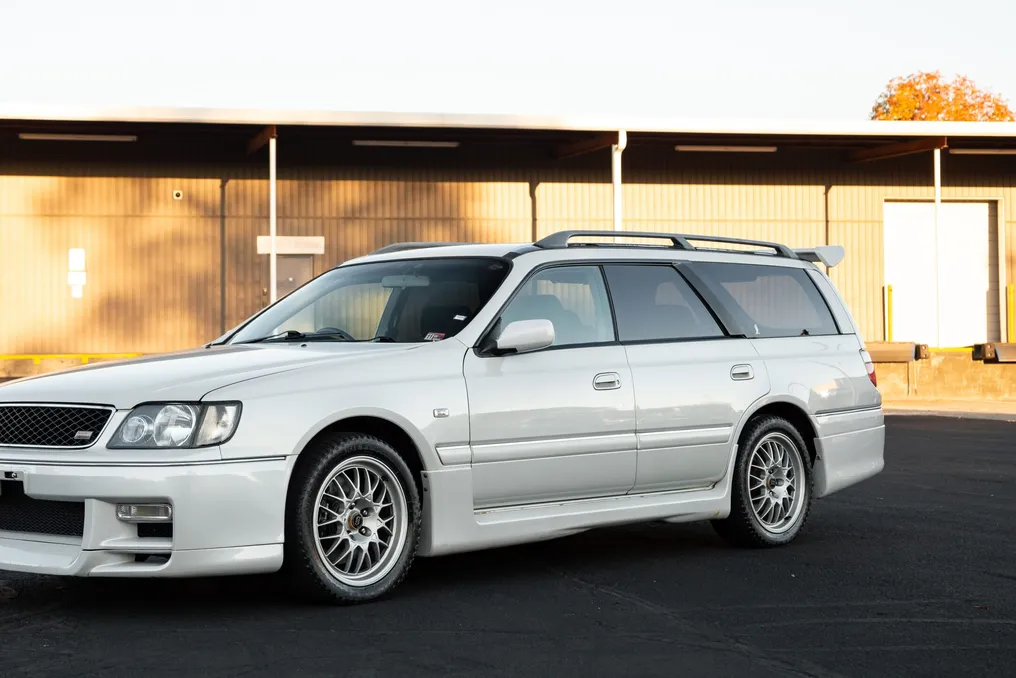
Autech also produced the Stagea 260RS, a sporty wagon beloved by JDM fans. They transferred all the mechanical and electronic components of the Skyline GT-R R33 to the Stagea WC34 body. The result was a powerful wagon, equipped with Brembo brakes and a reinforced chassis, comparable to a Japanese Audi RS2 Avant.
Besides the Silvia S15 Autech N/A, the same generation also yielded the Silvia Varietta, launched in 2000. This was the first Japanese convertible with a retractable hardtop, where Autech reinforced the coupe's structure to prevent typical open-car torsion, resulting in an elegant cruise, opposite to drifting cars.
Other Notable Autech Creations
Although the Stagea 260RS and the four-door GT-R are celebrated, Autech also created more obscure models. Among its achievements are:
Skyline Autech Version (HNR32): Following the line of the Silvia N/A, Autech started from a four-door sedan, installed the ATTESA all-wheel-drive system, and used the RB26DE engine. They removed the turbos from the GT-R engine, adapted it with specific manifolds, and converted it into a 2.6L naturally aspirated engine producing 220 hp, coupled with a four-speed automatic transmission, aiming for a smooth and comfortable road sedan.
Silvia Autech Version K’s MF-T (S14)
Based on the Kouki version of the S14 (produced in 1997 and 1998), Autech developed its ultimate S14 turbo. The SR20DET engine received an exclusive IHI roller turbocharger, larger injectors, and a modified exhaust, delivering 250 hp (compared to the original 220 hp). Aesthetically, the car featured a large rear wing, reminiscent of WRC cars.
Pulsar VZ-R N1 Version II (JN15)
Autech's contribution also extended to the Pulsar VZ-R N1 Version II (JN15).