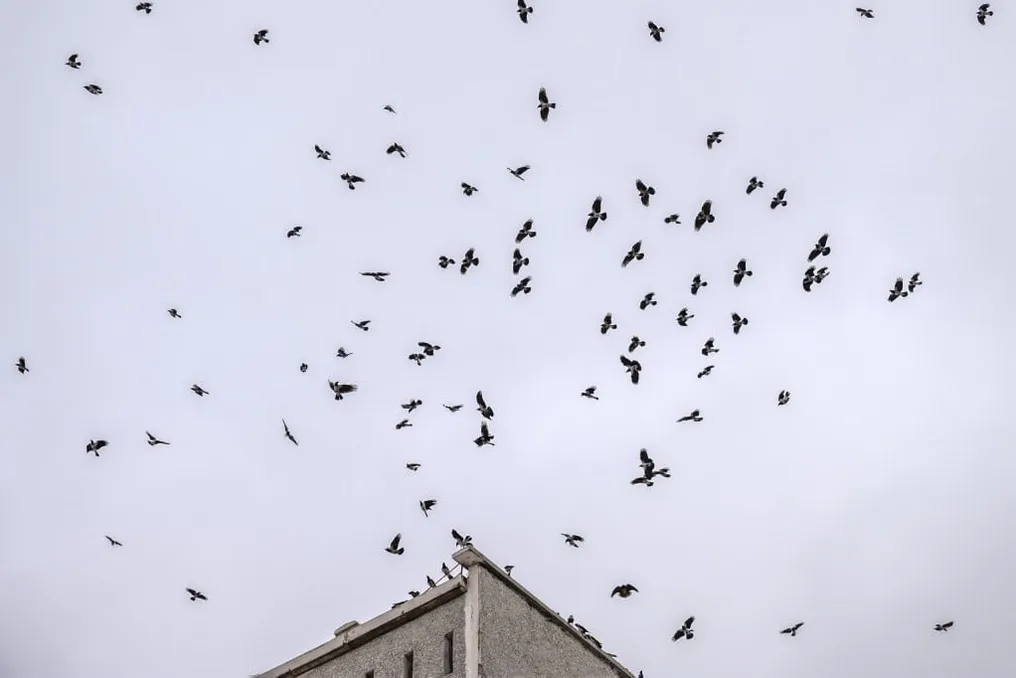
Crows of the species Corvus brachyrhynchos are capable of remembering the facial features of a specific person associated with danger and continue to show hostility only towards that individual even years later. This was demonstrated in a study conducted by the University of Washington (USA), using human masks for capturing and releasing the birds.
A more surprising discovery was that crows that were never captured also began to show aggression towards those wearing the same mask as the person exhibiting the 'dangerous face,' indicating the spread of information about the 'dangerous face' within the group.
Experiment Execution
The experiment took place at five locations near Seattle (USA) under the direction of biologist John Marzluff and his team from the University of Washington. In each location, seven to fifteen crows were caught using nets. After capture, identification rings were placed on the birds' legs before they were released.
During the capture, researchers used rubber masks classified as 'dangerous.' At other times, without conducting captures, they moved through the same territory in different masks called 'neutral.' Before the capture began, few crows reacted to either of these two masks.
However, the situation changed: the birds began to scream and dive at those wearing the 'dangerous' mask, regardless of the person's clothing, gender, or gait. The 'neutral' mask continued to be ignored, as did the researchers not wearing masks.
The results were published in two articles by the same team in the journals Animal Behaviour in 2010 and Proceedings of the Royal Society B in 2012.
Mechanisms of Warning Dissemination
The second study focused specifically on this issue and revealed two ways the alarm signal spreads within the group. The first is vertical: crow chicks that had never witnessed a capture already reacted to the 'dangerous' mask, presumably due to the influence of their own parents. The second is horizontal, between birds of the same generation.
When a crow is captured, other birds from the vicinity approach, alerted by the characteristic distress call of the species. Even without being harmed, these neighbors seem to associate the entire scene, including the face of the responsible individual, with danger.
There is a significant difference between the groups. Crows that were actually captured distinguish between 'dangerous' and 'neutral' masks much more accurately than those who learned about it by observing the reaction of others. This is not a situation where a crow 'reports' to another in the literal sense; learning occurs because one bird's alarm signal serves as a cue for neighbors, which is a mechanism documented in other species.
In the initial study, scientists confirmed that recognition persisted for at least 2.7 years after a single capture. Later reports from the same team suggest an even longer effect.
While walking across the university campus wearing the 'dangerous' mask, years after the experiment, Marzluff was subjected to aggression from 47 out of 53 crows that crossed his path. This is significantly more than those initially captured.
This indicates that the group retains and transmits this information over time, even with changes in participants across generations. The practical takeaway for those living near crows is simple: the concern of one bird can lead to a bad reputation among the entire flock for many years, including crows that never saw the original event.