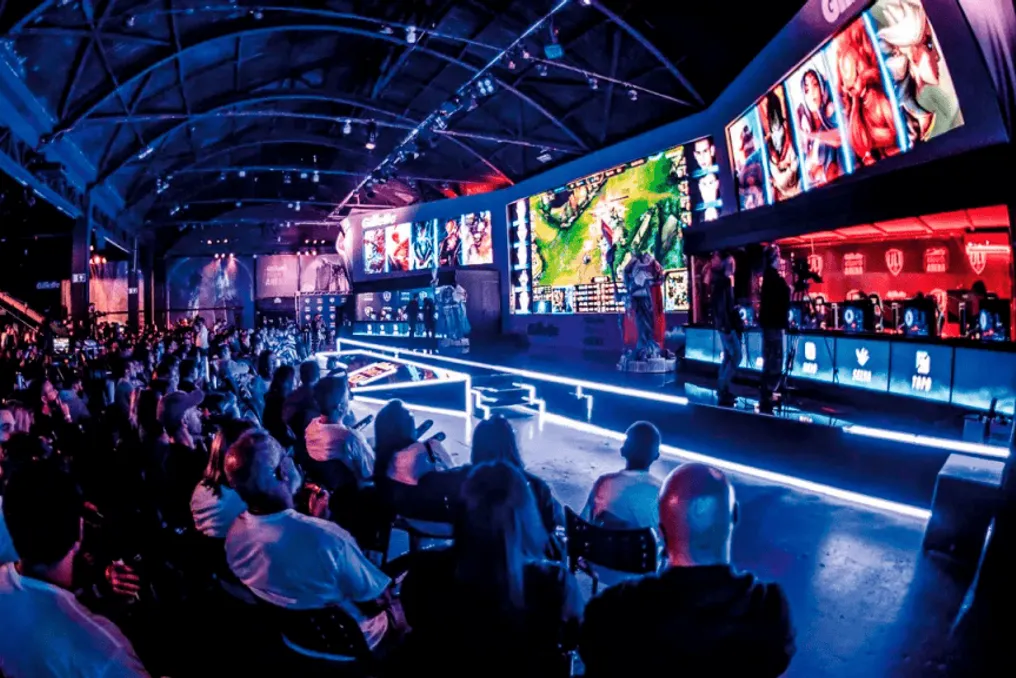
Historically, electronic sports competed in non-specialized venues, such as gyms, convention centers, or temporarily adapted football stadiums. However, this scenario is changing globally, with the construction or renovation of specific buildings to host competitions, broadcasts, and receive the public.
A notable example of this advancement occurs in Sunderland, England, where British Esports, the national British esports federation, is building the British Arena. This venue represents the first arena of this type built by a national federation in Europe, being the first with financial support and endorsement from a national organization, although it is not the first dedicated venue for these sports in the country.
British Esports announced the project in July 2025. The arena will cover over 1,300 square meters and will be located next to the National Esports Performance Campus (NEPC) in Sunderland. The design was custom-made for live events, high-level competitions, and immersive experiences, including an amphitheater with 200 seats, a 17-meter wide LED screen, production and broadcast studios, retail and hospitality areas, training rooms, and a large outdoor space for activities.
Although the initial inauguration deadline was April 2026, it has been postponed to the end of summer 2026, with a new date confirmed for September 22.
The Brazilian Model
In contrast to the British Esports approach, Brazil adopts a distinct model. Esports arenas in Brazil present a more dispersed pattern, distributed among private entities, municipal arenas, facilities within shopping malls, and stadiums. Due to this distribution, there are several dedicated esports arenas currently.
In Brasília, for example, there is the Glacon Arena, which has 20 computers and consoles, used both for organizing tournaments and for so-called 'corujões,' a traditional event in Brazilian gaming.
São Paulo also hosts multiple arenas. Among them, the MAX Arena, located in Mooca, has a capacity for 900 standing and 600 seated people. Additionally, the state has the Riot Games Arena, the venue for major events like CBLOL, which is the main professional League of Legends competition in Brazil.
Another relevant point is the Arena Gamer do Engenhão, considered the first public arena dedicated to esports in Brazil. Inaugurated on January 17, 2024, by the Municipal Secretariat of Science and Technology of Rio de Janeiro, it functions as a center of opportunities for the universe of games, esports, creative economy, and technology.
The Brazilian model prioritizes diversity, resulting in spaces of various sizes spread across the national territory. This stems from the absence of a centralized federation, as seen in the United Kingdom, and the limited nature of governmental initiatives. There is a lack of a consolidated national policy, present in countries like the United Kingdom, and of financial sustainability for these structures outside of event days.