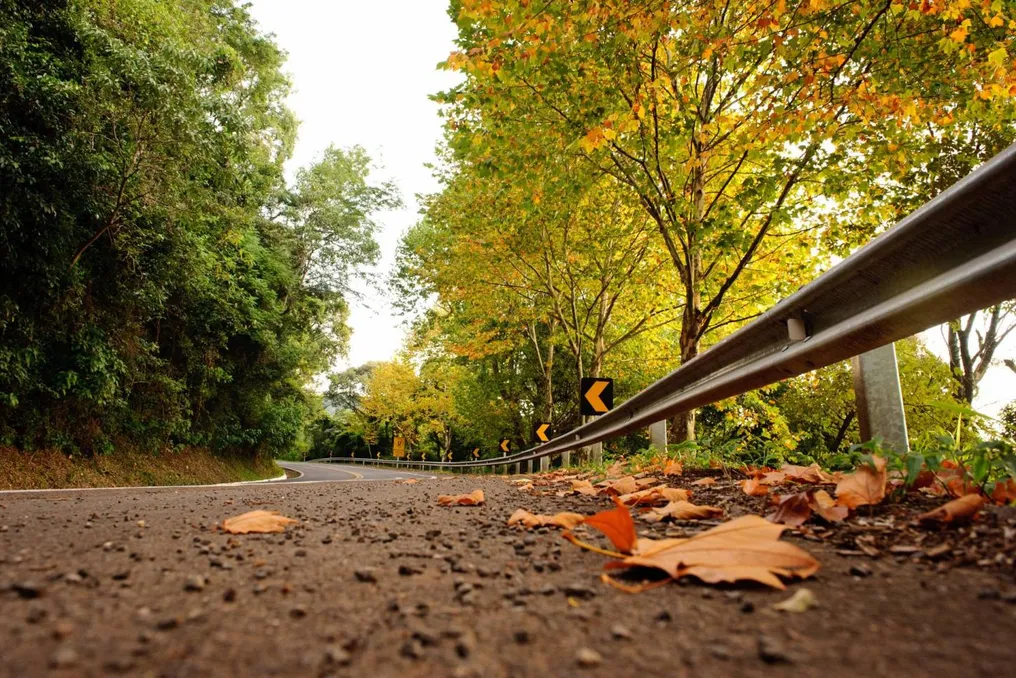
Traveling by car through Brazil represents a great adventure, allowing one to cross distinct cultures, discover varied landscapes, and appreciate the country's vast natural wealth, from the curves of Serra Gaúcha to the landscapes of Roraima.
One option is the Romantic Route, located in Serra Gaúcha, which is inspired by the German route. This journey in southern Brazil is notable for the strong influence of German immigration, visible in the half-timbered architecture. The complete route covers 14 cities and is about 350 kilometers; the main points can be covered in 48 hours.
On the Romantic Route, Nova Petrópolis offers the Immigrant Village Park and the Green Labyrinth in Praça das Flores, while Canela stands out for the Caracol Waterfall. During autumn, the trip gains a special charm with the changing colors of the banana leaves, creating golden and reddish tunnels on the winding roads of the mountain range.
Considered the largest national tourist route, Estrada Real exceeds 1,600 kilometers, covering Minas Gerais, Rio de Janeiro, and São Paulo. The route is divided into four distinct paths. Caminho Velho, or Gold Path, was the first official route, connecting Ouro Preto to Paraty over 710 kilometers. Caminho Novo was established as a faster alternative, connecting Ouro Preto to Petrópolis.
Caminho dos Diamantes, as its name suggests, was linked to the mining of precious stones in Diamantina, connecting this city to Ouro Preto. Já the Caminho do Sabarabuçu is the shortest stretch, with 160 kilometers between Cocais and Glaura, a district of Ouro Preto.
These paths were opened by the Portuguese Crown in the 18th century for the transport of riches such as gold and precious stones, preserving a piece of Brazilian history. By following the route, it is possible to visit attractions such as the Imperial Museum in Petrópolis, the Gold Museum in Sabará, and take the steam train ride between São João del Rei and Tiradentes. Travelers can use the Estrada Real Passport to collect stamps in the 199 municipalities along the route and obtain a completion certificate.
Federal Highway MT-060, known as the Transpantaneira Road, is ideal for those who wish to study the fauna and flora of the Central-West region. In the Pantanal, it is common to observe animals such as caimans, capybaras, tuiuiús, deer, or sloths, often seen from the vehicle.
The journey on the Transpantaneira typically starts in Cuiabá, the capital of Mato Grosso, covering about 105 kilometers of asphalt to Poconé, the starting point of the route. From Poconé, there are approximately 150 kilometers of dirt road to Porto Jofre, a district in Mato Grosso. Porto Jofre is a world highlight for concentrating jaguars, where boat tours for spotting them are offered.
The Route of Emotions connects three northeastern states: Maranhão, Piauí, and Ceará. With over a thousand kilometers, it connects the Lençóis Maranhenses National Park, the Parnaíba Delta Environmental Protection Area, and Jericoacoara National Park, presenting spectacular landscapes.
This itinerary is recommended for ecotourists, couples seeking romantic scenery, or water sports enthusiasts such as kitesurfing. Besides the Lençóis Maranhenses, which allow exploration of white dunes and freshwater lagoons, São Luís, the capital of Maranhão, offers an urban focus with its Historic Center listed by Unesco in 1997.
Route 174 links Amazonas to the northernmost part of Roraima, connecting Manaus to the border with Venezuela via federal highway BR-174. The journey is about a thousand kilometers and, to be done calmly, the expedition should last approximately ten days.
This route is perfect for adventurers seeking direct contact with nature, providing immersion in the landscapes of the North, transitioning from lush tropical forest to the cerrado and cultivated areas of Roraima. Presidente Figueiredo, in Amazonas, is a popular destination, nicknamed the 'Land of Waterfalls,' where one can enjoy several waterfalls, including Santuário and Iracema, in addition to practicing rafting and rappelling.
In the municipality of Amajari, in Roraima, there is the Serra do Tepequém, another essential point of Route 174. Famous for its trails and tea-colored waterfalls, the region exhibits unique and impressive rock formations.