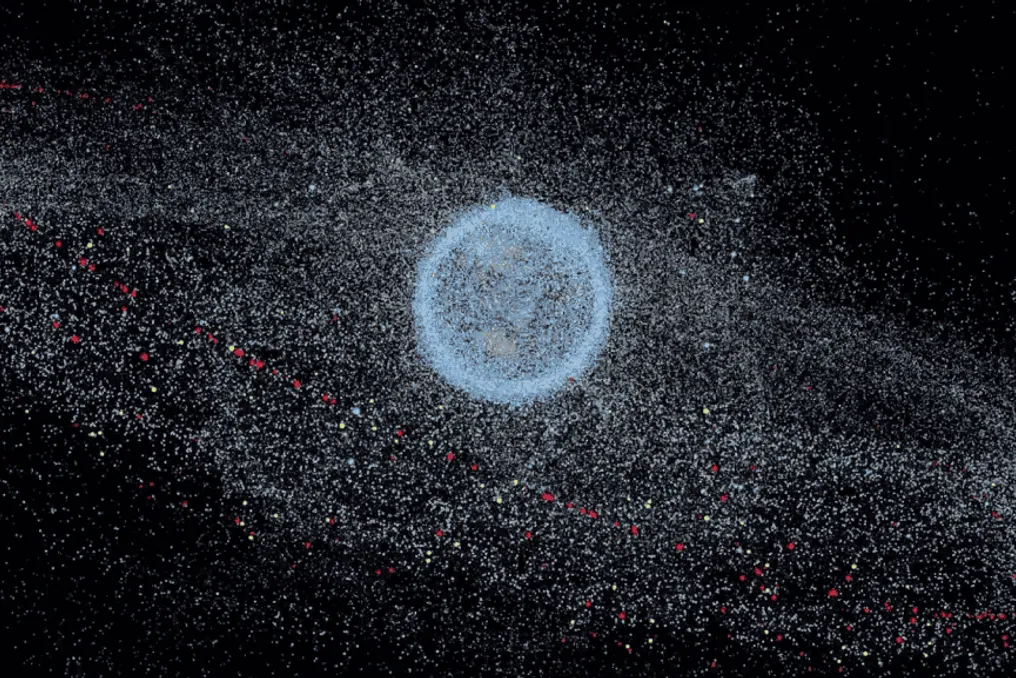
Researchers warn that low Earth orbit has reached its safe operational limit, and the situation tends to worsen rapidly. According to disclosed information, more than 34 thousand satellites and debris are currently circulating in this region, and it is estimated that at least 41 thousand new objects will be launched by 2034.
Éder Martioli, lead researcher at the National Astrophysics Laboratory (LNA/MCTI) and affiliated with the Institute of Astrophysics of Paris, stated in an interview that there will come a time when the amount of objects in space will be so large that it will become complicated to keep a large satellite in orbit without collisions occurring.
Current radars are capable of tracking debris approximately the size of a softball, which is about 10 centimeters. However, anything smaller than this size is invisible to monitoring systems, and this is the core of the danger.
Estimates from the European Space Agency (ESA) indicate that there are over 36 thousand debris items larger than 10 centimeters orbiting the Earth, totaling about 11 thousand tons of material. If we consider objects smaller than 10 centimeters, the number exceeds 1 million. Wagner José Corradi Barbosa, director of LNA/MCTI, added that, including fragments between 1 mm and 1 cm, the total could exceed 130 million.
Monitoring this space junk is crucial to ensuring the integrity of space equipment. Martioli emphasized that the problem already impacts science, mentioning that there may come a point where there will be no more available sky for studies, due to light pollution generated by sunlight reflected by satellites, which already harms observatories globally.
The scenario most feared by experts is known as the Kessler Syndrome. This concept was introduced in 1978 by astrophysicist Donald Kessler while he was working at NASA. Kessler warned that upon reaching a certain density of objects in orbit, collisions would begin to produce fragments faster than the atmosphere could consume them, triggering an uncontrollable chain reaction.
In 2009, Kessler had predicted, based on his model, that the orbital environment could already be unstable. The mechanism is simple: one collision generates thousands of pieces, which can hit other satellites, resulting in more fragments, and so on. This would lead to the rendering of the orbit unusable for decades or centuries.
A notable event occurred in 2009 when an Iridium Communications satellite collided with a deactivated Russian satellite, generating approximately 1,800 fragments with at least 10 centimeters in diameter.
The implications of an orbital collapse would be vast, affecting not only space missions but also essential services such as GPS, weather forecasting, global communications, environmental monitoring, and satellite internet.
Although the UN has established guidelines to mitigate debris, such as requiring inactive satellites to be removed within 25 years and designing modern satellites to release residual fuel, the pace of launches far exceeds these solutions. With SpaceX operating over 10 thousand Starlink objects and projects like Amazon's Kuiper and Chinese constellations expanding, the challenge of managing near-Earth space has become extremely urgent.