Astronomers analyzing data from the James Webb Space Telescope have confirmed the discovery of one of the most distant supernovae ever identified. This supernova, designated SN 2023aeaf, occurred when the universe was about two billion years old.
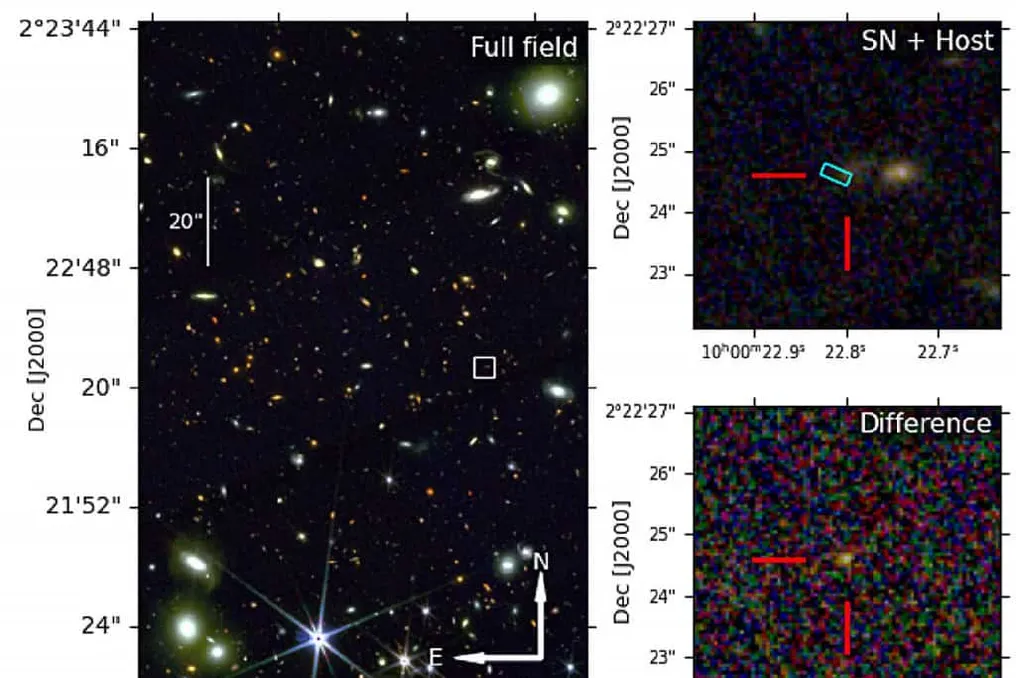
The light from this event took approximately 11.7 billion years to reach Earth. This observational material allows scientists to study the death of a massive star in an era when galaxies still contained few heavy elements. SN 2023aeaf was recorded in images from the COSMOS-Web survey and has a redshift of 3.195, placing the explosion in a very early stage of the universe's history.
Supernovae caused by the collapse of massive stellar cores are of significant interest to astronomers for several reasons. They help determine star formation sites and alter the surrounding gas during the explosion, which can then participate in the formation of new stars. However, there is a substantial gap in scientific knowledge because most detailedly studied supernovae are relatively close. In the young universe, the concentration of heavy elements was significantly lower, and it is unclear whether this affected the behavior of such explosions.
Valeria Aparicio from the University of Hawaii's Institute of Astronomy and her team compared the brightness and color evolution of SN 2023aeaf with simulations of different types of supernovae. The results showed that this was a Type II supernova with a 97.2% probability. This phenomenon occurs when a massive star exhausts its nuclear fuel, and its iron core subsequently collapses under its own gravity, triggering an explosion. The presence of hydrogen in the spectrum is one characteristic of this type of event, as the star retains its hydrogen-rich outer layer before death.
The galaxy hosting the star is also young, small, and actively forming stars, possessing a relatively low abundance of heavy elements. Researchers state that 'the low-mass, metal-poor host of SN 2023aeaf is consistent with expectations for massive star explosions in chemically young galaxies at z ∼ 3.'
The supernova's behavior was reproduced in simulations using STELLA software. Initially, the object exhibited high temperatures and a particularly blue appearance. The most likely hypothesis is that the shockwave reached a dense layer of gas ejected by the star shortly before the explosion. After this interaction weakened, the supernova cooled down and transitioned into the typical plateau phase for Type II events.
Models suggest that the progenitor star had a mass approximately 12 times that of the Sun and was surrounded by about half a solar mass of circumstellar material. Key data supporting this analysis include the researchers' own note that the limited number of available observations reduces the accuracy of estimates for the star that caused the explosion. Nevertheless, SN 2023aeaf joins a small group of supernovae discovered at a redshift of 3. Discovering more such events could help more accurately calculate the rate of these explosions and, consequently, reconstruct the evolution of star formation throughout cosmic history.