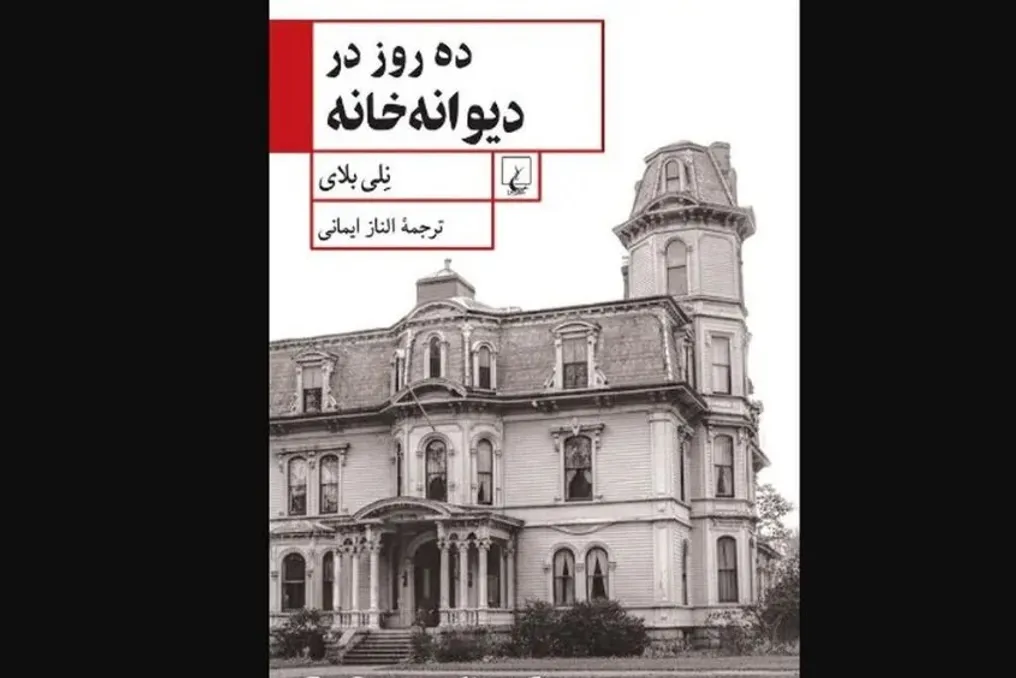
The Persian translation of the American journalist Nellie Bly's book 'Ten Days in a Mad-House' has been released in bookstores across Iran. Qoqnoos Publishing House published the 136-page book, and the translation was carried out by Elnaz Imani, according to the ILNA agency.
Initially, the material was published as a series of articles for the New York World newspaper. Later, Bly compiled these articles into a book, which Norman Munro published in New York in 1887.
The book is based on reports written during Bly's secret mission for the New York World. She pretended to be insane in a women's sanatorium so that she could be unjustifiably committed to a psychiatric hospital. There, she began investigating cases of abuse and neglect at the Women's Hospital on Blackwell Island (now known as Roosevelt Island).
After a night spent in front of a mirror practicing expressions, she settled into the sanatorium. She refused to go to bed, telling the residents that she was afraid of them and that they looked 'mad.' Soon they decided she was 'insane,' and the police were called the next morning. In court, she claimed to suffer from amnesia, leading the judge to conclude that she had been drugged.
Several doctors examined her, and all deemed her insane. One stated: 'Positive dementia, I consider this a hopeless case. She needs to be placed somewhere someone can take care of her.' The head of the asylum's mad ward called her 'undeniably insane.' The case of this 'beautiful mad girl' attracted press attention: the New York Sun asked, 'Who is this mad girl?', while the New York Times wrote about a 'mysterious orphan' with a 'wild, haunted look' and her desperate cry: 'I cannot remember, I cannot remember.'
After admission to the hospital, Bly stopped feigning mental illness and began behaving normally. The hospital staff seemed unaware that she was no longer 'mad,' and instead began interpreting her normal actions as symptoms of illness. Even her pleas for discharge were interpreted as further signs of mental disorder.
By interacting with other patients, Bly confirmed that some of them were as 'normal' as she was. She personally encountered horrific conditions. Nurses behaved rudely and aggressively, ordering patients to be silent and beating them if they disobeyed. Food consisted of porridge broth, spoiled beef, bread that was barely more than dry dough, and dirty, undrinkable water. Dangerous patients were tied up with ropes. Patients were forced to sit on hard benches for most of the day with little protection from the cold. Garbage was everywhere in the dining areas. Rats scurried throughout the hospital.
After ten days, The World managed to secure Bly's release from the hospital. Her report, published in The World and later released as a book, caused a sensation and brought her lasting fame.
The question was how Bly managed to convince specialists of her madness initially. As revealed in her personal account 'Ten Days in a Mad-House,' Bly mentioned that the attending physician who conducted the examination was more focused on the attractive nurse assisting with the examination than on Bly herself. Although doctors and staff tried to explain how she fooled so many specialists, her report prompted a grand jury to begin its own investigation involving Bly. The jury's report led to an increase in the budget of the Department of Public Charities and Corrections by $850,000. The grand jury also ensured that future examinations would be more thorough, and only the severely ill would be admitted to the hospital.
The book received widespread acclaim. The combination of her reports and the publication of the material brought her fame, which in turn led to the grand jury investigation and the financial increase in the budget of the Department of Public Charities and Corrections.