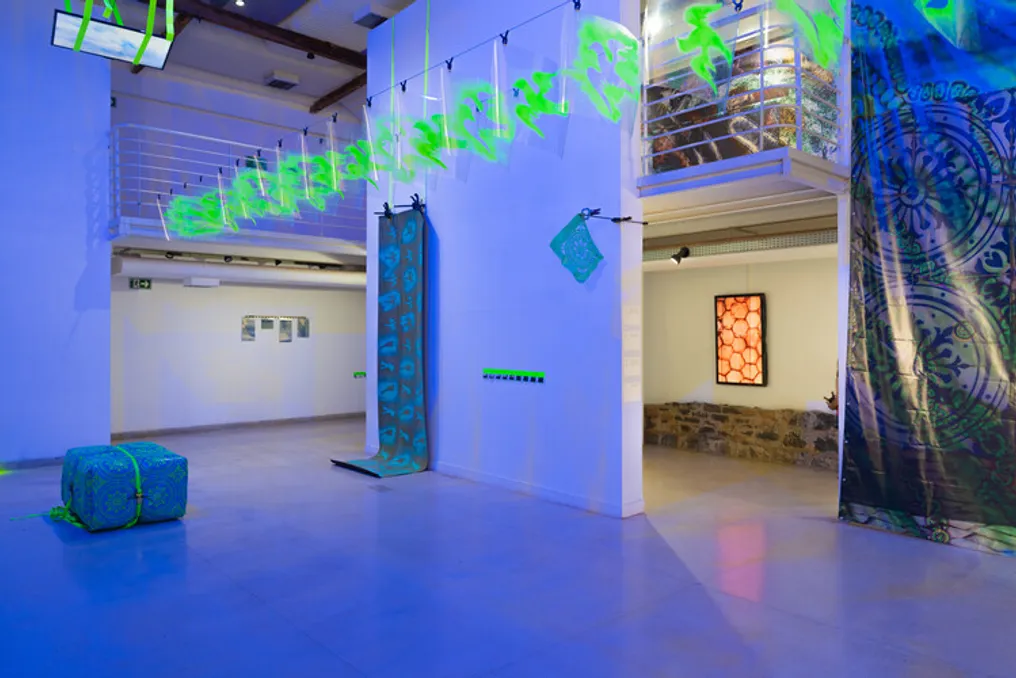
The Moderno da Pampulha Complex, a UNESCO World Heritage site, serves as the starting point for the exhibition 'Alienígenas do baile'. Within this exposition, the artistic duo Lâmina examines the processes of formation and change in the imagery of contemporary Brazilian architecture.
The exhibition is held at the Museum of University Art (MUnA) in Uberlândia. It features works by Gabriela De Laurentiis and João Mascaro, who view the complex through the lens of their images, materials, techniques, and ways of life, employing methods such as photography, video, scanning, screen printing, artificial intelligence, and 3D printing.
The exhibition presents various elements, including European tiles reinterpreted by Paulo Verneque; images of birds, fish, and dogs created by Cândido Portinari; as well as mosaics, columns, and curves captured using photographs and scanners. Carp have appeared in the pond of Casa do Baía, and lizards have settled in the lake, although the mechanism of their appearance remains unclear. Furthermore, cyanobacteria are observed, indicating a disruption of the ecological balance.
In 'Alienígenas do baile', Pampulha is presented as a landscape shaped by movements, appropriations, and transformations layered upon Oscar Niemeyer's original architectural design. These changes manifest in the works through processes of translation between different materials, techniques, and visual images.
In the work 'Digitile', the tile standards present in the buildings of Pampulha and the reinterpretation of European tiles from the colonial church in Rio de Janeiro are photographed, filmed, processed with artificial intelligence, modeled digitally, and 3D printed. In 'Diluições', handheld scanners pass over the mosaics, tiles, and columns of Casa do Baía, adding noise and distortion to the recordings. And in 'Aberturas', photographs taken by Lâmina since 2015 in the old Casino and in Casa do Baía are enlarged on canvas—a material usually used in advertising communication—linking them to the production of architectural images, the formation of modernist imagination, and the tourist landscape of Pampulha.
The unpublished video installation 'Alienígenas do baile', which gives the exhibition its name, originates from the carp inhabiting the water surface of Casa do Baía. The artists film them, and their images are successively overlaid upon each other, appearing both in original and reversed order, causing color and motion distortions that lend the landscape a fantastic dimension. Fish, which were not originally part of Burle Marx's landscape design, were later introduced to this area to combat mosquitoes. As an exotic species in Brazilian territory, the carp becomes an alien inhabitant in the constantly transforming modernist landscape of the work.
Curator Marina Frugoli, who has followed the duo's work for several years, notes that she is interested in the freedom with which Gabriela De Laurentiis and João Mascaro move between different materialities, carriers, and scales—from a small instant photograph to a billboard, from an object to a soundscape. She is also drawn to the way they articulate a critical and political reading of contemporary culture into sensory experiences, allowing for multiple levels of interpretation and fiction.
Overall, 'Alienígenas do baile' shifts the focus to one of the most famous complexes of modern Brazilian architecture, bringing the architectural project closer to a series of images, techniques, forms of life, and transformations that continue to constitute the Pampulha landscape.