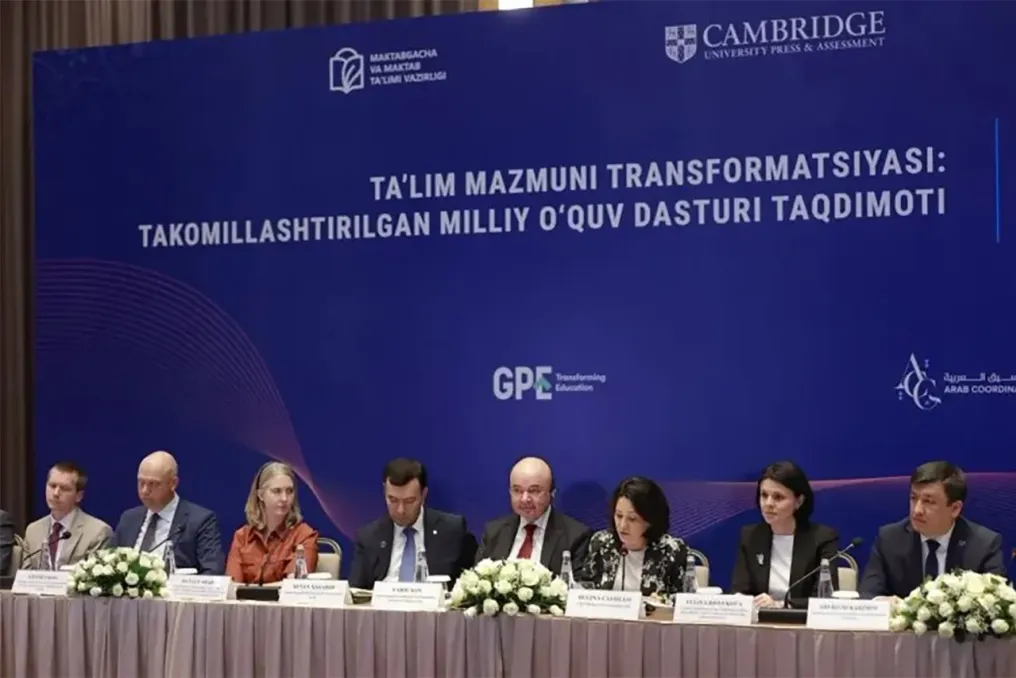
The Ministry of Preschool and School Education of Uzbekistan presented the new National Curriculum on August 18. After its implementation, it is expected to cover approximately seven million students across the country.
The main goal of this curriculum is to improve the quality of education and bring it closer to international standards. The program's implementation will be carried out in collaboration with Cambridge University Press and Assessment, with support from UNICEF.
The new curriculum defines educational objectives for all students in primary, basic, and secondary education. One of the key tasks is to improve academic performance and create educational trajectories that allow students to achieve results comparable to international Advanced Level (A Level) standards.
The development of the revised curriculum took two years and involved 147 national and 30 international specialists. More than 260 working meetings and consultations were held during the process.
According to UNICEF, for the first time, international subject matter experts worked alongside corresponding national subject groups throughout the entire process. Previously, international experts participated in curriculum development, but this cooperation did not cover all subjects and all grades simultaneously.
The revised curriculum is based on a competency-based approach, as well as the principles of inclusivity and equality. It applies the Universal Design for Learning approach, which aims to make educational content accessible to all students, including children with disabilities, as well as talented and highly motivated schoolchildren.
The curriculum sets clear learning goals and uses a spiral approach, whereby knowledge and skills are gradually developed as students progress between grades. Furthermore, it strengthens connections between different subjects and pays more attention to the practical application of knowledge in daily life.
The new teaching materials will include digital literacy, environmental and 'green' education, as well as socio-emotional competencies. According to UNICEF, this will help students prepare for future changes, supporting Uzbekistan's sustainable development priorities.
Sherzod Karimov, Deputy Minister of Preschool and School Education, stated that the curriculum reform is part of a broader transformation of the education system. This reform also includes improvements in assessment mechanisms, pedagogical practices, textbooks, and teaching materials.
Within the framework of the reform, methodological guides were developed for teachers and school principals. They cover the organization of the educational process, formative assessment, inclusion, gender equality, and maintaining high expectations for every student.
Rehina Kastidjo, UNICEF representative in Uzbekistan, noted that the creation of the new curriculum became a nationwide process, uniting national experts, teachers, and organizations with international experience.
She emphasized that the success of the reform will depend on the further implementation of the curriculum in all grades and the improvement of education quality across the country.
Steve King, Head of Educational Reforms at Cambridge University Press and Assessment, reported that the curriculum development was led by the Republican Center for Education and subject working groups, while Cambridge and UNICEF provided international data, research findings, and practical experience.
The new National Curriculum was developed by the Republican Center for Education under the Ministry of Preschool and School Education as part of the SmartED project. The project is financed by the Islamic Development Bank, the Arab Coordination Group, and the Global Partnership for Education.
It is also noted that the National Curriculum was adopted by the Republican Center for Education in 2020, and the full transition of schools to it is expected by 2025. Its development was supported by UNICEF and the former United States Agency for International Development (USAID). As part of a related education improvement project since 2021, localized Cambridge University Press textbooks on informatics and IT for grades 5–11, as well as English language for grades 1–11, have begun to be implemented.